Quick answer
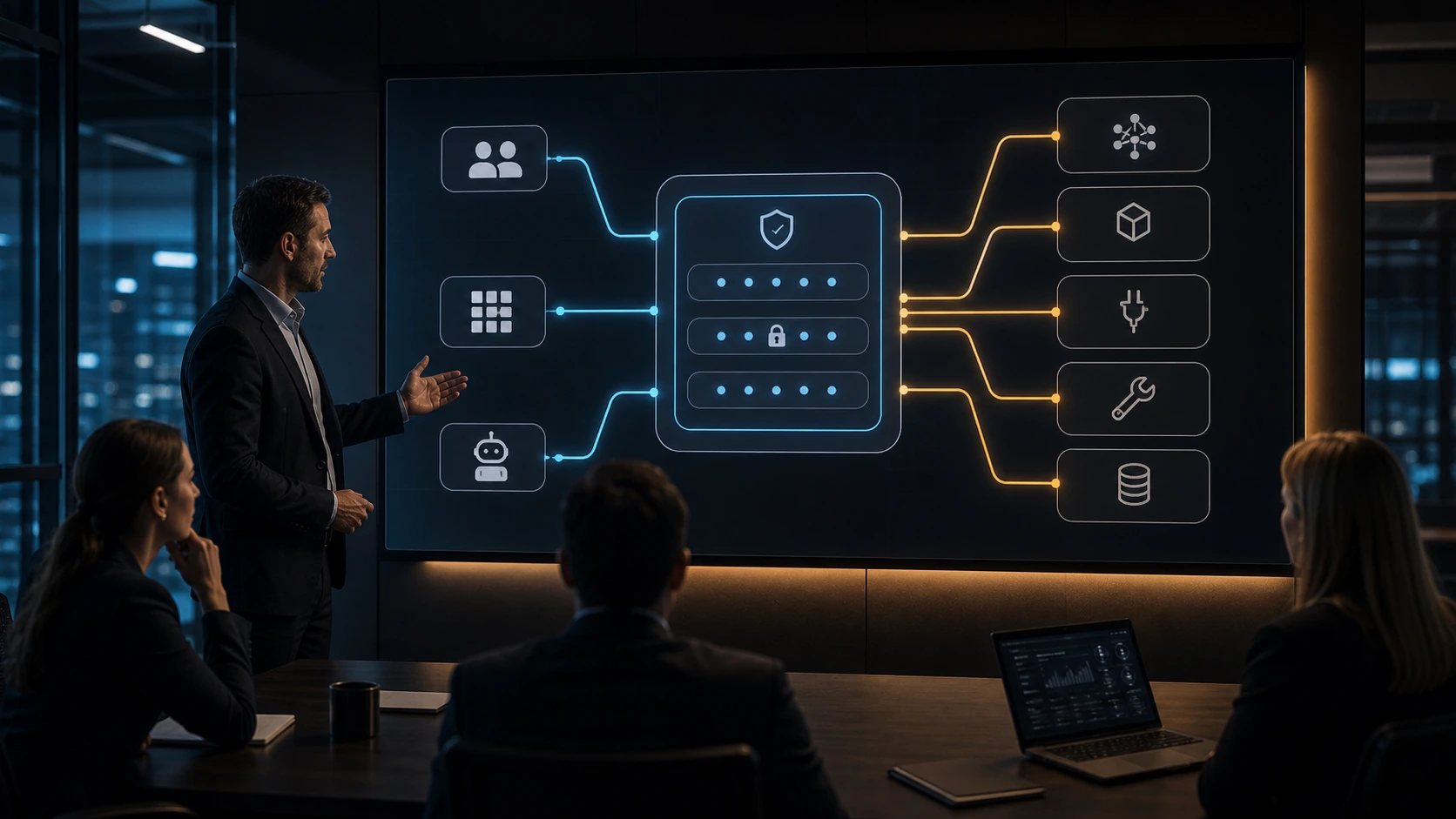
An AI control plane is the operating layer that sits between people, applications, AI agents, models, tools, and enterprise data. It governs who can use AI, which models or tools are available, how requests are routed, what business context is accessible, how costs are managed, and how AI activity is monitored across the enterprise.
Unlike an AI gateway, which primarily routes model requests, an AI control plane also provides governance, policy enforcement, observability, context management, and operational visibility. It helps organizations move from isolated AI deployments to governed enterprise AI operations. Vendor definitions from TrueFoundry and Speakeasy both frame it as a centralized governance layer between AI demand and enterprise execution paths (TrueFoundry, Speakeasy).
People
     │
Applications
     │
AI Agents
     │
AI Control Plane
     │
Models • Tools • Enterprise Data
Rather than acting as another chatbot or model endpoint, the control plane becomes the operating layer that coordinates AI usage across the organization.
Enterprise AI is moving from experimentation to daily operations. Employees use AI assistants. Product teams embed LLMs into workflows. Engineering teams connect agents to tools. As adoption grows, the challenge shifts from simply connecting to AI models to governing how AI is used across the business — and that is where the idea of an AI control plane becomes important.
AI control plane vs. AI gateway, at a glance
| Capability | AI gateway | AI control plane |
|---|---|---|
| Request routing | Yes | Yes |
| Provider abstraction | Yes | Yes |
| Authentication | Yes | Yes |
| Access governance | Limited | Yes |
| Context governance | Limited | Yes |
| Policy enforcement | Limited | Yes |
| Cost visibility | Limited | Yes |
| Enterprise observability | Basic | Yes |
| AI operations | No | Yes |
An AI gateway and an AI control plane are complementary rather than competing technologies. A gateway manages AI traffic, while a control plane manages enterprise AI operations. See AI Control Plane vs. LLM Gateway for the full comparison.
Why the term "control plane" matters
The term "control plane" comes from infrastructure and networking. In those systems, the control plane decides how traffic should move, what policies apply, and how the system should behave. The data plane carries out the actual traffic movement.
The same idea now applies to enterprise AI.
In AI systems:
- The data plane is where the work happens: model inference, tool calls, retrieval, API calls, and agent actions.
- The control plane is where operating decisions are made: access, policy, routing, context selection, cost controls, logging, and audit.
This distinction matters because enterprise AI is no longer limited to one chatbot or one API call. A single AI workflow may include a user, an internal app, a retrieval system, a vector database, an LLM provider, a private model, a tool call, and a business system such as Salesforce, Jira, ERP, or a data warehouse.
Without a control plane, every team creates its own rules. That quickly becomes expensive, risky, and difficult to govern.
Why enterprises need an AI control plane now
AI adoption usually starts with access. Someone buys ChatGPT Enterprise, Azure OpenAI, Claude, Gemini, Bedrock, or another model platform. A team builds a prototype. Another team creates a RAG assistant. Engineering experiments with coding agents. Operations tries workflow automation.
At small scale, this looks productive.
At enterprise scale, the problems change.
The company now needs to answer questions like:
- Who is using AI?
- Which workflows are using sensitive data?
- Which teams are spending the most?
- Which models are being used for which tasks?
- Which requests should use frontier models?
- Which requests can use cheaper or private models?
- Which prompts include confidential or regulated information?
- Which AI agents can call internal tools?
- Which outputs need human review?
- Which interactions are logged for audit?
- Which AI workflows are actually creating business value?
These are not model questions. They are operating questions.
An AI control plane exists because AI adoption without an operating layer creates blind spots across cost, quality, latency, privacy, security, compliance, and accountability. If your AI stack is already spreading across teams and tools, that operating-layer problem starts to look a lot like the one covered in Custom AI vs Off-the-Shelf AI: the issue is no longer just which tool to buy, but how to govern the full estate.
What an AI control plane controls
A mature AI control plane should not only control model access. It should control the full path between AI demand and AI execution.
1. Access governance
The first job of an AI control plane is to govern access.
That means answering:
- Who is making the request?
- Which team, role, or system do they belong to?
- What AI tools are they allowed to use?
- What data are they allowed to access?
- What actions are they allowed to trigger?
- Does this request require approval or human review?
This is especially important when AI moves from passive chat to active workflows. A support assistant that only drafts an answer has one risk profile. An agent that updates CRM records, refunds an order, or queries financial data has another.
Access governance should be identity-aware, role-aware, and workflow-aware.
2. Model routing
Not every task needs the most expensive model.
A good AI control plane should help route requests based on workload requirements, such as:
- Reasoning complexity
- Data sensitivity
- Latency requirements
- Cost tolerance
- Quality threshold
- Compliance needs
- Availability requirements
- Whether private or hosted models are appropriate
For example:
| Workload | Likely routing decision |
|---|---|
| Low-risk summarization | Smaller or cheaper model |
| Sensitive HR analysis | Private or tightly governed model path |
| Complex legal reasoning | Frontier model with human review |
| High-volume support classification | Cost-optimized model with evaluation |
| Enterprise RAG answer | Retrieval-aware route with source grounding |
| Agentic tool action | Strict policy, approval, and audit path |
This is where AI operating efficiency becomes real. Frontier models should be reserved for work where their reasoning quality justifies the cost. Routine work should be optimized for speed and cost. Sensitive work should be optimized for privacy and control. For teams comparing those paths systematically, a Model Benchmarking Assessment is the practical step before locking in routing rules.
3. Secure context handling
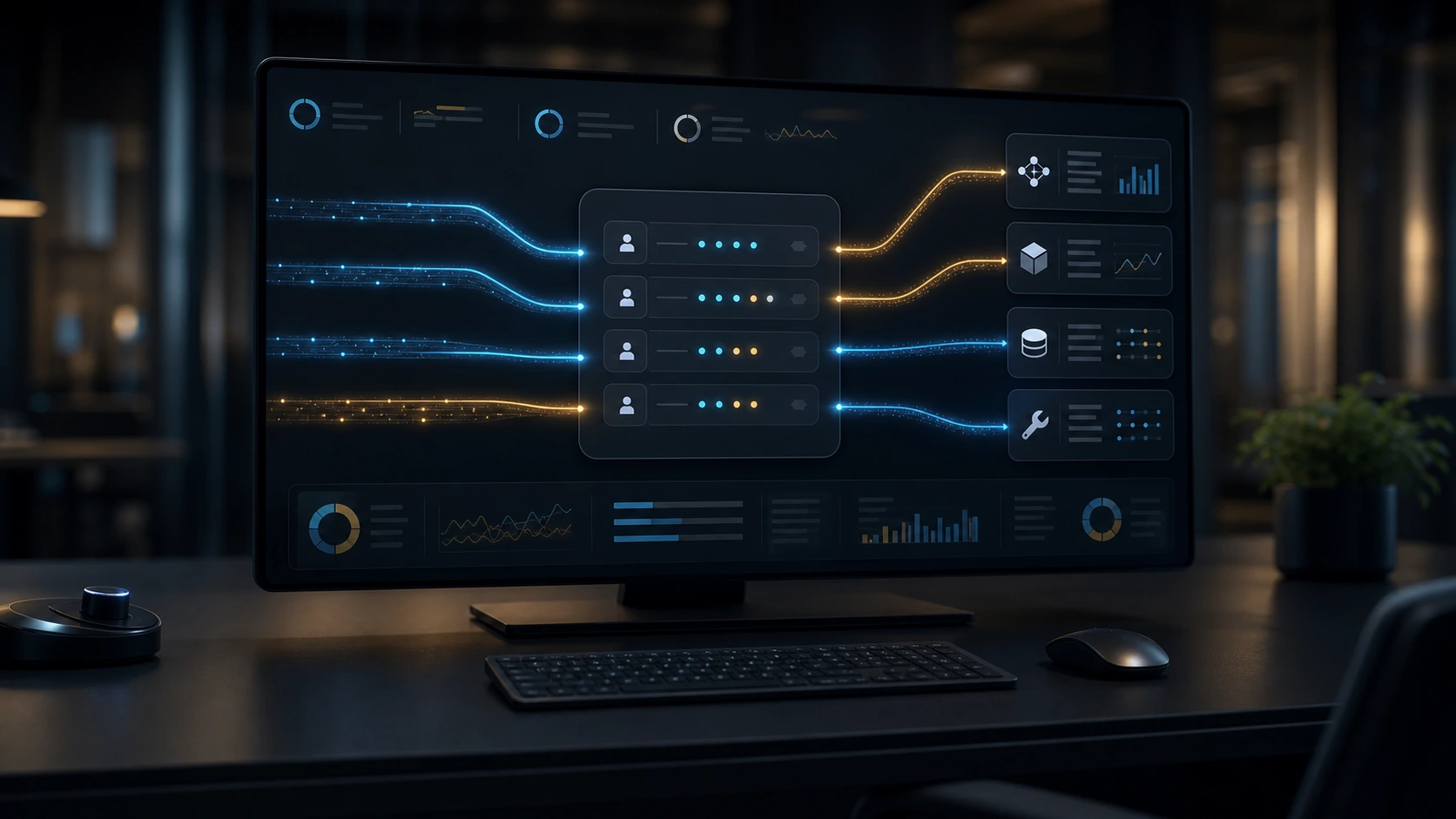
Most enterprise AI value comes from context. Models become more useful when they can work with internal documents, tickets, product data, customer records, policies, contracts, or knowledge bases.
But context is also where risk enters.
An AI control plane should help govern:
- Which data sources can be used
- Which documents can be retrieved
- Which users can access which context
- Whether PII or confidential data is present
- Whether retrieved context should be redacted
- Whether the request should be blocked, reviewed, or routed differently
- Whether the answer should include citations or source references
This is especially important for RAG systems. RAG quality depends on more than embeddings and vector search. It depends on source quality, chunking, permission filtering, retrieval design, context size, evaluation, and auditability. The operational side of that architecture is covered in more detail in our Enterprise RAG Implementation Guide.
A RAG system without context governance can accidentally expose documents the user should not see. A control plane helps make retrieval permission-aware and reviewable. OWASP specifically calls out prompt injection and sensitive information disclosure as core LLM application risks, which is why context assembly and tool exposure should be treated as runtime controls rather than prompt-only concerns (OWASP).
4. Cost controls
LLM cost behaves differently from traditional software cost.
One request may use a few hundred tokens. Another may use tens of thousands. One workflow may call a model once. An agentic workflow may call models, tools, rerankers, and retrieval systems many times before producing a final result.
A control plane should provide cost controls such as:
- Token budgets
- Model-specific spend limits
- Team-level usage visibility
- Workflow-level cost attribution
- Caching rules
- Context-size controls
- Alerts for abnormal usage
- Budget-based routing
- Chargeback or showback reporting
The goal is not simply to reduce cost. The goal is to match cost to business value.
A high-cost model call may be justified for a high-value workflow. The problem is using high-cost paths for low-value, repeatable, or poorly measured work. That is also why a Managed AI Efficiency Layer matters commercially: the operating layer is where cost, quality, and routing decisions become enforceable rather than aspirational.
5. Policy enforcement
Most companies already have AI policies. The problem is that many policies live in documents, training decks, or approval workflows. They do not always operate at runtime.
An AI control plane helps translate policy into executable controls.
Examples:
- Block confidential data from being sent to unapproved external models.
- Require human review for regulated or customer-facing outputs.
- Route sensitive workloads to private or approved environments.
- Prevent certain agents from calling financial or production systems.
- Limit use of frontier models to approved workflows.
- Log all interactions involving sensitive data.
- Enforce model and provider choices by workload category.
This is the difference between policy as documentation and policy as infrastructure. NIST's AI Risk Management Framework is useful here because it treats governance, mapping, measurement, and management as connected operating disciplines, not one-time approvals (NIST AI RMF).
6. Observability and audit logs
Enterprise AI cannot be managed through anecdotes.
A control plane should provide visibility into:
- Who used AI
- Which model was called
- Which tool was used
- Which context was retrieved
- What policy decision was applied
- How much the request cost
- How long the request took
- Whether the output passed review
- Whether the workflow succeeded
- Whether quality drift or cost drift is appearing
This matters for finance, security, engineering, operations, product, compliance, and leadership.
If a high-risk AI workflow produces a bad output, the company should be able to review what happened. If AI cost rises, the company should know which workflows are responsible. If adoption looks strong, leadership should know whether usage is creating value or just activity. Google Cloud's generative AI security guidance also emphasizes audit logs, policy enforcement, and controlled access patterns as part of secure AI architecture, which aligns closely with control-plane design (Google Cloud).
AI control plane vs AI gateway
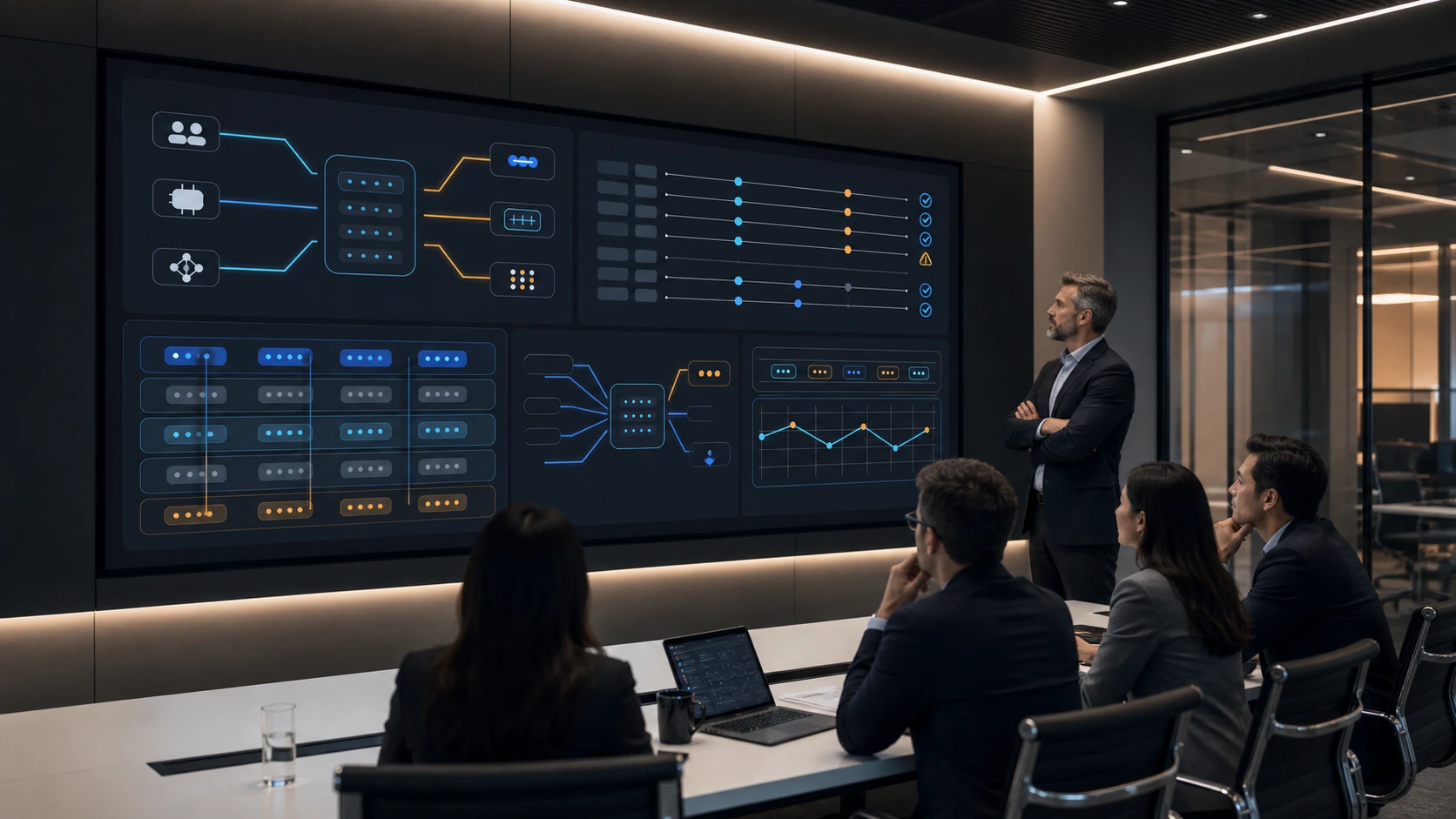
An AI gateway is usually one component of an AI control plane. An AI gateway typically sits between an application and one or more model providers, handling model routing, authentication, rate limits, provider abstraction, token tracking, and caching. Kong and Treblle both position the category around routing, access control, usage visibility, and policy enforcement for AI traffic (Kong Docs, Treblle).
An AI control plane is broader — it governs the operating layer around AI usage across users, apps, agents, models, tools, context, policy, cost, and audit. If a company only needs to manage model API traffic, a gateway may be enough. If AI is spreading across multiple teams, tools, agents, private data sources, and business workflows, the company likely needs a control plane.
👉 Read the full comparison: AI Control Plane vs. LLM Gateway. For the broader buying landscape around platforms and gateways, see our Ultimate Guide to AI Platforms.
AI control plane vs MLOps
MLOps platforms manage the model lifecycle. They help teams train, deploy, monitor, version, and manage machine learning models.
An AI control plane manages runtime AI usage.
That means it focuses less on training models and more on governing how people, apps, and agents use models, tools, and data in production.
| Category | MLOps | AI control plane |
|---|---|---|
| Primary focus | Model lifecycle | AI usage lifecycle |
| Core users | ML engineers, data scientists | Platform, security, AI, product, operations, leadership |
| Controls | Training, versioning, deployment, evaluation | Access, routing, context, policy, cost, audit, observability |
| Best for | Building and managing models | Operating AI safely and efficiently across the business |
A company may need both. MLOps helps manage models. A control plane helps manage how AI is used across the enterprise.
AI governance vs an AI control plane
These terms are closely related but represent different concepts. AI governance defines the organization's policies, responsibilities, acceptable use, and oversight processes. An AI control plane helps operationalize those policies by providing routing, access management, observability, context controls, and operational visibility.
In simple terms: governance defines what should happen. A control plane helps implement how it happens.
👉 Read the full guide: AI Governance vs. AI Control Plane
AI control plane vs orchestration framework
AI orchestration frameworks help developers build workflows. They connect prompts, tools, agents, memory, retrieval, and model calls.
Examples include agent frameworks, RAG orchestration tools, and workflow builders.
A control plane governs the operation of those workflows.
The distinction is simple:
- Orchestration decides how an AI workflow runs.
- The control plane decides whether it is allowed, how it should be routed, what it can access, what policies apply, and what must be logged.
An orchestration framework is not a substitute for governance. A control plane is not a substitute for workflow design. They should work together. For a full six-layer reference architecture covering orchestration, routing, governance, observability, and human-in-the-loop checkpoints, see Control Plane for AI Agents: A Reference Architecture.
What a mature AI control plane architecture includes
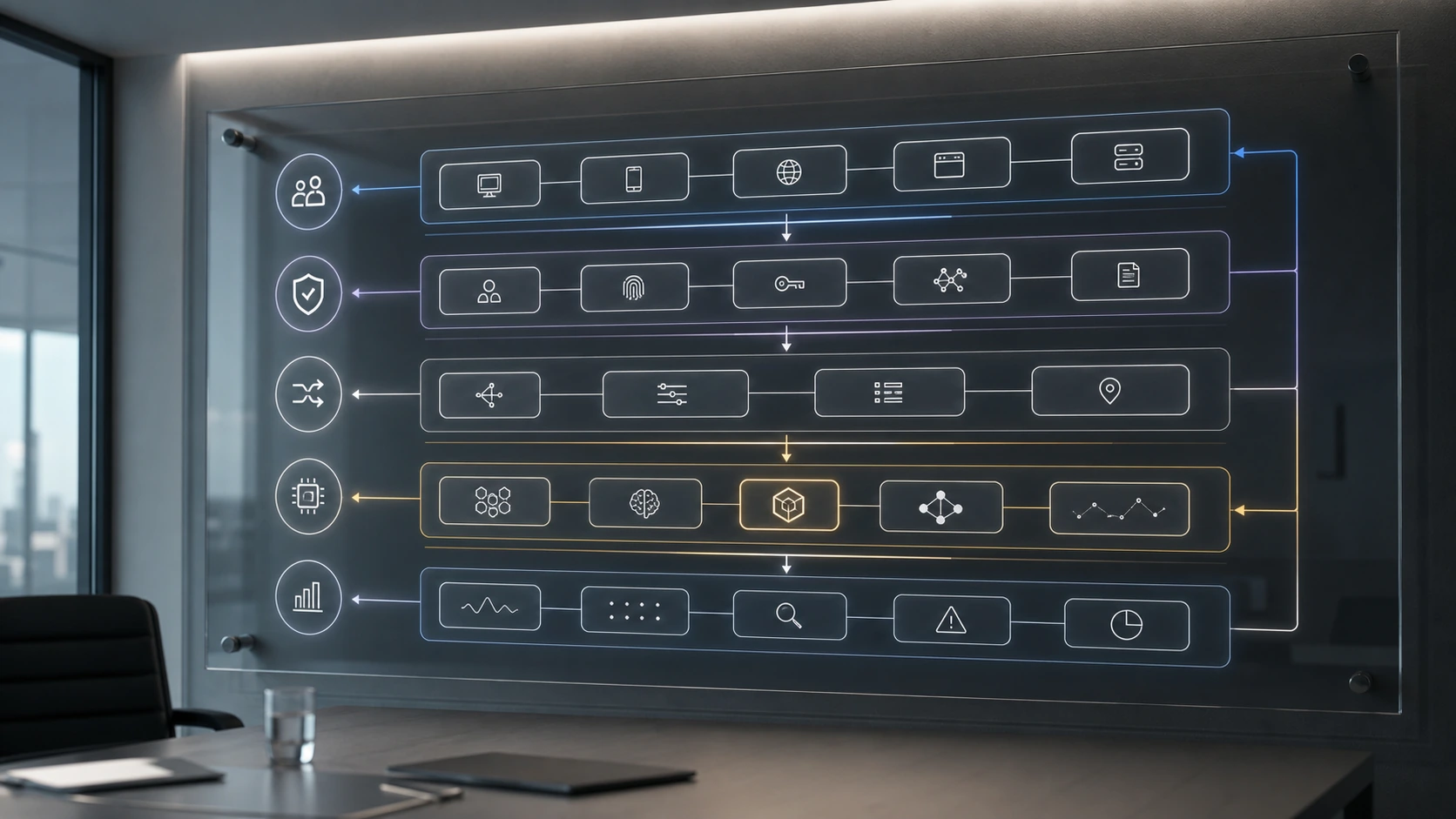
A practical AI control plane can be understood as five layers.
Layer 1: Demand layer
This includes the people, apps, agents, and workflows requesting AI.
Examples:
- Employees using AI assistants
- Internal apps calling LLMs
- Customer support tools
- Product features using AI
- Coding agents
- Sales or operations copilots
- Automated workflows
- AI agents calling internal tools
Layer 2: Identity and policy layer
This layer identifies the requester and applies business rules.
It should answer:
- Who is requesting?
- Which role, team, or app is responsible?
- What is the business purpose?
- What data sensitivity level applies?
- What policy applies to this workflow?
- Is approval required?
Layer 3: Routing and context layer
This layer decides how the request should be handled.
It may route based on:
- Model fit
- Cost
- Latency
- Privacy
- Reasoning complexity
- Context requirements
- Provider availability
- Compliance requirements
- Fallback logic
It also controls which context can be assembled and sent to the model.
Layer 4: Execution layer
This is where the actual AI work happens.
It may include:
- Frontier models
- Open or private models
- Cloud AI platforms
- RAG systems
- Vector databases
- Search systems
- Tool calls
- Internal APIs
- Business systems
- Inference infrastructure
Layer 5: Observability and operations layer
This layer tracks what happened and supports ongoing improvement.
It should monitor:
- Usage
- Cost
- Latency
- Quality
- Errors
- Routing decisions
- Policy decisions
- Sensitive data events
- User adoption
- Model drift
- Workflow outcomes
This is what turns AI from a set of projects into a managed operating system.
Practical example: support automation
Consider an enterprise support team using AI to summarize tickets, suggest responses, retrieve policy information, and escalate edge cases.
Without a control plane:
- One tool uses a frontier model for every task.
- Another team uses a different provider.
- Support reps paste sensitive customer information into prompts.
- Retrieval pulls from outdated or permission-mismatched documents.
- Costs rise but finance cannot see which workflows caused it.
- Nobody knows which AI-generated responses were reviewed.
- Security cannot reconstruct what happened after a bad response.
With a control plane:
- Low-risk classification uses a cheaper model.
- Complex escalation summaries use a stronger model.
- Sensitive requests are routed through approved paths.
- Retrieval respects permissions and approved sources.
- High-risk outputs require human review.
- Token usage and model cost are tracked by workflow.
- Every important interaction is logged for audit.
- The system can be tuned over time.
The AI experience may look similar to the user. The operating model behind it is completely different.
Practical example: internal enterprise copilot
An internal copilot may answer employee questions across policies, documents, tickets, wikis, and data systems.
Without a control plane, the copilot may answer from the wrong documents, expose sensitive information, ignore role-based access, or use expensive models for every query.
With a control plane, the company can:
- Authenticate the user.
- Apply role-based access.
- Retrieve only permitted context.
- Route simple questions to cheaper models.
- Route complex reasoning to frontier models.
- Block or redact sensitive data.
- Log source documents used in answers.
- Monitor answer quality and adoption.
- Require review for sensitive workflows.
This is where an AI control plane becomes more than infrastructure. It becomes the way the organization operates AI responsibly.
When does a company need an AI control plane?
A company probably needs an AI control plane when at least three of these are true:
- Multiple teams are using different AI tools.
- AI usage involves internal or sensitive data.
- Teams are building RAG systems or internal copilots.
- AI agents can call tools or APIs.
- Model costs are rising without clear attribution.
- Security cannot see what data is being sent to models.
- Leaders cannot tell which AI workflows are creating value.
- Developers are managing provider integrations separately.
- The company uses more than one model provider.
- The company needs private, VPC, or on-prem AI paths.
- Human review requirements vary by workflow.
- AI outputs affect customers, employees, financial decisions, or regulated processes.
A company may not need a full AI control plane if AI usage is small, low-risk, non-sensitive, and limited to a few controlled tools. But once AI becomes part of business operations, the absence of a control plane becomes an operating risk.
What an AI control plane is not
An AI control plane is not just a chatbot interface.
It is not just a logging dashboard.
It is not just an AI gateway.
It is not just a governance policy document.
It is not just an MLOps platform.
It is not a guarantee that AI will be safe, compliant, cheap, or high-quality by default.
A control plane gives the organization a place to apply and monitor decisions. Those decisions still need good policy, good architecture, good evaluation, strong ownership, and continuous operations.
Evaluation checklist: what to look for in an AI control plane
Use this checklist when evaluating a control plane, gateway, or operating-layer architecture.
Access and identity
- Does it integrate with existing identity systems?
- Can it enforce role-based or attribute-based access?
- Can it govern employees, apps, and agents?
- Can it restrict tool access by role or workflow?
Model routing
- Can it route requests across multiple providers?
- Can it route based on cost, privacy, quality, latency, or workload class?
- Can it support private or open models where needed?
- Can it provide fallback routing if a provider fails?
Context governance
- Can it control which data sources are available?
- Can it enforce document-level permissions?
- Can it detect or redact sensitive information?
- Can it govern RAG context before it reaches the model?
Cost control
- Can it track token usage by team, workflow, model, and app?
- Can it enforce budget limits?
- Can it support caching or context optimization?
- Can it show which workloads are driving spend?
Security and policy
- Can it inspect prompts, responses, and tool calls?
- Can it detect prompt injection attempts?
- Can it block sensitive data exposure?
- Can it apply different policies by risk level?
Observability
- Can it log requests, responses, routing decisions, and policy decisions?
- Can it track cost, latency, quality, adoption, and errors?
- Can it support audit reviews?
- Can it integrate with existing monitoring or security systems?
Operations
- Can policies change without rewriting every application?
- Can workflows be improved over time?
- Can model performance be reviewed after deployment?
- Can leadership see adoption and value signals?
A control plane should not only make AI safer. It should make AI easier to operate.
Limitations and tradeoffs
An AI control plane introduces value, but it also introduces design decisions.
It can add latency
Every layer that inspects, routes, or logs traffic may add some overhead. For simple requests this may be minor. For agentic workflows with many steps, the latency impact can accumulate.
It requires good policy
A control plane cannot invent business judgment. It can enforce policies, but the organization still needs to define workload categories, approval paths, sensitive-data rules, and acceptable-risk thresholds.
It does not replace evaluation
Routing a request to a model does not prove the model is good for that workload. Teams still need benchmarking, testing, review, and ongoing monitoring.
It does not make private AI automatically better
Private or open models can improve control and data handling for some workloads, but they may add operational complexity. The right path depends on the task, sensitivity, quality needs, latency, and cost.
It should not block useful adoption
The goal is not to slow teams down. The goal is to let teams use AI inside clear operating rules. A good control plane should improve enablement and governance at the same time.
How AgenixHub thinks about the AI control plane
AgenixHub's view is simple: AI adoption is no longer the hard part. Operating AI efficiently is.
The control plane matters because most enterprise AI problems are no longer only model problems. They are operating problems:
- The wrong model is used for the wrong task.
- Sensitive context reaches the wrong path.
- Costs grow without clear ownership.
- RAG systems retrieve too much or the wrong context.
- Teams duplicate tools and prompts.
- AI agents gain access without enough review.
- Leadership sees activity but not value.
- Security sees risk after workflows are already live.
AgenixHub helps companies classify AI workloads, route tasks to the right models, improve prompt and RAG efficiency, govern sensitive workflows, and monitor cost, quality, latency, privacy, adoption, and model performance over time. That commercial motion is visible across the capabilities pages and the core operating offers around Managed AI Efficiency Layer, AI Operating Efficiency Audit, and Managed AI Operations.
That operating model usually starts with three questions:
- Where is AI already being used?
- Which usage creates value, waste, or risk?
- What control layer is needed before adoption scales further?
Where AgenixCore fits
AgenixCore is AgenixHub's AI control plane for private, governed enterprise AI. The live product positioning centers on the same operating needs this article describes: governing access, routing model requests, controlling context, managing cost, and maintaining audit visibility across people, apps, agents, models, tools, and enterprise data (AgenixCore).
It is designed to sit between people, applications, agents, models, tools, and data sources so companies can govern access, route requests, control cost, assemble safer context, and capture audit logs.
The fit is strongest when an organization needs to:
- Govern AI access across teams and workflows.
- Route requests across frontier, cloud, private, or open model paths.
- Control which context reaches which model.
- Improve visibility into cost, latency, quality, and usage.
- Apply consistent policy before AI requests reach sensitive destinations.
- Move from scattered AI adoption to managed AI operations.
AgenixCore should not be treated as a magic layer that makes every AI project successful. Its value depends on workload testing, policy design, implementation quality, user adoption, integration depth, and ongoing operations.
But if an enterprise is already using multiple models, tools, RAG systems, agents, or private data paths, a control plane becomes the foundation for operating AI with more visibility and control.
How to start before deploying a control plane
Most companies should not start by buying or building the biggest possible control layer.
A better path is:
Step 1: Map current AI usage
Identify which teams, apps, agents, tools, models, and data sources are already involved.
Step 2: Classify workloads
Group AI usage by complexity, sensitivity, volume, business value, and risk.
Step 3: Find waste and risk
Look for oversized prompts, wrong-model usage, duplicated tools, sensitive-data exposure, weak review paths, and unclear cost ownership.
Step 4: Define routing rules
Decide which workflows should use frontier models, cheaper models, private models, RAG paths, or human review.
Step 5: Add policy and observability
Introduce controls where cost, privacy, quality, and audit visibility matter most.
Step 6: Operate continuously
Monitor cost behavior, quality drift, model changes, adoption, and routing decisions over time.
This is the Audit -> Build -> Operate motion. The control plane is not a one-time deployment. It is an operating layer that should improve as AI usage expands.
Final thoughts
The AI control plane is emerging as one of the foundational architectural layers for enterprise AI. It does not replace models, orchestration frameworks, gateways, or governance frameworks. Instead, it connects them into a governed operating model that helps organizations manage AI consistently across people, applications, agents, models, tools, and enterprise data.
As enterprises move beyond isolated AI pilots, operational capabilities such as policy enforcement, intelligent routing, observability, cost management, and access governance become just as important as model performance.
The future of enterprise AI is not simply about choosing the best model — it is about operating AI responsibly, efficiently, and at scale. That is the control-plane problem. And solving it early is how companies move from AI adoption to AI operating efficiency. If your organization is already at that point, start with an AI Operating Efficiency Audit and use it to decide where AgenixCore, Managed AI Efficiency Layer, and Managed AI Operations should fit.
Continue reading
If you're exploring enterprise AI architecture, these guides expand on the topics covered here:
- AI Control Plane vs. LLM Gateway: What's the Difference?
- Control Plane for AI Agents: A Reference Architecture
- AI Governance vs. AI Control Plane: Are They the Same Thing?
- ROI of an AI Control Plane: What Enterprise Teams Should Measure
- LLM Model Routing Strategy for Enterprise AI
FAQ
What is an AI control plane?
An AI control plane is a governed operating layer that manages how people, applications, and AI agents access models, tools, context, and enterprise data. It controls identity, policy, routing, cost, observability, and audit across AI workflows.
Is an AI control plane the same as an AI gateway?
No. An AI gateway usually manages model traffic between applications and LLM providers. An AI control plane is broader. It includes gateway-like routing, but also governs users, agents, tools, context, policy, cost, and audit visibility.
Why do enterprises need an AI control plane?
Enterprises need an AI control plane when AI usage spreads across teams, tools, models, agents, and internal data. Without one, cost, privacy, model routing, policy enforcement, and audit visibility become difficult to manage.
How is an AI control plane different from MLOps?
MLOps manages the model lifecycle: training, deployment, versioning, and model monitoring. An AI control plane manages the AI usage lifecycle: who uses AI, what they access, how requests are routed, what policies apply, and what gets logged.
Does an AI control plane reduce AI cost?
It can help reduce avoidable waste, but cost reduction is not automatic. Savings depend on workload volume, context size, model choice, caching, routing rules, evaluation quality, and whether cheaper paths meet the required quality threshold.
Does an AI control plane improve security?
It can improve security by enforcing access rules, inspecting prompts and responses, controlling sensitive context, limiting tool access, and maintaining audit logs. It does not remove the need for security architecture, policy design, and human review.
Do small companies need an AI control plane?
Not always. If AI usage is limited, low-risk, and non-sensitive, a lighter setup may be enough. A control plane becomes more important when AI touches sensitive data, customer workflows, internal systems, agents, or multiple model providers.
Where does AgenixCore fit?
AgenixCore is AgenixHub's AI control plane for private, governed enterprise AI. It helps companies govern access, route model requests, control context, manage cost, and maintain audit visibility across people, apps, agents, models, tools, and enterprise data.