
As enterprise AI adoption matures, two terms appear frequently in architecture discussions: AI governance and AI control plane. They are closely related, but they are not the same thing.
AI governance defines the policies, principles, and operating rules for how AI should be used within an organization. An AI control plane provides the operational layer that helps implement those policies across users, models, applications, and workflows. One defines the rules; the other helps apply them consistently.
Understanding this distinction is essential for organizations moving from AI experimentation to enterprise-scale operations.
Quick answer
AI governance is a management framework, while an AI control plane is an operational system. Governance establishes policies around security, privacy, model usage, human oversight, and responsible AI. A control plane helps translate those policies into day-to-day operations through capabilities such as routing, access management, observability, and policy enforcement. Governance answers what should happen; a control plane helps operationalize how it happens.
What is AI governance?
AI governance is the collection of policies, processes, responsibilities, and decision-making practices that guide how an organization develops, deploys, and operates AI. Typical governance objectives include protecting sensitive information, defining approved AI tools, establishing accountability, managing operational risk, supporting responsible AI use, and introducing human oversight where appropriate.
Governance is fundamentally about organizational decision-making rather than technology. A governance framework might answer questions such as: which AI models are approved, can employees upload confidential information to public AI services, which workflows require human review, how should new AI use cases be approved, and who owns AI risk within the organization? These are policy decisions.
What is an AI control plane?
A control plane is the operational layer that helps organizations manage AI consistently across the enterprise. Rather than defining governance policies, it supports the implementation of those policies during day-to-day AI operations.
Depending on the architecture, a control plane may support activities such as request routing, workload classification, access management, policy-aware execution, operational monitoring, observability, and audit-ready operational records. Instead of writing governance documents, it provides operational mechanisms that help organizations apply governance at scale. See What Is an AI Control Plane? for the full architecture.
Governance without operations
Many organizations begin their AI journey by creating an AI policy document. Typical policies might include statements such as "only approved AI tools may be used," "sensitive information should not leave the organization," "certain workflows require human review," and "teams should use AI responsibly." These are valuable governance principles.
The challenge is operational consistency. As AI adoption expands across departments, enforcing those policies manually becomes increasingly difficult. This is where governance and operations begin to diverge.
Why governance policies often break down
Imagine a company with marketing using one AI platform, engineering using another, HR experimenting with AI assistants, customer support deploying AI chatbots, and legal reviewing AI-generated contracts. Each team may interpret governance policies differently.
Questions emerge: which models are actually being used, are approved tools being followed, is sensitive data routed appropriately, are policies being applied consistently, and can AI usage be monitored across the organization? A written governance policy alone cannot answer these operational questions.
What an AI control plane adds
An AI control plane provides operational capabilities that help organizations move from policy to practice.
| Governance objective | Operational support from a control plane |
|---|---|
| Approve specific AI models | Support controlled model access and routing |
| Protect sensitive workloads | Apply policy-aware routing decisions where configured |
| Standardize AI usage | Help centralize operational management across teams |
| Monitor AI adoption | Provide visibility into AI usage patterns |
| Improve accountability | Support observability and operational records |
| Manage enterprise AI consistently | Coordinate AI operations across multiple models and environments |
The control plane does not replace governance. It provides the operational infrastructure that helps organizations execute governance more consistently.
Governance and control planes work together
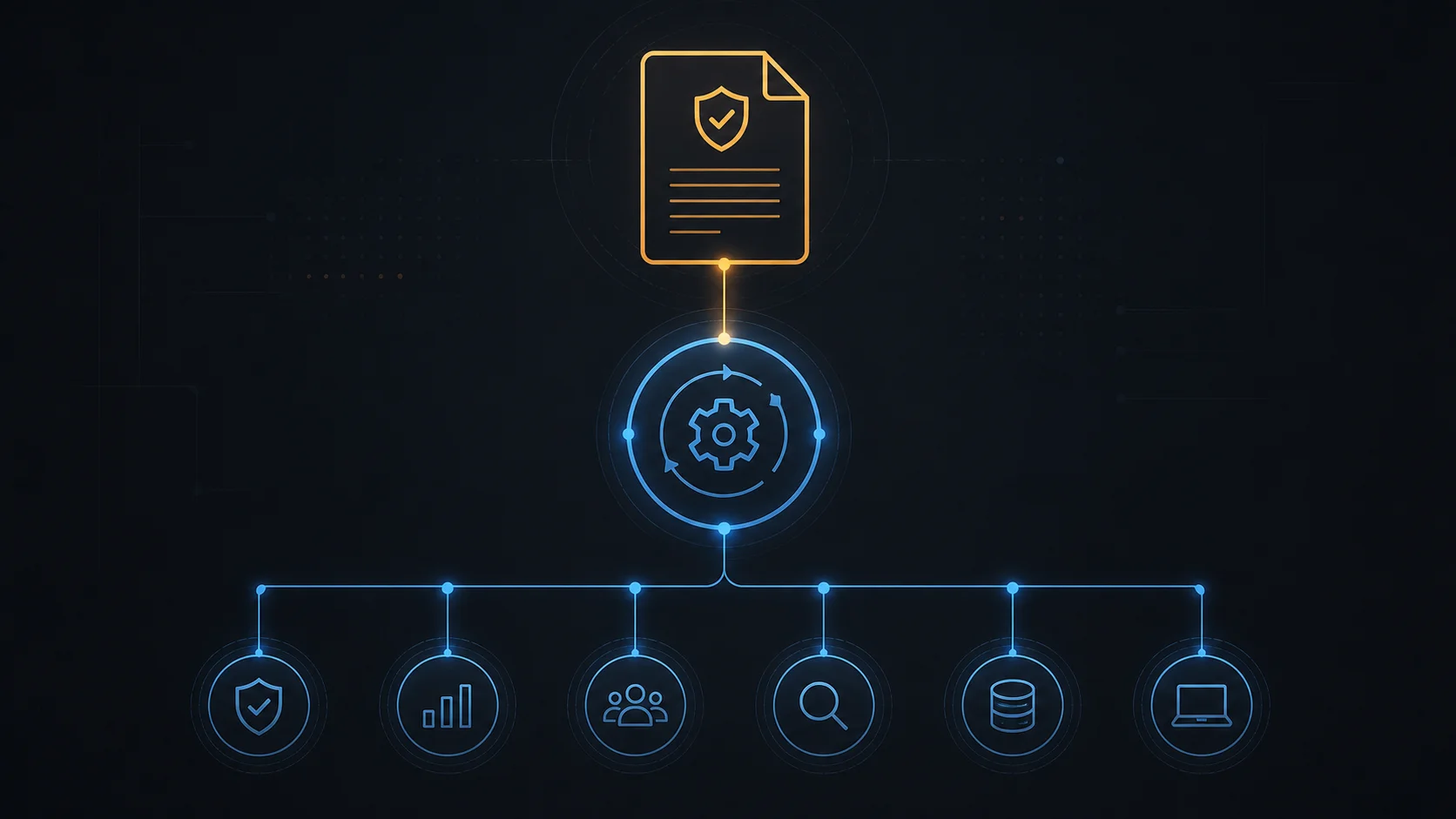
A useful way to think about the relationship:
Governance
        │
Defines policies
        │
        ▼
AI Control Plane
        │
Operationalizes policies
        │
        ▼
Users • Applications • Models • Agents • Data
Neither layer is sufficient on its own. Without governance, organizations lack clear operating principles. Without operational infrastructure, governance often becomes difficult to apply consistently as AI adoption grows.
A practical example
Suppose an organization establishes three governance policies: sensitive business data should use private AI infrastructure; customer-facing AI interactions require additional oversight; and employees should use approved AI models. These policies define the organization's expectations.
Operationally, however, the organization still needs a way to determine which workloads are sensitive, direct requests appropriately, manage access, monitor AI usage, and review operational activity over time. This illustrates the complementary relationship between governance and operational infrastructure.
Where AgenixCore fits
AgenixHub is an enterprise AI implementation and operations company. Its flagship product, AgenixCore, is an AI control plane for private, governed, cost-efficient enterprise AI.
Based on AgenixHub's published positioning, AgenixCore supports enterprise AI operations through capabilities such as request routing, governance controls, observability, access management, and operational visibility. These capabilities help organizations operationalize governance practices across AI models, applications, and workflows.
Importantly, AgenixCore is not the governance policy itself. Organizations remain responsible for defining their governance framework, risk appetite, and operational policies. AgenixCore provides the operational layer that helps implement those decisions consistently.
Building mature enterprise AI
Organizations that successfully scale AI generally treat governance and operations as complementary disciplines. A governance framework establishes policies, ownership, responsibilities, acceptable use, and review processes. An operational layer helps apply those policies, coordinate AI systems, monitor activity, improve consistency, and adapt as AI adoption evolves. Together, they create a more sustainable enterprise AI operating model.
Review notes
Governance is broader than technology. A control plane supports governance but does not replace organizational decision-making. Technology cannot guarantee responsible AI without appropriate policies and oversight. Governance should evolve alongside AI adoption rather than remain a static document. The appropriate operational architecture depends on organizational size, AI maturity, and business objectives.
FAQ
Is AI governance software?
No. AI governance is an organizational framework that includes policies, processes, responsibilities, and oversight. Software can support governance but does not replace it.
Does every company need an AI control plane?
Not necessarily. Organizations with limited AI adoption may manage effectively without one. As AI usage expands across teams and systems, operational infrastructure often becomes more valuable.
Can an AI control plane create governance policies?
No. Governance policies should be defined by the organization. A control plane helps operationalize those policies once they have been established.
Is a control plane only about routing AI requests?
No. While routing may be one capability, a control plane typically addresses broader operational concerns such as governance support, observability, access management, and operational consistency.
Conclusion
AI governance and an AI control plane solve different — but closely connected — enterprise challenges. Governance defines how AI should be used. A control plane helps organizations operate AI according to those principles across users, applications, models, and workflows. As enterprise AI grows beyond isolated pilots, this distinction becomes increasingly important. Policies create direction, but operational infrastructure helps transform those policies into consistent day-to-day practice.
Continue reading: