
As enterprise AI adoption grows, two infrastructure terms appear more frequently: LLM gateway and AI control plane. They're often used interchangeably, but they solve different problems.
An LLM gateway primarily manages and routes requests between applications and AI models. An AI control plane goes further by adding governance, policy enforcement, monitoring, workload classification, access controls, and operational visibility across enterprise AI.
Understanding the difference helps organizations build the right architecture instead of expecting one component to solve every AI operations challenge.
Quick answer
An LLM gateway sits in front of AI models and manages traffic — handling tasks such as authentication, routing, failover, or rate limiting. An AI control plane sits above the AI ecosystem, coordinating how people, applications, models, tools, and data interact through governance, policy, observability, routing decisions, and operational controls. In many enterprise environments, a control plane complements rather than replaces a gateway.
What is an LLM gateway?
An LLM gateway acts as an intermediary between applications and one or more language models. Typical responsibilities include routing requests to model providers, authentication, API abstraction, load balancing, failover, rate limiting, and provider switching.
Think of it as the traffic manager for AI requests. If an application needs to send prompts to multiple providers without changing application code, an LLM gateway is often the right solution.
What is an AI control plane?
An AI control plane focuses on operating AI across the enterprise rather than simply forwarding requests. Instead of only asking "which model should receive this request?", it also asks: Who is making this request? Is this workload approved? Should sensitive data use a private route? Which model is appropriate for this workload? Does company policy allow this interaction? Should the interaction be monitored or captured? What did the request cost? How is AI adoption changing over time?
The control plane becomes the coordination layer between users, applications, models, tools, and enterprise data. For the full architecture, see What Is an AI Control Plane?
AI control plane vs. LLM gateway
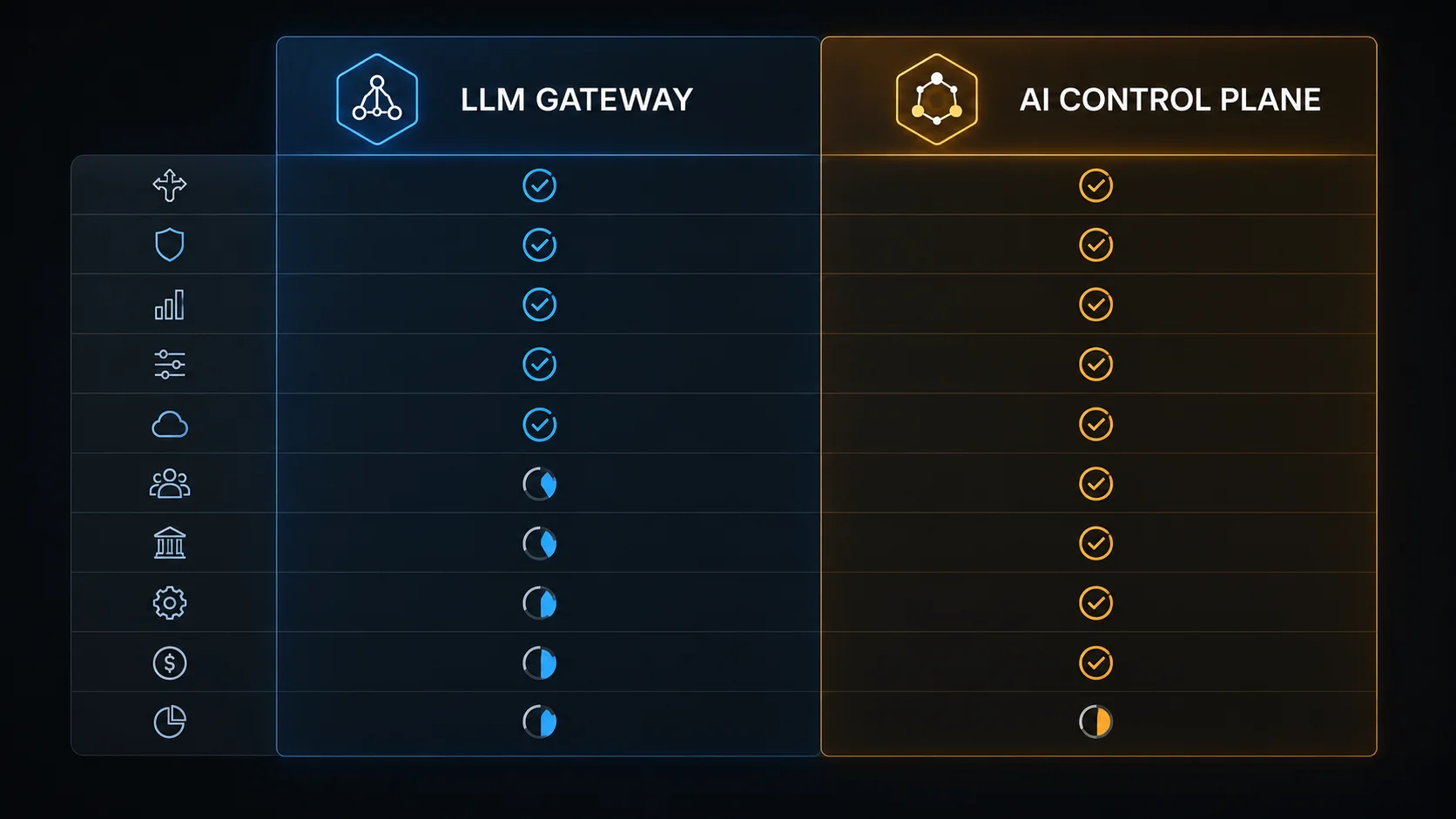
| Capability | Typical LLM gateway | AI control plane |
|---|---|---|
| Request routing | Yes | Yes |
| Provider abstraction | Yes | Yes |
| Authentication | Yes | Yes |
| Failover | Yes | Yes |
| Rate limiting | Yes | Sometimes |
| Access governance | Limited | Yes |
| Workload classification | Usually no | Yes |
| Policy-aware routing | Limited | Yes |
| Cost visibility across AI usage | Limited | Yes |
| Cross-model governance | Limited | Yes |
| Observability | Basic request metrics | Enterprise operational visibility |
| Audit-ready interaction capture | Varies | Common enterprise requirement |
| AI operating policies | Usually no | Yes |
This distinction reflects architecture rather than product categories. Some gateway products continue adding governance features, while some control planes include gateway capabilities. The important question is which operational problems you need to solve.
A gateway solves connectivity
For many teams, an LLM gateway is the first infrastructure layer they deploy. It works well when the primary objective is to simplify integrations, avoid provider lock-in, manage API keys, route requests, and improve resilience. For a startup using one or two applications, that may be enough.
A control plane solves operations
As AI spreads across departments, new questions emerge that routing alone cannot answer. Engineering uses one model. Marketing uses another. Legal uses a private model. Customer support uses an AI assistant connected to internal documentation. Leadership now wants to understand which teams use which models, which workloads should use frontier models, which requests contain sensitive information, how much each workload costs, which AI policies are being followed, and how AI usage should evolve over time.
These questions move beyond networking and into enterprise operations.
Do you need both?
Often, yes. The two layers are complementary rather than competitive. A practical architecture might look like this:
Users
   │
Applications
   │
AI Control Plane
   │
LLM Gateway
   │
Model Providers / Private Models
The gateway manages technical connectivity. The control plane manages enterprise AI operations. Not every organization needs both from day one, but larger deployments frequently benefit from separating these responsibilities.
When an LLM gateway is enough
A gateway may be sufficient if you are experimenting with AI, have only a few applications, primarily need provider routing, have limited governance requirements, or don't yet need organization-wide AI visibility. For many early-stage AI initiatives, this is a sensible starting point.
When you need an AI control plane
A control plane becomes more valuable when AI adoption reaches operational scale. Typical indicators include multiple AI models across the business, AI agents operating in different workflows, sensitive data requiring different routing paths, cost management across departments, a need for access governance, organization-wide monitoring, policy enforcement, operational reporting, and private, cloud, and hybrid AI environments. At this point, AI stops being a collection of individual tools and becomes enterprise infrastructure.
The shift from AI adoption to AI operations
Many organizations initially focus on connecting applications to AI. Over time, they discover that connectivity is only one part of the challenge. Operating AI consistently across users, models, tools, and data requires additional capabilities around governance, visibility, workload management, and operational decision-making. This is the transition from AI infrastructure to AI operations.
Where AgenixCore fits
AgenixHub is an enterprise AI implementation and operations company. Its flagship product, AgenixCore, is an AI control plane for private, governed, cost-efficient enterprise AI.
According to AgenixHub's published positioning, AgenixCore sits between people, applications, models, tools, and data to support governed access, request routing, context handling, cost controls, and audit-ready operations. It is designed to address the operational gap that appears after enterprises move beyond isolated AI pilots and begin operating AI across multiple teams and environments.
Rather than replacing an LLM gateway, AgenixCore is positioned as the enterprise operating layer that connects routing with governance, policy management, observability, and ongoing AI operations.
Review notes
Not every organization needs an AI control plane immediately. Small deployments may operate effectively with a gateway alone. Gateway and control plane are complementary architectural layers rather than mutually exclusive products. Governance requirements increase as AI adoption expands across business units, models, and data sources. The right architecture depends on workload complexity, organizational scale, and operational goals.
FAQ
Is an AI control plane the same as an LLM gateway?
No. An LLM gateway primarily manages connectivity and request routing, while an AI control plane adds governance, operational visibility, policy management, and enterprise-wide coordination.
Can an LLM gateway enforce governance policies?
Some gateways provide governance-related features, but enterprise AI governance often extends beyond request routing into access management, workload classification, monitoring, and operational oversight.
Do enterprises need both?
Many do. A gateway manages technical traffic, while a control plane helps manage AI as an enterprise operating capability.
Does every AI project need a control plane?
No. Smaller or experimental deployments may not require one. Control planes become more valuable as AI usage expands across teams, workflows, and multiple model environments.
Conclusion
An LLM gateway and an AI control plane address different layers of the enterprise AI stack. A gateway answers "how should this request reach the right model?" A control plane answers the broader question: "how should AI operate across the enterprise?" As organizations move from isolated AI experiments to enterprise-wide adoption, governance, policy enforcement, observability, workload management, and operational visibility become increasingly important. That is the point where many enterprises begin looking beyond routing alone toward a true AI control plane.
Continue reading: