Enterprise AI teams are no longer choosing one model and calling it a strategy.
A customer-support summary, a legal contract review, a SQL generation task, a private HR query, a RAG answer from internal documents, and a complex planning workflow should not always go to the same model. Some tasks need frontier reasoning. Some need low latency. Some need private deployment. Some need strict review. Some need the cheapest reliable path because they happen thousands of times a day.
That is where LLM model routing becomes important.
LLM model routing is the practice of sending each AI request to the most suitable model, tool, retrieval system, or review path based on the workload's complexity, sensitivity, cost tolerance, latency requirement, and quality threshold. In enterprise AI, routing is not only a technical optimization. It becomes part of the AI operating layer.

AgenixCore is designed for this exact problem: it sits between people, models, tools, and data sources, governing access, routing requests, controlling cost, and capturing interactions across enterprise AI usage. (AgenixHub)
Quick answer: What is LLM model routing?
LLM model routing is a strategy for directing each AI request to the right model or execution path. Instead of sending every prompt to one expensive frontier model, enterprises classify workloads by complexity, privacy, cost, latency, and quality needs, then route requests to frontier models, smaller models, private models, RAG systems, tools, or human review.
Why model routing matters now
Early enterprise AI adoption was simple: pick a model, add a chatbot interface, connect a few documents, and run pilots.
That phase is over.
Most companies now face a messier reality:
- teams use different AI tools without central visibility,
- expensive models handle routine work,
- sensitive data flows into unclear systems,
- RAG quality varies by document source,
- prompts become longer than needed,
- AI spend rises without clear attribution,
- business teams cannot explain which model is used for which task,
- governance teams cannot audit every AI interaction.
The problem is not that enterprises lack access to models. The problem is that they lack an operating layer for deciding which workload should use which model, under which policy, at what cost, with what level of monitoring.
Research and platform documentation now reflect the same direction. RouteLLM frames routing as a way to direct simpler queries to smaller models and complex queries to stronger models, balancing quality and cost efficiency. (Requesty) AWS describes both static and dynamic routing patterns for multi-LLM applications. (Amazon Web Services, Inc.) Microsoft Foundry's model router supports routing modes such as Balanced, Quality, and Cost, and allows teams to route across selected model subsets. (Microsoft Learn)
The market is moving from model access to model operating control.
That is the category AgenixCore should own.
What LLM model routing actually does
A model router evaluates a request before execution and decides where it should go.
That decision can be based on:
| Routing signal | Example | Likely routing decision |
|---|---|---|
| Task type | Summarize a short support note | Smaller or faster model |
| Reasoning complexity | Analyze a multi-step legal clause | Frontier reasoning model |
| Data sensitivity | Query involving HR or finance data | Private model, VPC path, or stricter controls |
| Cost tolerance | High-volume tagging or classification | Low-cost model or batch path |
| Latency need | Real-time customer chat | Fast model with fallback |
| Quality threshold | Board-level strategy synthesis | Higher-quality model with review |
| RAG dependency | Answer from internal documents | Retrieval-first path with citation checks |
| User role | Analyst vs executive vs external user | Role-aware permissions and model access |
| Failure risk | Medical, legal, compliance, financial impact | Human review or restricted workflow |
The simple version is: send simple work to simple paths and complex work to stronger paths.
The enterprise version is more serious: route every AI request through a governed decision layer that understands cost, quality, sensitivity, user permissions, business value, and operational risk.
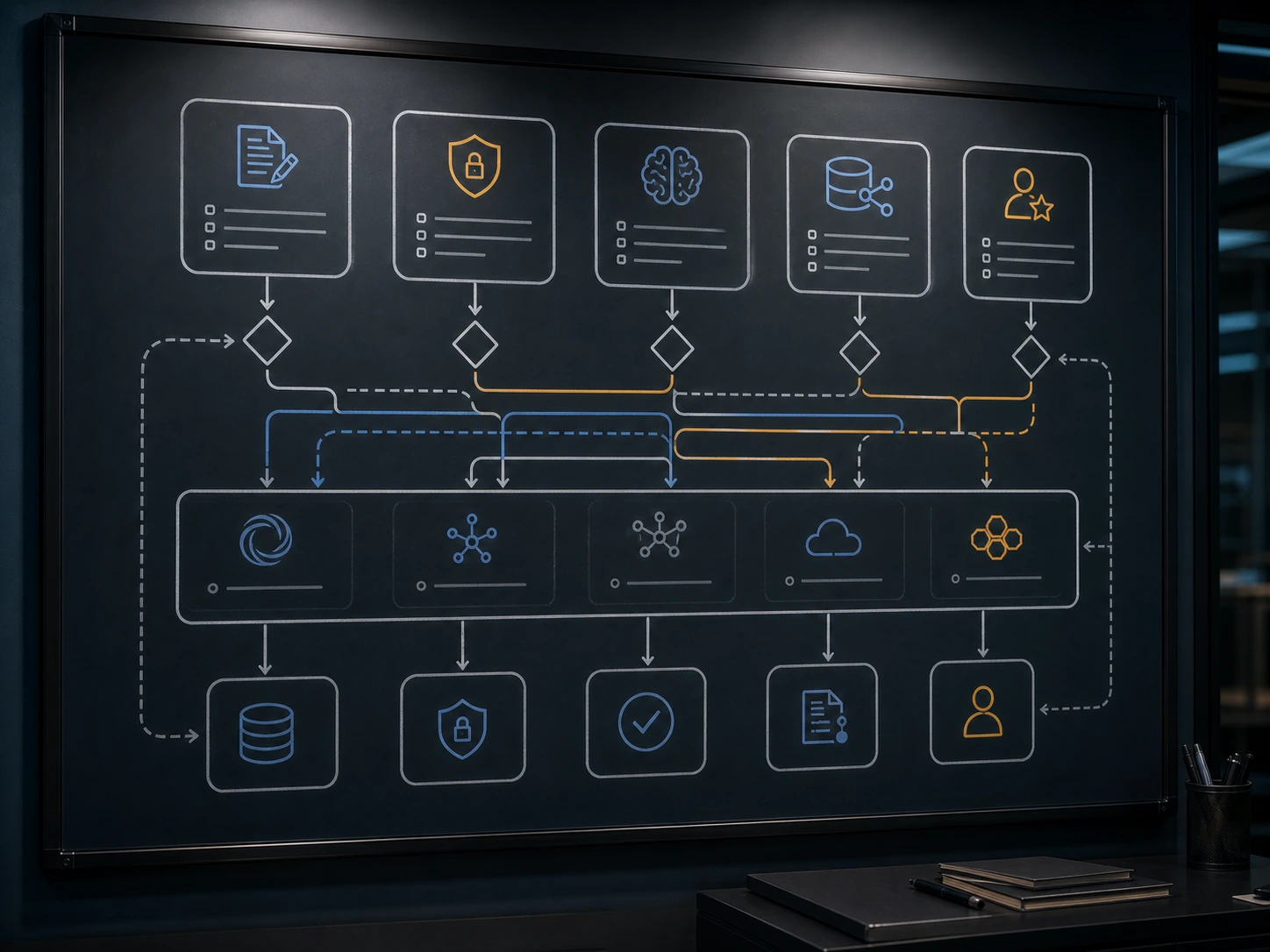
LLM routing is not the same as choosing the "best model"
A common mistake is to treat model routing as a leaderboard problem.
That thinking breaks quickly.
The "best" model for one task may be the wrong choice for another. A frontier model may be ideal for complex reasoning, but wasteful for repetitive classification. A private model may be better for sensitive workflows, but unnecessary for generic content transformation. A fast small model may be perfect for real-time response suggestions, but weak for long-context synthesis.
Recent routing research also shows why teams should not treat routers as magic. LLMRouterBench, a large benchmark with more than 400,000 instances across 21 datasets and 33 models, found strong model complementarity but also showed that several routing approaches fail to reliably outperform simple baselines, and that careful model curation can matter more than merely adding more models. (arXiv)
That matters for enterprises.
A routing strategy should not begin with "connect every model." It should begin with "which workloads do we actually have?"
The enterprise model routing framework
A good LLM model routing strategy has seven layers.
1. Workload classification
Before routing anything, classify AI workloads.
AgenixHub's operating principle is simple: not all AI work has the same value, risk, or complexity.
Classify each workload by:
- business function,
- task type,
- expected volume,
- complexity,
- data sensitivity,
- user group,
- latency requirement,
- quality threshold,
- compliance exposure,
- review requirement,
- expected cost per request,
- failure impact.
Example workload categories:
| Workload | Complexity | Sensitivity | Volume | Suggested path |
|---|---|---|---|---|
| Product description rewrite | Low | Low | High | Smaller model |
| Customer ticket summarization | Low-medium | Medium | High | Fast model plus policy filters |
| Contract clause review | High | High | Medium | Frontier or private model plus human review |
| Internal policy Q&A | Medium | High | Medium | RAG plus permission-aware retrieval |
| Executive strategy synthesis | High | Medium | Low | Frontier model |
| Data classification | Low | Medium | Very high | Batch-optimized model |
| Agentic workflow with system actions | High | High | Medium | Governed agent path plus audit logs |
This is where most companies go wrong. They try to design routing at the model level before understanding the work.
AgenixCore should be positioned as the layer that helps operationalize this classification into routing logic.
2. Model portfolio design
Enterprises should not route across random models. They need a curated model portfolio.
A practical portfolio may include:
- one or more frontier models for high-reasoning tasks,
- smaller commercial models for routine work,
- private or open models for sensitive internal workflows,
- domain-specific models where appropriate,
- embedding models for retrieval,
- rerankers for RAG quality,
- fallback models for reliability,
- human review paths for high-risk decisions.
Microsoft's model router documentation reflects this need by allowing teams to customize routing modes and select model subsets rather than routing blindly across every available model. (Microsoft Learn) LiteLLM's routing documentation also shows how routing groups can apply different routing strategies to different model groups.
The lesson: the model portfolio must be intentional.
More models do not automatically mean better routing. More models can create more policy, testing, monitoring, procurement, and debugging work.
3. Policy-aware routing
Enterprise model routing cannot be based only on "which model is cheapest?"
It also needs policy.
Policy-aware routing asks:
- Is the user allowed to perform this task?
- Is the data allowed to leave the environment?
- Does this request contain confidential, regulated, or customer-sensitive content?
- Does this task need human approval?
- Should the output be logged?
- Should this use a private model?
- Should this request be blocked?
- Should this route through RAG instead of direct generation?
- Should this be handled by a tool or workflow rather than an LLM?
This is where an AI gateway alone is often not enough. Gateways may help with access, observability, provider routing, and failover. But enterprise routing also needs business-level workload rules.
AgenixCore should be positioned as the AI control layer that connects model routing with access governance, cost control, and interaction capture across AI usage. (AgenixHub)
4. Cost-quality routing
The most obvious reason to route models is cost.
But cost optimization without quality control becomes dangerous. A cheaper response that creates rework, poor decisions, customer frustration, or compliance risk is not cheaper.
A better routing target is cost per acceptable outcome.
That means teams should measure:
- cost per request,
- cost per completed workflow,
- cost per accepted answer,
- cost per escalated answer,
- cost per reviewed output,
- cost per avoided manual task,
- quality score by workload type,
- latency by route,
- failure rate by model,
- human correction rate.
RouteLLM research describes the routing challenge as maximizing quality within a cost constraint or minimizing cost for a target quality. That framing is useful, but enterprises should extend it to include privacy, governance, adoption, and workflow impact.
AgenixHub's Model Benchmarking Assessment is relevant here because it compares models by workload fit, cost, quality, latency, privacy, and deployment path. (AgenixHub)
5. Privacy and deployment routing
Some workloads should not route to a public API by default.
But that does not mean every workload needs on-prem AI either.
A practical enterprise routing strategy may include:
| Workload type | Routing path |
|---|---|
| Public content transformation | Commercial API model |
| Low-risk internal summarization | Approved cloud model |
| Confidential internal documents | Private RAG path |
| Regulated customer data | Private model, VPC, or restricted environment |
| High-risk business decision | Strong model plus human review |
| Routine high-volume extraction | Smaller or batch model |
| Agentic workflow with actions | Governed tool path with audit trail |
The right question is not "cloud or private?" The right question is which workload needs which control boundary?
That is a perfect fit for AgenixCore's positioning as a governed layer across models, tools, and data sources. (AgenixHub)
6. RAG and context routing
Many enterprise AI failures are not model failures. They are context failures.
The model receives:
- too much context,
- stale context,
- irrelevant documents,
- duplicated chunks,
- missing permissions,
- weak citations,
- poor retrieval results,
- no source grounding.
Model routing should not only decide which model to use. It should also decide which context path to use.
For example:
| Request | Context decision | Model decision |
|---|---|---|
| "Summarize this public article" | No RAG needed | Small or fast model |
| "What is our refund policy for enterprise customers?" | Policy-document RAG | Medium model with citations |
| "Compare these three contracts" | Secure document retrieval | Strong model plus human review |
| "Draft a response using customer history" | CRM or context tool path | Approved model with privacy controls |
| "Answer from confidential board notes" | Restricted access or block | Private model or review path |
This is why model routing and RAG routing should be designed together.
AgenixHub's capabilities page already frames the company around control and efficiency across the model ecosystem, including frontier models, retrieval systems, governance, cost, and accountability. (AgenixHub)
7. Monitoring and continuous improvement
Routing is not a one-time setup.
Models change. Prices change. Latency changes. User behavior changes. New departments adopt AI. Prompt patterns drift. RAG sources become stale. New compliance requirements appear.
A routing layer should continuously monitor:
- route volume,
- cost by team and workflow,
- model usage by task type,
- fallback rates,
- latency,
- output quality,
- human correction rate,
- hallucination or citation failure rate,
- sensitive data exposure,
- blocked requests,
- policy exceptions,
- adoption by department,
- model retirement opportunities.
AgenixHub's Managed AI Operations page is relevant because it supports continuous monitoring, routing, and improvement rather than treating AI implementation as a one-time build. (AgenixHub)
That is the difference between deploying AI and operating AI.

Static vs dynamic vs policy-aware routing
There are three practical routing levels.
| Routing type | How it works | Best for | Limitation |
|---|---|---|---|
| Static routing | Predefined workflows always use predefined models | Clear use cases and fixed workflows | Not adaptive |
| Dynamic routing | A classifier or router selects the model at runtime | Multi-purpose assistants and variable prompts | Needs evaluation and guardrails |
| Policy-aware routing | Routing considers task, user, data sensitivity, cost, and governance | Enterprise AI operations | Requires a control layer |
AWS describes static and dynamic routing as two main approaches in multi-LLM routing, with dynamic routing using a layer to intercept prompts and route them to the best-suited downstream LLM. (Amazon Web Services, Inc.)
For enterprise AI, the end state should usually be policy-aware routing.
Dynamic routing without policy can reduce cost but still create governance risk. Policy-aware routing connects model choice to business rules.
A practical LLM model routing architecture
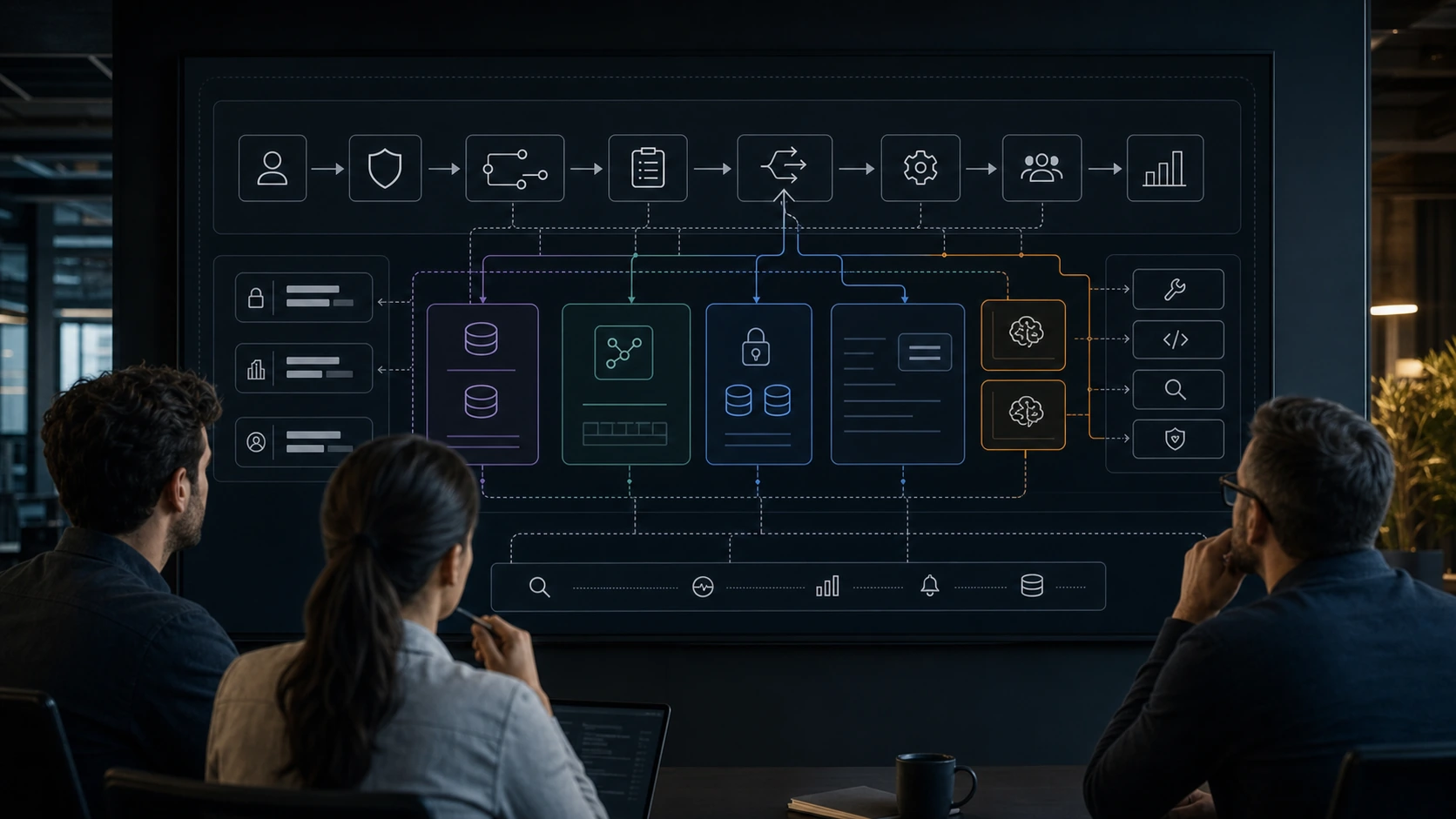
A production enterprise routing architecture usually includes:
- Request intake
Captures prompt, user, application, department, metadata, and context requirements. - Identity and access layer
Checks who the user is and what systems or data they are allowed to access. - Workload classifier
Identifies task type, complexity, sensitivity, expected output, and risk level. - Policy engine
Applies rules for data handling, model eligibility, review needs, logging, and blocking. - Context or RAG selector
Decides whether retrieval is needed and which sources can be used. - Model router
Selects the model path: frontier model, smaller model, private model, domain model, batch model, or fallback. - Tool or action controller
Controls whether the system can call APIs, trigger workflows, or only generate text. - Output review layer
Applies checks, citations, human approval, or escalation. - Observability layer
Tracks cost, latency, quality, routing decisions, failures, and adoption. - Continuous tuning loop
Updates routing rules based on model performance, cost, policy, and business outcomes.
AgenixCore should be framed as the governed layer that coordinates this operating flow across people, applications, models, tools, and data sources.
Sample enterprise routing rules
Here is a simple routing rule set an enterprise might start with.
| Rule | Routing action |
|---|---|
| Low-complexity, low-sensitivity, high-volume task | Route to smaller cost-efficient model |
| High-complexity reasoning task | Route to frontier model |
| Sensitive HR, finance, legal, or customer data | Route to private or approved restricted path |
| Internal knowledge question | Route through permission-aware RAG |
| Customer-facing answer | Add quality checks, policy filters, and escalation |
| Regulated or high-impact workflow | Require human review |
| Provider outage or high latency | Trigger fallback route |
| Repeated prompt or context pattern | Apply caching or prompt compression |
| Unknown workload type | Route to safe default or review queue |
This is not a final architecture. It is a starting point.
The right routing rules depend on the company's data, systems, regulatory context, model portfolio, user groups, and business goals.
Common model routing mistakes
Mistake 1: Routing only for cost
Cost matters, but cost-only routing can damage quality and trust.
The better goal is lowest cost at the required quality, privacy, and risk threshold.
Mistake 2: Sending all complex-looking prompts to frontier models
Some long prompts are not complex. They are just bloated.
Before upgrading the model, check whether the prompt, retrieval design, context length, or task framing is the real issue.
Mistake 3: Ignoring human review
Routing should include human review paths for high-risk workflows. Not every decision should be fully automated.
Mistake 4: Treating private AI as always better
Private AI can improve control, but it can also add infrastructure, monitoring, and maintenance complexity. Use private models where the workload justifies the control boundary.
Mistake 5: No model benchmarking
Routing rules should be tested against real workloads, not vendor demos or generic benchmark scores.
Mistake 6: No audit trail
If teams cannot explain why a request went to a model, what data it used, what it cost, and who approved the output, they do not have enterprise-grade routing.
How to build an enterprise LLM model routing strategy
Step 1: Audit current AI usage
Start by mapping where AI is already being used.
Look for:
- which teams use AI,
- which tools and models are in use,
- what tasks are repeated,
- where spend is rising,
- where sensitive data appears,
- which outputs need review,
- where RAG or context is inefficient,
- where users are bypassing approved systems.
AgenixHub's AI Operating Efficiency Audit is designed to identify usage waste, routing gaps, risk exposure, and cost leakage before those patterns scale. (AgenixHub)
Step 2: Create workload lanes
Create routing lanes such as:
- routine automation,
- high-volume classification,
- internal knowledge Q&A,
- sensitive private workflows,
- complex reasoning,
- customer-facing responses,
- agentic workflows,
- human-review workflows.
Step 3: Benchmark real tasks
Test models on your own prompts, documents, examples, and acceptance criteria.
Measure:
- accuracy,
- latency,
- cost,
- consistency,
- citation quality,
- privacy suitability,
- failure behavior,
- human correction rate.
Step 4: Define routing policies
Policies should answer:
- Which models are approved?
- Which data can be sent where?
- Which users can access which model paths?
- Which tasks need review?
- Which outputs need citations?
- Which workflows can call tools?
- Which routes are blocked?
Step 5: Deploy the routing layer
This may start with a limited route map for a few high-value workflows.
Do not try to route everything on day one.
Start with high-volume or high-risk patterns where routing can quickly improve control. This is the implementation lane for the Managed AI Efficiency Layer.
Step 6: Monitor and tune
Review routing performance monthly or continuously.
The operating question is not "did the model answer?" The operating question is "did the route produce the right business outcome at the right cost, with the right control?"
Where AgenixCore fits
AgenixCore is the natural product fit for enterprise LLM routing because routing is not only a model-selection problem. It is a control-layer problem.
A company needs to know:
- who made the request,
- what task was being performed,
- what data was involved,
- what model path was selected,
- why that path was selected,
- what it cost,
- whether the response passed review,
- whether the interaction should be logged,
- whether the route should change next time.
AgenixCore is publicly positioned as the governed layer between people, models, tools, and data sources, with access governance, request routing, cost control, and interaction capture. (AgenixHub)
That makes it the right commercial destination for this article.
AgenixCore should be described as useful when an enterprise needs to:
- classify AI workloads,
- route requests across multiple model paths,
- govern access to AI systems,
- control cost by workload,
- route sensitive work through approved paths,
- monitor model usage and outcomes,
- capture audit trails,
- coordinate AI usage across tools and teams.
In simple terms: AgenixCore helps turn model routing from engineering logic into an enterprise operating layer.
How AgenixHub helps
AgenixHub helps companies move from uncontrolled AI usage to managed AI operations.
For LLM model routing, the operating path is:
- AI Operating Efficiency Audit
Map current AI usage, wrong-model patterns, cost leakage, risk exposure, and routing opportunities. - Model Benchmarking Assessment
Compare frontier, commercial, cloud, private, and open model paths against real workloads. - AgenixCore and Managed AI Efficiency Layer
Deploy the governed routing layer across users, models, tools, data sources, policies, and cost controls. - Managed AI Operations
Continuously monitor routing, cost, quality, latency, privacy, adoption, and model performance. - Inward Deployed AI Engineers
Work inside the AI operating layer to tune routing, prompts, limits, policies, private model paths, and operating reports. AgenixHub describes this delivery model as helping improve orchestration, reduce unnecessary frontier-model dependency, deploy private or open models where suitable, and keep AI systems efficient, secure, and measurable. (AgenixHub)
The goal is not to avoid frontier models. The goal is to reserve them for work that justifies frontier cost and route everything else through the most appropriate path.
Limitations and review notes
LLM model routing is powerful, but it should not be treated as automatic savings.
A strong routing strategy still depends on:
- real workload benchmarking,
- high-quality evaluation data,
- clear privacy policies,
- source quality for RAG,
- good prompt and context design,
- reliable monitoring,
- human review for high-risk workflows,
- periodic model re-evaluation,
- business ownership.
Model routing can reduce waste, but only when routing rules match real usage. It can improve privacy, but only when sensitive workflows are correctly classified. It can improve quality, but only when models are benchmarked against actual tasks.
The safest enterprise approach is to start with an audit, route a few high-value workflows first, measure outcomes, and expand gradually.
FAQ
What is LLM model routing?
LLM model routing is the process of sending each AI request to the most suitable model or execution path based on task type, complexity, cost, latency, privacy, quality, and governance needs.
Why should enterprises use model routing?
Enterprises use model routing to avoid sending every request to the same model. Routing helps control cost, improve latency, reserve frontier models for complex work, protect sensitive data, and create more consistent AI governance.
Is model routing only about reducing LLM cost?
No. Cost is one benefit, but enterprise routing also covers quality, privacy, compliance, availability, RAG context, human review, and auditability.
What is the difference between an LLM router and an AI gateway?
An LLM router selects the right model path for a request. An AI gateway often provides a broader interface for provider access, authentication, logging, fallbacks, and policy controls. In enterprise settings, both functions may sit inside a larger AI operating layer or control plane.
When should a request go to a frontier model?
A request should go to a frontier model when the task requires advanced reasoning, complex synthesis, high-stakes analysis, or quality levels that smaller models cannot reliably meet.
When should a request go to a smaller or cheaper model?
A request can often go to a smaller model when the task is repetitive, low-risk, high-volume, structured, or easy to evaluate, such as classification, short summarization, formatting, extraction, or simple rewrite tasks.
How does model routing work with private AI?
Private AI routing sends sensitive or restricted workloads through approved private, VPC, on-prem, or open-model paths when public API routing is not appropriate. The decision should be based on workload sensitivity, compliance needs, infrastructure maturity, and quality requirements.
How does AgenixCore help with model routing?
AgenixCore acts as a governed layer between users, models, tools, and data sources. For model routing, it helps enterprises classify workloads, govern access, route requests, control cost, and capture interactions across AI usage. (AgenixHub)
Conclusion
LLM model routing is becoming a core enterprise AI capability.
As companies adopt more models, agents, RAG systems, private deployments, and AI-enabled workflows, the main question changes from "which model should we use?" to "how should every AI workload be routed, governed, measured, and improved?"
That is the shift from AI experimentation to AI operations.
For simple teams, model routing may start as cost control. For enterprises, it becomes the operating logic behind AI adoption: which user, which task, which data, which model, which policy, which review path, and which outcome.
AgenixCore is built for that control layer.
If your company is already using multiple AI tools, models, RAG systems, or private AI paths, book an AgenixCore briefing or start with an AI Operating Efficiency Audit to identify wrong-model usage, cost leakage, sensitive workflows, and the first routing opportunities to operationalize.