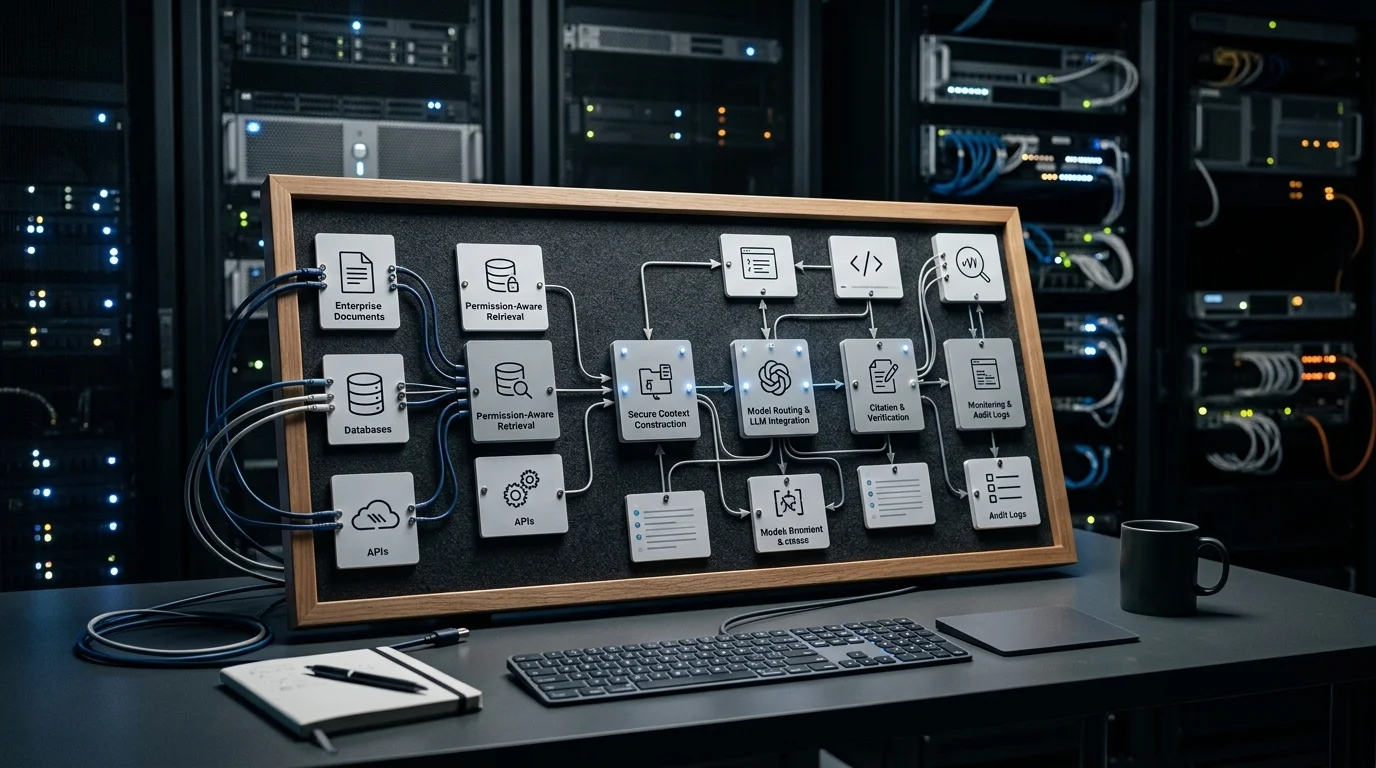
Enterprise RAG is no longer just a way to connect a chatbot to internal documents. For companies moving AI into production, RAG becomes part of the operating layer that determines what data an AI system can access, which model should answer, how much context should be used, how responses are verified, and how the system is monitored after launch.
That is where many RAG pilots break.
A prototype can answer questions from a PDF folder. A production enterprise RAG system has to respect permissions, retrieve the right evidence, avoid leaking sensitive data, manage cost, cite sources, handle stale documents, route workloads across models, and keep improving as users, data, and business workflows change.
Quick answer
Enterprise RAG implementation is the process of building a retrieval-augmented generation system that connects large language models to trusted enterprise knowledge while preserving access control, citations, quality, cost visibility, and operational governance. A production-ready RAG system needs more than a vector database: it needs data preparation, permission-aware retrieval, model routing, evaluation, monitoring, and a clear operating model. Start with an AI Operating Efficiency Audit to map your data and models.
What is enterprise RAG?
Retrieval-augmented generation, or RAG, is an AI architecture where a system retrieves relevant information from external knowledge sources and uses that information as grounding context before generating an answer. Lewis et al. introduced retrieval-augmented generation as combining pre-trained parametric memory with non-parametric memory accessed through dense retrieval (arXiv).
In simple terms:
- A user asks a question.
- The system searches trusted documents, databases, or knowledge sources.
- The most relevant passages are added to the model’s context.
- The model generates an answer using the retrieved evidence.
- The response may include citations back to source content.
Enterprise RAG applies this pattern inside a company environment where the data is private, fragmented, permissioned, constantly changing, and often business-critical.
That creates a different problem from a demo.
A demo asks, “Can the model answer from these documents?”
An enterprise RAG system asks:
- Is the user allowed to see this document?
- Is the document current?
- Was the right chunk retrieved?
- Was the context too large, too small, or noisy?
- Should this request go to a frontier model, private model, or cheaper model?
- Can the answer cite the source?
- Can security, finance, and operations review what happened?
- Can the system improve after launch?
That is why enterprise RAG should be treated as an operating architecture, not a chatbot feature.
Why enterprises implement RAG
Large language models are powerful, but they do not automatically know your current company policies, contracts, product documentation, support history, engineering standards, customer records, or compliance requirements. RAG helps bridge that gap by grounding answers in company-approved knowledge. TechTarget explains why enterprise RAG uses proprietary and current data while maintaining accuracy, security, and regulatory compliance (TechTarget).
Common enterprise RAG use cases include:
| Use case | What RAG retrieves | Typical users |
|---|---|---|
| Employee knowledge assistant | HR policies, onboarding docs, SOPs, internal wikis | Employees, HR, operations |
| Customer support copilot | Product docs, ticket history, known issues, troubleshooting guides | Support teams |
| Sales enablement assistant | Case studies, product sheets, pricing rules, CRM notes | Sales and account teams |
| Compliance research assistant | Policies, regulatory memos, audit evidence, controls | Legal, risk, compliance |
| Engineering knowledge assistant | Architecture docs, runbooks, incident logs, code documentation | Engineering and DevOps |
| Procurement and vendor-risk assistant | Vendor files, contracts, security questionnaires, approval notes | Finance, procurement, security |
| Executive intelligence layer | Reports, strategy docs, dashboards, internal memos | Leadership teams |
RAG is most useful when the answer depends on trusted enterprise context, not just general model knowledge.
Enterprise RAG architecture
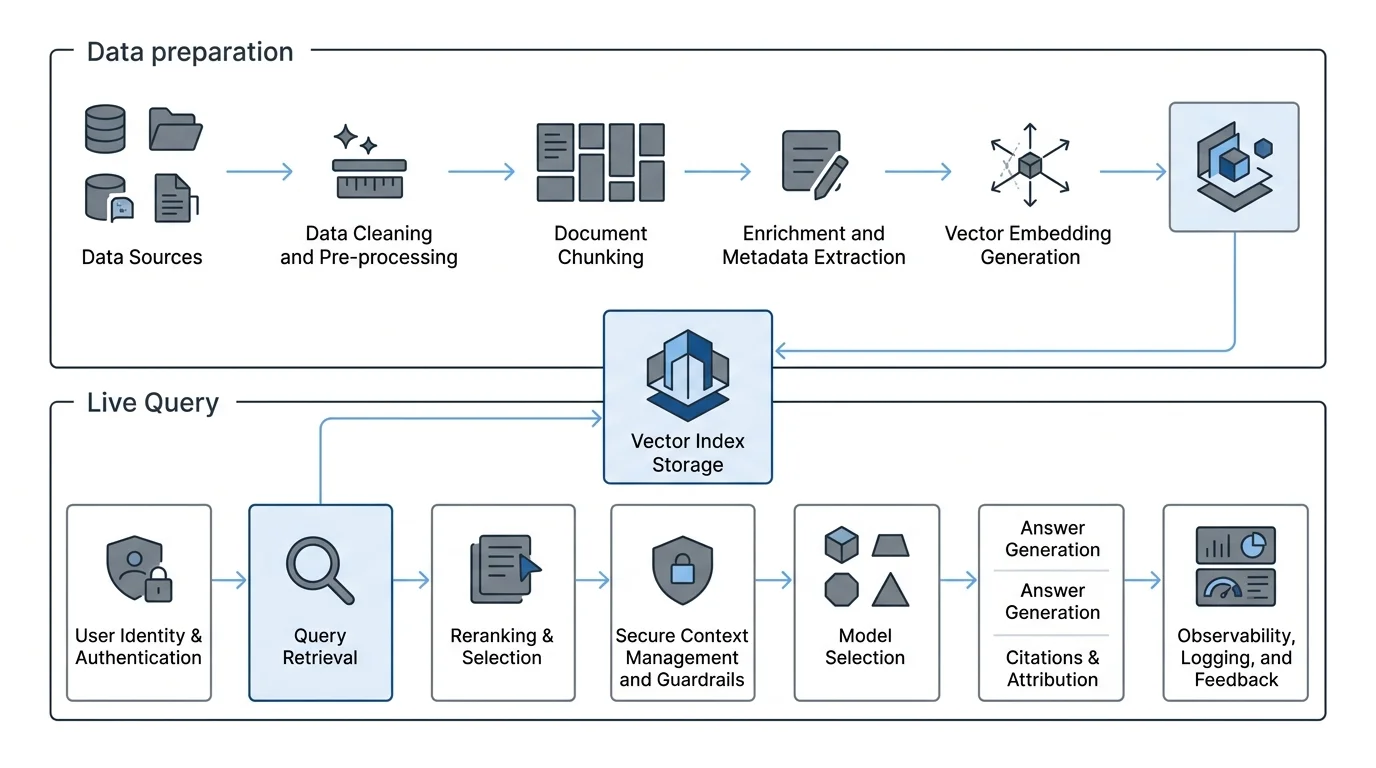
A production RAG system usually has two connected pipelines:
- The data pipeline that prepares knowledge for retrieval.
- The application pipeline that handles user queries and generates answers.
Microsoft’s architecture guide explains the RAG application flow, data pipeline, chunking, embedding, search index, and evaluation considerations (Microsoft Learn). Microsoft describes RAG as grounding LLM responses in proprietary content and highlights production challenges including query understanding, multi-source data, token constraints, response time, and security/governance (Microsoft Learn). AWS also recommends structured headings, clear numbering, preprocessing graphical information, session starters, and section summaries for RAG-ready documentation (AWS Documentation).
1. Data pipeline
The data pipeline prepares source material so it can be searched reliably.
Typical flow:
- Connect to source systems.
- Extract or sync documents, pages, records, or structured data.
- Clean the content.
- Remove duplicates, outdated material, and low-value noise.
- Split content into useful chunks.
- Add metadata such as title, owner, department, date, source URL, sensitivity level, and access permissions.
- Create embeddings for semantic retrieval.
- Store chunks and metadata in a search index, vector database, or hybrid retrieval system.
- Refresh the index when source documents change.
The most common mistake is treating ingestion as a one-time upload. In production, documents change, policies change, access rights change, and users quickly lose trust when the AI gives outdated answers.
2. Application pipeline
The application pipeline handles the live user request.
A strong enterprise RAG flow looks like this:
- User submits a question through an app, chat interface, workflow, or API.
- Identity and authorization are checked.
- Query intent is classified.
- The system decides which retrieval path to use.
- Search runs across approved data sources.
- Results are filtered by user permissions.
- Retrieved chunks are reranked and compressed.
- The system chooses the right model for the task.
- The model generates an answer using only approved context.
- The response includes citations where possible.
- Logs capture the request, retrieval path, model used, policy decisions, cost, latency, and feedback.
This is where RAG starts to overlap with AI control-plane design. Once multiple users, models, data sources, and workflows are involved, the company needs a governed layer around retrieval, context, routing, cost, and auditability.
The enterprise RAG control plane
The best way to think about production RAG is not “chatbot plus vector database.”
A better mental model is:
User intent + identity + policy + retrieval + model routing + secure context + evaluation + monitoring.
That means RAG needs controls at multiple points. Microsoft explains RAG’s retrieve-augment-generate flow, index types, hybrid search, citations, and agentic retrieval (Microsoft Learn).
| Layer | Question it answers |
|---|---|
| Identity | Who is asking? |
| Authorization | What are they allowed to retrieve? |
| Data classification | Which sources are public, internal, confidential, regulated, or restricted? |
| Retrieval strategy | Should the system use vector search, keyword search, hybrid search, graph retrieval, API lookup, or agentic retrieval? |
| Context assembly | Which chunks should be passed to the model, and how much context is enough? |
| Model routing | Which model is appropriate for this task based on cost, privacy, quality, and latency? |
| Guardrails | What should be blocked, redacted, escalated, or reviewed? |
| Evaluation | Did the system retrieve and answer correctly? |
| Observability | What happened, what did it cost, and where did it fail? |
This is the point where AgenixCore becomes relevant. AgenixCore is designed as a governed AI control plane between people, models, tools, and data sources. For RAG-heavy environments, the important idea is not just “connect to documents,” but “control how context is retrieved, routed, governed, and monitored.” RAG-heavy environments also benefit from a Managed AI Efficiency Layer to unify these controls.
Classic RAG vs agentic RAG vs other approaches
Not every enterprise AI use case should use the same retrieval pattern.
| Approach | Best for | Weakness |
|---|---|---|
| Classic RAG | Direct Q&A over known document collections | Can struggle with complex multi-step questions |
| Hybrid RAG | Enterprise documents where exact terms and semantic meaning both matter | Requires tuning of keyword, vector, and metadata ranking |
| Agentic RAG | Complex questions that need query planning, multiple searches, or tool use | Higher latency, more orchestration risk |
| Graph RAG | Relationship-heavy domains like contracts, policies, entities, systems, or compliance | Requires graph modeling effort |
| Long-context prompting | Smaller knowledge sets or one-off document analysis | Can become expensive and noisy at scale |
| Fine-tuning | Style, behavior, domain language, repeatable classification | Not ideal for constantly changing factual knowledge |
| Direct API/tool access | Transactional or real-time operational data | Requires stronger action controls and authorization |
| Private/on-prem RAG | Sensitive workflows, regulated data, data residency needs | More infrastructure and operations responsibility |
A practical enterprise architecture often combines these patterns.
For example, a support assistant may use hybrid RAG for documentation, API lookup for live order status, model routing for cost control, and human escalation for high-risk answers.
When RAG is the right answer
RAG is a strong fit when:
- Answers depend on company-specific documents.
- Knowledge changes frequently.
- Users need citations or source traceability.
- The same knowledge base supports many repeated queries.
- Fine-tuning would be too expensive or too slow to update.
- Teams need to reduce manual search across fragmented systems.
- The workflow benefits from natural-language access to policies, manuals, tickets, contracts, or reports.
Good examples include support knowledge bases, HR policies, sales enablement, compliance research, technical documentation, onboarding, internal search, and procurement review.
When RAG is not the right answer
RAG is not automatically the best architecture.
It may be the wrong path when:
- The source data is low-quality, outdated, or contradictory.
- The task requires live transactional action rather than document retrieval.
- The user needs deterministic calculations or database operations.
- The data is highly sensitive and cannot be exposed to the selected model path.
- The organization cannot maintain document freshness.
- The workflow has no clear adoption path.
- The company wants RAG to replace expert judgment in high-risk decisions.
RAG improves grounding, but it does not guarantee truth. If the retrieved source is wrong, outdated, unauthorized, or incomplete, the generated answer can still be wrong.
Enterprise RAG implementation roadmap
Step 1: Define the business workflow
Start with a narrow, valuable use case.
Bad starting point:
“Let’s connect all company documents to an AI assistant.”
Better starting point:
“Reduce time spent by support agents searching troubleshooting documentation for the top 20 recurring product issues.”
A good RAG use case has:
- Frequent questions.
- Trusted source material.
- Clear users.
- Clear success metrics.
- Manageable risk.
- A realistic review process.
- Enough volume to justify implementation.
Define the workflow before choosing tools.
Step 2: Classify workloads and data sensitivity
Not all RAG queries have the same risk.
A benefits-policy question is different from a legal-contract interpretation. A public product-documentation query is different from a customer-specific account query.
Classify workloads by:
- Business value.
- User group.
- Data sensitivity.
- Required accuracy.
- Latency expectations.
- Compliance constraints.
- Need for human review.
- Model path suitability.
This classification determines whether the workload can use hosted frontier models, cloud AI platforms, private models, on-prem infrastructure, or a hybrid route.
Step 3: Audit data sources
Before indexing anything, map the data landscape.
For each source, capture:
- Owner.
- System of record.
- Update frequency.
- Document type.
- Sensitivity level.
- Permission model.
- Format quality.
- Known duplication.
- Retention rules.
- Business importance.
This phase often reveals the real bottleneck: the company does not have an AI problem; it has a knowledge-governance problem.
Step 4: Design the retrieval strategy
Retrieval strategy determines what evidence reaches the model.
Common retrieval methods include:
- Keyword search for exact terms, SKUs, codes, policy IDs, and names.
- Vector search for semantic similarity.
- Hybrid search for combined keyword and semantic retrieval.
- Metadata filtering for department, product, date, region, user role, or sensitivity.
- Reranking to improve the ordering of candidate chunks.
- Query rewriting to turn vague questions into better searches.
- Multi-query retrieval for complex questions.
- Graph retrieval for relationship-heavy knowledge.
Enterprise systems should rarely depend on raw vector search alone. Hybrid retrieval with metadata and permission filters is usually more reliable for business use.
Step 5: Build permission-aware retrieval
This is one of the most important differences between prototype RAG and enterprise RAG.
A RAG system should not retrieve the most relevant document if the user is not authorized to see it.
Permission-aware retrieval requires:
- User identity from SSO or IAM.
- Role-based, attribute-based, or relationship-based access logic.
- Document-level or chunk-level permissions.
- Sensitivity labels.
- Retrieval-time filtering.
- Audit logs for retrieved sources.
- Data redaction for sensitive fields.
- Tests that attempt unauthorized retrieval.
Do not rely only on the model to “decide” what should be disclosed. Security should be enforced before sensitive context reaches the model.
Step 6: Choose the model path
RAG does not require one model for every query.
A production system may route different tasks to different models:
| Query type | Possible model path |
|---|---|
| Simple policy lookup | Smaller or cheaper model |
| Complex legal synthesis | Higher-reasoning frontier model with human review |
| Sensitive HR data | Private model or restricted deployment path |
| Customer support draft | Frontier or mid-tier model with source citations |
| Batch summarization | Cost-optimized model |
| Regulated workflow | Private or controlled environment with audit logging |
Model routing matters because RAG can become expensive if every request sends large context windows to the most expensive model. Performing a structured Model Benchmarking Assessment helps select the most cost-effective model path. The right model is the one that meets the workload’s quality, privacy, latency, and cost requirements — not automatically the most powerful one.
Step 7: Design context assembly
Context quality matters more than context quantity.
A weak RAG system dumps too many chunks into the prompt and hopes the model figures it out.
A stronger system decides:
- Which chunks are relevant enough.
- Which chunks should be excluded.
- Whether chunks should be compressed.
- Whether citations are required.
- Whether conflicting sources need escalation.
- Whether the model should refuse when evidence is weak.
- Whether structured data should be retrieved through an API instead of text chunks.
Good context assembly reduces hallucination risk, lowers token cost, improves latency, and makes answers easier to verify.
Step 8: Evaluate before production
RAG should be tested with representative questions before rollout. Ragas provides RAG evaluation metrics including context precision, context recall, response relevancy, and faithfulness (Ragas). NIST AI RMF provides a risk-management framework for AI risks to individuals, organizations, and society (NIST) to guide deployment safety.
Evaluation should include:
| Metric | What it measures |
|---|---|
| Context precision | Whether the top retrieved chunks are relevant |
| Context recall | Whether the system retrieved enough of the required evidence |
| Faithfulness | Whether the answer is supported by retrieved context |
| Answer relevance | Whether the answer actually addresses the user’s question |
| Citation accuracy | Whether cited sources support the answer |
| Refusal quality | Whether the system refuses when evidence is insufficient |
| Access-control accuracy | Whether unauthorized content is blocked |
| Latency | Whether response time is acceptable |
| Cost per successful answer | Whether the workflow is economically viable |
| User satisfaction | Whether people trust and reuse the system |
A RAG system can appear impressive in demos and still fail production evaluation. Testing must include vague questions, incomplete questions, adversarial prompts, conflicting documents, outdated documents, permission boundaries, and multi-turn follow-ups.
Step 9: Launch as a controlled pilot
Do not begin with the whole company.
A good pilot has:
- One or two business workflows.
- A defined user group.
- Clear source systems.
- Measurable baseline.
- Human feedback loop.
- Error-reporting path.
- Usage monitoring.
- Weekly review.
- Go/no-go criteria.
Pilot success should not be measured only by “the chatbot works.” Measure whether the system improves the actual workflow.
Examples:
- Did support agents resolve issues faster?
- Did employees find policy answers without opening tickets?
- Did compliance teams reduce manual search time?
- Did the system avoid unauthorized retrieval?
- Did users trust the citations?
- Did costs stay within expected range?
Step 10: Operate RAG continuously
RAG does not end at launch.
After deployment, teams need to monitor:
- Retrieval failures.
- Low-confidence answers.
- Citation gaps.
- Latency spikes.
- Cost increases.
- Model changes.
- Embedding model changes.
- Stale documents.
- Permission changes.
- Sensitive-data exposure attempts.
- User adoption.
- Escalation patterns.
- Feedback trends.
This is where many companies underinvest. RAG quality decays when documents change, permissions drift, source systems evolve, or model behavior changes. Production RAG needs Managed AI Operations to continuously evaluate and improve RAG performance.
RAG security checklist
Enterprise RAG security should be designed before the first pilot, not added later. OWASP defines prompt injection as manipulating model responses through inputs that alter behavior or bypass safeguards (OWASP Gen AI Security Project). Furthermore, OWASP warns that failure to protect against sensitive information disclosure in LLM outputs can create legal and competitive risks (OWASP Foundation). Finally, OWASP identifies vector and embedding weaknesses as specific risks for RAG systems, including harmful content injection and sensitive-information access (OWASP Gen AI Security Project).
Use this checklist:
- Enforce identity before retrieval.
- Apply permissions before context reaches the model.
- Store document ownership and sensitivity metadata.
- Filter retrieved chunks by user access.
- Redact sensitive data when required.
- Log retrieved source IDs.
- Separate trusted and untrusted content.
- Defend against prompt injection.
- Validate outputs before downstream use.
- Avoid giving the model unnecessary agency.
- Monitor for unusual queries and data access patterns.
- Test against unauthorized retrieval attempts.
- Keep human review for high-risk workflows.
RAG systems are especially sensitive because they combine user prompts, enterprise documents, model generation, and sometimes tool access. That makes security a system-design issue, not just a prompt-engineering issue.

RAG cost drivers
RAG cost is shaped by more than model pricing.
Important cost drivers include:
- Number of queries.
- Average retrieved context size.
- Embedding volume.
- Re-indexing frequency.
- Vector database or search infrastructure.
- Reranking model usage.
- Model selected for generation.
- Input and output token volume.
- Caching strategy.
- Latency requirements.
- Monitoring and evaluation.
- Human review time.
- Operational support.
Cost optimization usually comes from several small decisions:
- Route simple queries to cheaper models.
- Reduce unnecessary context.
- Cache repeated answers where safe.
- Use hybrid retrieval to improve precision.
- Avoid full re-indexing when incremental updates are enough.
- Compress context before generation.
- Monitor cost per successful answer, not just cost per API call.
The goal is not to make every query cheap. The goal is to spend the right amount for the required quality, privacy, and business value.
RAG evaluation framework for enterprise teams
A practical enterprise evaluation set should include at least six test categories:
1. Known-answer questions
Questions where the correct answer is clearly present in source documents.
Purpose: test retrieval accuracy and answer faithfulness.
2. Multi-document questions
Questions that require combining evidence from multiple documents.
Purpose: test retrieval coverage, synthesis, and citation quality.
3. Permission-boundary questions
Questions where different users should receive different answers.
Purpose: test authorization and secure context assembly.
4. Out-of-scope questions
Questions the system should refuse or redirect.
Purpose: test refusal behavior and scope discipline.
5. Conflicting-source questions
Questions where documents disagree.
Purpose: test escalation, source recency, and uncertainty handling.
6. Adversarial questions
Questions containing prompt injection, hidden instructions, or attempts to expose sensitive data.
Purpose: test security controls.
The best RAG systems are not the ones that answer every question. They are the ones that answer grounded questions well, refuse when evidence is weak, and escalate when the risk is too high.
What most RAG guides miss
Many RAG implementation guides focus on the pipeline:
Documents → chunks → embeddings → vector database → LLM → answer.
That is useful, but incomplete.
Enterprise teams also need to answer:
- Who owns each data source?
- Who approves which knowledge enters the system?
- How are permissions enforced?
- What happens when documents conflict?
- Which model should handle which workload?
- Which workflows need private deployment?
- How will cost be monitored?
- How will model changes be reviewed?
- What happens when retrieval quality drops?
- Who is accountable for ongoing improvement?
These are operating questions. Without them, RAG remains a pilot.
Where AgenixCore fits
AgenixCore is relevant when enterprise RAG becomes more than one isolated application.
If a company has multiple teams using AI across documents, tools, models, and data sources, it needs a governed layer for:
- Access governance.
- Model routing.
- Secure context assembly.
- RAG and search controls.
- Data connector governance.
- PII detection.
- Cost controls.
- Token management.
- Audit logs.
- Policy decisions.
- Operational visibility.
In a RAG environment, AgenixCore should not be positioned as “another chatbot.” It should be positioned as the AI control plane around RAG workflows — the layer that decides who can retrieve what, which model should answer, how context is assembled, how cost is controlled, and how every interaction is logged.
How AgenixHub helps with enterprise RAG implementation
AgenixHub helps teams move from RAG experiments to managed AI operations.
The work usually starts with an AI Operating Efficiency Audit:
- Map current AI usage.
- Identify high-value RAG workflows.
- Review data sources and permission boundaries.
- Classify workloads by sensitivity and value.
- Identify model-routing opportunities.
- Assess prompt and context efficiency.
- Define pilot success metrics.
- Find operational risks before scaling.
From there, AgenixHub can help design and operate the Managed AI Efficiency Layer around RAG:
- Retrieval architecture.
- Data-source governance.
- Secure context handling.
- Model benchmarking.
- Model routing.
- Cost monitoring.
- Evaluation workflows.
- Human review paths.
- Production AI operations supported by Managed AI Operations.
The goal is not to force every workflow into RAG. The goal is to decide where RAG is useful, where another architecture is better, and how to operate the selected path safely and efficiently. Compare different options in our guide on Custom AI vs Off-the-Shelf AI or explore the Ultimate Guide to AI Platforms.
Enterprise RAG implementation checklist
Before scaling RAG, review this checklist:
- The business workflow is clearly defined.
- Source systems are mapped.
- Data owners are identified.
- Documents are clean enough for retrieval.
- Chunking strategy is tested.
- Metadata strategy is defined.
- Permissions are enforced before generation.
- Retrieval method is selected and tested.
- Model path is chosen by workload, not habit.
- Context size is controlled.
- Citations are available where needed.
- Evaluation set includes real user questions.
- Security tests include prompt injection and unauthorized retrieval.
- Costs are monitored per successful answer.
- Feedback loop is in place.
- Operations owner is assigned.
- Review cadence is defined.
If these items are missing, the RAG system may still work in a demo — but it will be fragile in production.
FAQ
What is enterprise RAG implementation?
Enterprise RAG implementation is the process of building a retrieval-augmented generation system that connects AI models to trusted company knowledge while enforcing permissions, citations, security controls, evaluation, cost visibility, and operational monitoring.
How is enterprise RAG different from a normal chatbot?
A normal chatbot may answer from model memory or a small document upload. Enterprise RAG retrieves approved information from company systems, applies access controls, uses that content as grounding context, and logs the retrieval and response process for review.
Does RAG eliminate hallucinations?
No. RAG reduces the risk of unsupported answers by grounding responses in retrieved context, but it does not guarantee correctness. The answer still depends on document quality, retrieval accuracy, prompt design, model behavior, and evaluation controls.
What are the main components of an enterprise RAG system?
Core components include source connectors, ingestion pipeline, chunking, metadata enrichment, embeddings, search index or vector database, retriever, reranker, context assembly layer, language model, permission filters, citation layer, observability, and audit logs.
Should enterprises use vector search or hybrid search for RAG?
Hybrid search is often stronger for enterprise use because it combines semantic similarity with exact keyword and metadata filtering. Vector search is useful, but business documents often require exact terms, product codes, policy names, dates, and permission filters.
What is agentic RAG?
Agentic RAG uses an AI agent or orchestrator to plan retrieval, break complex questions into subqueries, choose tools or sources, and assemble evidence across multiple steps. It can be powerful for complex workflows but requires stronger security, monitoring, and cost controls.
How do you measure RAG quality?
Measure retrieval quality, generation quality, and operating quality. Useful metrics include context precision, context recall, faithfulness, answer relevance, citation accuracy, latency, cost per successful answer, refusal quality, user satisfaction, and access-control accuracy.
When should a company use private or on-prem RAG?
Private or on-prem RAG is worth evaluating when the workflow involves sensitive data, strict compliance requirements, data residency constraints, proprietary knowledge, or internal policies that prevent sending context to external model APIs. It may add operational complexity, so it should be tested against real workload requirements.
Conclusion
Enterprise RAG is one of the most practical ways to bring AI into company workflows, but only when it is implemented as more than a search layer.
The real work is not just choosing a vector database or connecting an LLM to documents. The real work is building a governed system that understands user permissions, retrieves the right evidence, controls context, routes to the right model, tracks cost, evaluates quality, and improves after launch.
That is the difference between a RAG demo and a RAG operating layer.
If your team is planning enterprise RAG, start by mapping the workflow, data sources, permissions, model paths, cost drivers, and operational risks. AgenixHub’s AI Operating Efficiency Audit is designed for exactly that first step — identifying where RAG can create value, where it can create risk, and what operating layer is needed before scaling.
Recommended Follow-Up
- Operating Audit: Learn how an AI Operating Efficiency Audit maps workflow inefficiencies.
- Operations Guide: Explore how Managed AI Operations ensures safety and compliance.
- Capabilities Map: Review our AI Capabilities to understand modular integration patterns.
- ROI Tool: Use our AI ROI Calculator to model your integration savings.
- ROI Blog: Read our Enterprise AI ROI Calculation guide to map the implementation gap.
- Custom vs Off-the-Shelf: Compare paths in Custom AI vs Off-the-Shelf AI.
- AI Platforms: Explore the Ultimate Guide to AI Platforms.