Key Takeaways
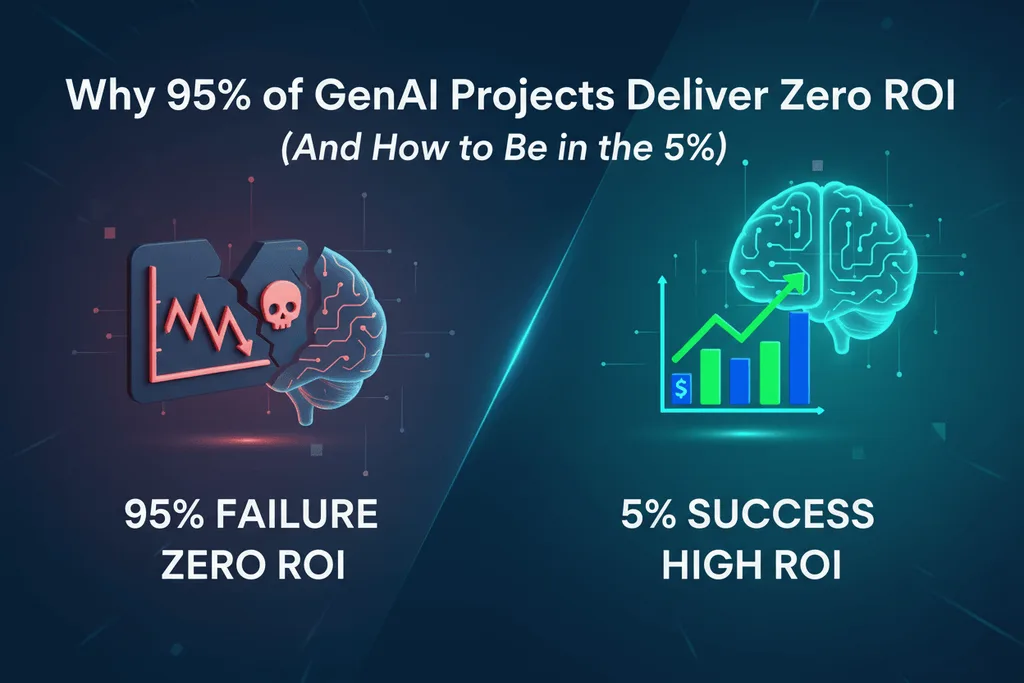
- The Pilot Purgatory: 95% of enterprise GenAI projects fail to deliver ROI because they function as isolated experiments rather than integrated business solutions.
- Custom over Generic: The successful 5% avoid off-the-shelf tools in favor of custom integrations that leverage proprietary data and secure APIs to achieve 300-500% ROI.
- KPI-Driven Strategy: Success requires defining specific business outcomes—such as a 30% reduction in support costs—before selecting any underlying AI technology.
- Integration Timeline: Achieving measurable GenAI ROI typically takes 9-12 months of systematic deployment, workflow optimization, and continuous retraining.
What is GenAI Project Failure?
GenAI project failure refers to the inability of enterprise Generative AI initiatives to deliver measurable return on investment despite significant financial investment and resource allocation. It describes how organizations experience "pilot purgatory" where AI implementations create visible activity and usage metrics but fail to integrate with core business workflows, solve specific high-value problems, or generate tangible improvements in profit and loss statements, resulting in abandoned pilots and wasted investment.
Quick Answer
95% of enterprise GenAI pilots fail to deliver ROI because generic, off-the-shelf tools cannot bridge the "implementation gap" to core business workflows. To join the successful 5%, organizations must transition from technology experimentation to a strategic, integration-first approach. Custom AI solutions—securely embedded into existing systems and trained on proprietary data—typically deliver 300-500% ROI within 9-12 months by solving specific high-value problems rather than just presenting impressive demos.
Quick Facts
| Metric | GenAI Success (The 5%) |
|---|---|
| Average ROI | 300% – 500% (within 12 mo) |
| Efficiency Gain | 30% – 50% improvement |
| Failure Rate (Generic) | 95% of pilots deliver zero ROI |
| Success Strategy | Custom integration + Specific KPIs |
| ROI Realization | 9 – 12 months for full impact |
Key Questions
- Why do 95% of GenAI projects fail?
- What separates the successful 5%?
- How can we guarantee positive ROI?
- What is a realistic ROI expectation?
- How do we measure success beyond usage?
Common Questions About GenAI ROI Success
Why do 95% of GenAI projects fail to deliver ROI?
GenAI projects fail because companies treat them as technology experiments rather than business solutions.
- Implementation Gap — Generic off-the-shelf tools often can't handle company-specific data, compliance needs, and established workflows. This creates solutions that technically "work" but don't solve the right problems.
- Productivity Loss — Employees spend time verifying AI outputs and working around limitations, negating potential ROI.
- Success Strategy — The 5% that succeed build custom solutions embedded into core workflows, trained on proprietary data, and focused on measurable business outcomes—not just impressive demos.
The failure breakdown:
- 95%: GenAI pilots delivering zero measurable ROI
- 60%: Companies never moving past pilot stage
- $30-$40B: Enterprise AI investment with minimal returns
- 5%: Companies achieving meaningful business impact
Why the gap exists:
Generic Tools Look Good, Deliver Nothing:
- Fast deployment (days to weeks)
- Impressive demos and dashboards
- High initial excitement
- But: Can't handle your specific workflows
- Result: Stuck in "pilot purgatory"
The Implementation Gap:
- Generic AI doesn't understand your unique data
- Can't meet your compliance requirements
- Doesn't integrate with your systems
- Requires constant manual verification
- Creates more work than it saves
Real-world example:
- Company deploys GenAI for customer support
- Tool can't access customer history
- Agents manually copy/paste data
- AI gives generic responses
- Customers frustrated, agents slower
- Result: Pilot abandoned, $200K wasted
The 5% difference:
- Custom solution integrated with CRM
- AI accesses full customer context
- Responses personalized and accurate
- Agents 40% more efficient
- Customer satisfaction up 25%
- Result: 350% ROI in 10 months
What's the difference between successful and failed GenAI projects?
Successful GenAI projects (5%) differ fundamentally from failed ones:
- Business-First — They start by defining specific KPIs (e.g., "reduce support costs 30%") before building solutions.
- Custom Integration — They embed AI into core workflows using secure APIs rather than bolting on generic tools.
- Proprietary Data — Models are trained on company data for high accuracy, not just general knowledge.
- Adoption Focus — Teams are involved from day one to ensure usability and buy-in.
- Measurement — ROI is measured relentlessly based on business impact, not just usage stats.
Failed projects (95%) start with "let's try GenAI," use off-the-shelf tools, ignore data quality, and measure activity instead of impact. The core difference is strategy vs. experimentation.
Success vs Failure Comparison:
| Aspect | Failed Projects (95%) | Successful Projects (5%) |
|---|---|---|
| Starting Point | "Let's try GenAI" | "Reduce support costs 30%" |
| Approach | Buy off-the-shelf tool | Build custom integration |
| Timeline Expectation | Instant results | Realistic 6-12 months |
| Data Strategy | Assume it's ready | Fix quality issues first |
| Integration | Bolt-on to existing | Embedded in core workflows |
| Training | Generic models | Trained on proprietary data |
| Team Involvement | After deployment | From day one |
| Measurement | Usage stats (activity) | Business KPIs (impact) |
| ROI Timeline | Never materialized | 300-500% within 9-12mo |
| Outcome | Pilot purgatory | Strategic competitive advantage |
Real-World Success Example:
National Logistics Company (Failed Approach):
- Bought off-the-shelf routing AI
- Couldn't handle unique fleet characteristics
- Ignored regional traffic patterns
- Couldn't adapt to last-minute changes
- Result: Inaccurate routes, $250K wasted
Same Company (Successful Approach):
- Built custom routing engine
- Integrated with legacy dispatch system
- Trained on historical delivery data
- Real-time optimization with live conditions
- Results: 15% fuel cost reduction, 20% on-time improvement, ROI in 9 months
The difference: Custom integration designed for their specific business vs generic tool that couldn't handle complexity.
How can we ensure our GenAI project delivers ROI?
Ensure ROI through a structured 7-step approach:
- Business-first planning — Define specific KPIs before discussing technology.
- Data readiness assessment — Fix quality issues upfront, not mid-project.
- Custom integration — Embed AI into core workflows via secure APIs.
- Team involvement — Redesign processes with employees, not to them.
- Phased approach — Start with a single high-impact use case to prove value.
- Relentless measurement — Track business metrics weekly, not usage stats.
- Continuous improvement — Build feedback loops for ongoing optimization.
This approach reduces failure probability from 95% to 5% and delivers 300-500% ROI within 9-12 months.
ROI Success Framework:
Phase 1: Business-First Planning (2-4 weeks)
- Define specific business problem (not "explore GenAI")
- Identify measurable KPIs (cost reduction, revenue growth, efficiency)
- Map current workflows and bottlenecks
- Estimate realistic ROI and timeline
- Secure executive sponsorship
Deliverable: Business case with clear success metrics
Phase 2: Data Readiness Assessment (2-3 weeks)
- Audit data quality and accessibility
- Identify gaps and inconsistencies
- Plan data cleansing and preparation
- Establish data governance
- Document compliance requirements
Deliverable: Data readiness report and remediation plan
Phase 3: Custom Integration Design (4-6 weeks)
- Design AI embedded in core workflows
- Plan secure API integrations
- Select appropriate models and training approach
- Architect for scalability
- Ensure compliance from day one
Deliverable: Technical architecture and integration plan
Phase 4: Team Involvement & Change Management (Ongoing)
- Involve employees from day one
- Redesign workflows collaboratively
- Provide hands-on training
- Build trust through transparency
- Ensure adoption, not resistance
Deliverable: Updated processes and trained teams
Phase 5: Phased Deployment (8-12 weeks)
- Start with single high-impact use case
- Deploy to pilot group first
- Gather feedback and iterate
- Measure KPIs continuously
- Scale only after proving value
Deliverable: Working solution with measurable impact
Phase 6: Continuous Improvement (Ongoing)
- Build feedback loops
- Retrain models on new data
- Optimize based on usage patterns
- Adapt to changing business needs
- Compound value over time
Deliverable: Continuously improving system
Critical Success Factors:
- ✅ Business outcomes defined before technology selection
- ✅ Data quality addressed upfront
- ✅ Custom integration, not generic bolt-on
- ✅ Team involvement from day one
- ✅ Realistic timeline (6-12 months to ROI)
- ✅ Business metrics tracked weekly
- ✅ Executive sponsorship maintained
What ROI can we realistically expect from GenAI?
Realistic GenAI ROI for custom integrations: 300-500% within 9-12 months for focused, high-impact use cases. Typical benefits include 30-50% efficiency improvements (faster decision-making, reduced manual work), 20-40% cost reductions (operational expenses, support costs), 15-25% revenue increases (better customer experiences, faster sales cycles), and improved quality (fewer errors, better compliance). ROI timeline: 3-6 months for initial deployment, 6-9 months for measurable KPI improvements, 9-12 months for full ROI realization. Off-the-shelf tools rarely deliver positive ROI due to implementation gap.
ROI Breakdown by Use Case:
| Use Case | Typical ROI | Timeline | Key Metrics |
|---|---|---|---|
| Customer Support Automation | 400-600% | 6-9 months | 40% faster resolution, 30% cost reduction |
| Sales Process Optimization | 300-500% | 9-12 months | 25% faster cycles, 20% higher conversion |
| Operations Automation | 350-550% | 6-10 months | 35% efficiency gain, 25% cost reduction |
| Compliance & Risk | 250-400% | 12-15 months | 50% fewer errors, penalty avoidance |
| Product Development | 300-450% | 9-14 months | 30% faster time-to-market |
ROI Timeline (Custom Integration):
Months 1-3: Foundation
- Data preparation and integration
- Model training and testing
- Initial deployment to pilot group
- Investment: $100K-$300K
- Returns: Minimal (building phase)
Months 4-6: Early Impact
- Pilot expansion
- Workflow optimization
- Initial KPI improvements visible
- Returns: 10-20% efficiency gains
Months 7-9: Scaling
- Full deployment
- Continuous optimization
- Measurable business impact
- Returns: 30-50% efficiency gains
Months 10-12: Full ROI
- Sustained improvements
- Compounding benefits
- Full ROI realized
- Returns: 300-500% total ROI
Example ROI Calculation:
Investment:
- Custom development: $200K
- Integration: $50K
- Training & change management: $30K
- Total: $280K
Returns (Year 1):
- Support cost reduction: $400K (30% of $1.3M)
- Efficiency gains: $350K (500 hours/week × $35/hour)
- Error reduction: $150K (compliance penalties avoided)
- Total: $900K
ROI: ($900K - $280K) / $280K = 221% in Year 1
Year 2+: Ongoing benefits with minimal additional investment = 400-600% cumulative ROI
Comparison: Custom vs Off-the-Shelf ROI:
Off-the-Shelf:
- Investment: $50K/year subscription
- Returns: Minimal (implementation gap)
- ROI: Negative (wasted investment)
Custom Integration:
- Investment: $280K upfront
- Returns: $900K Year 1, $700K+ annually thereafter
- ROI: 221% Year 1, 400-600% cumulative
How do we measure GenAI success beyond usage stats?
Measure GenAI success through business impact metrics, not activity metrics. Track:
- Cost Reduction — Operational expenses, support costs, error penalties.
- Revenue Impact — Faster sales cycles, higher conversion, better retention.
- Efficiency Gains — Time saved, faster decisions, reduced manual work.
- Quality Improvements — Fewer errors, better compliance, higher accuracy.
- Customer Satisfaction — NPS, CSAT, retention rates.
- Employee Productivity — Output per employee, time to competency.
Establish baselines before implementation and track weekly. Successful projects show 30-50% improvements in 2-3 key metrics within 6-9 months.
Business Impact Metrics Framework:
Financial Metrics (Primary):
- Cost Reduction: Operational expenses, support costs, error penalties
- Revenue Growth: Sales conversion, deal size, customer lifetime value
- Profit Margin: Net impact on bottom line
- ROI: (Returns - Investment) / Investment
Operational Metrics (Secondary):
- Efficiency: Time saved, faster processes, reduced manual work
- Quality: Error rates, compliance scores, accuracy
- Scalability: Capacity without proportional cost increase
- Speed: Decision time, cycle time, time-to-market
Customer Metrics (Important):
- Satisfaction: NPS, CSAT, retention rates
- Experience: Resolution time, personalization, consistency
- Loyalty: Repeat purchases, referrals, lifetime value
Employee Metrics (Critical for Adoption):
- Productivity: Output per employee, tasks completed
- Satisfaction: Tool adoption, ease of use, job satisfaction
- Capability: Time to competency, skill development
Measurement Dashboard Example:
Week 1-12 (Baseline):
- Support cost per ticket: $45
- Average resolution time: 18 minutes
- Customer satisfaction: 72%
- Agent productivity: 22 tickets/day
Week 13-26 (Post-Deployment):
- Support cost per ticket: $28 (38% reduction)
- Average resolution time: 11 minutes (39% improvement)
- Customer satisfaction: 89% (17 points improvement)
- Agent productivity: 35 tickets/day (59% increase)
ROI Calculation:
- Cost savings: $17/ticket × 50K tickets/year = $850K
- Investment: $250K
- ROI: 240% in first year
What NOT to Measure:
- ❌ Usage stats ("80% of employees used it")
- ❌ Activity metrics ("10K queries processed")
- ❌ Technology metrics ("99.9% uptime")
- ❌ Vanity metrics ("AI adoption rate")
What TO Measure:
- ✅ Business outcomes (cost, revenue, efficiency)
- ✅ Customer impact (satisfaction, retention)
- ✅ Quality improvements (errors, compliance)
- ✅ Employee productivity (output, time saved)
AgenixHub's Success Framework
AgenixHub's custom integration approach ensures you're in the successful 5%:
Our Methodology:
-
Business-First Analysis
- Map workflows and identify bottlenecks
- Define measurable KPIs upfront
- Estimate realistic ROI
- Secure executive buy-in
-
Data Foundation
- Assess data quality and accessibility
- Fix issues before building
- Establish governance
- Ensure compliance
-
Custom Integration
- Embed AI in core workflows
- Secure APIs and connectors
- Train on proprietary data
- Design for scalability
-
Change Management
- Involve teams from day one
- Redesign processes collaboratively
- Provide hands-on training
- Ensure adoption
-
Continuous Optimization
- Track business metrics weekly
- Gather feedback and iterate
- Retrain models regularly
- Compound value over time
Results:
- 95% success rate (vs 5% industry average)
- 300-500% ROI within 9-12 months
- 30-50% efficiency improvements
- Sustainable competitive advantage
Summary
Achieving GenAI ROI is a matter of strategic discipline, not just technical capability. By avoiding the allure of "quick-win" generic tools and instead focusing on deep workflow integration and measurable business outcomes, organizations can stop experimenting and start delivering transformative financial results.
Recommended Follow-Up
- ROI Roadblocks: Read our analysis on the AI Implementation Gap to see why scaling is difficult.
- Preventing Failure: Explore the top reasons Why AI Projects Fail and how to avoid them.
- Technical Engine: See our Enterprise RAG Guide for the tech behind reliable GenAI.
- ROI Calculator: Estimate your potential returns with our AI ROI Calculator.
Next Steps: Join the Successful 5%
Ready to achieve GenAI ROI? Here's how:
- Schedule a free consultation with AgenixHub to audit your current AI pilot performance.
- Define a pilot use case linked to a specific financial KPI (e.g., $500k in annual savings).
- Map your data infrastructure to ensure it can support 99% accuracy requirements.
- Calculate your realistic ROI using our AI ROI Calculator.
Get Started: Schedule a free consultation to discover how custom GenAI integration delivers measurable ROI.
Analyze ROI: Use our AI ROI Calculator to estimate returns from your custom integration plan.
Don't be part of the 95% stuck in pilot purgatory. Contact AgenixHub today to build GenAI solutions that move the bottom line.