
AI adoption is no longer the hard part. Most enterprises now have people using copilots, chatbots, coding assistants, AI search, meeting summarizers, document tools, and embedded AI features across SaaS products.
The harder question is now coming from the CFO, CIO, CTO, and board:
What did all of this AI usage actually return?
That question is uncomfortable because many companies can show adoption, but not operating impact. They can show licenses purchased, prompts submitted, meetings summarized, code generated, and teams experimenting. But they often struggle to show reduced cost per workflow, faster cycle time, higher decision quality, lower risk, or measurable revenue impact.
That is the enterprise AI implementation gap.
It is not a gap between companies that use AI and companies that do not. It is the gap between AI activity and AI operating value.
Quick answer: how do you calculate enterprise AI ROI?
Enterprise AI ROI is calculated by comparing the measurable value created by AI against the full cost of implementing, integrating, governing, and operating it.
A practical formula is:
Enterprise AI ROI = (AI value created - total AI operating cost) / total AI operating cost
But the formula only works if the inputs are honest. Enterprises need to count not just tool subscriptions and API costs, but also integration work, review time, workflow redesign, data preparation, governance, risk controls, training, monitoring, and ongoing optimization.
The better question is not “What is our AI ROI?” The better question is:
Which AI workloads are creating measurable value, which are creating invisible waste, and which need a better operating model?
Estimate your AI ROI with the AI ROI Calculator, then validate it with an AI Operating Efficiency Audit.
Why enterprise AI ROI is hard to prove
AI ROI is difficult because AI is rarely deployed as a single isolated system with clean before-and-after numbers.
A support chatbot may reduce repetitive questions, but it may also increase review work if answers are unreliable. A coding assistant may speed up code generation, but the actual ROI depends on review time, defect rates, release speed, architecture quality, and developer adoption. A document assistant may save time, but if employees use it mainly for low-value summaries, the savings may never reach the P&L.
AI value often appears across several layers:
- time saved,
- capacity created,
- quality improved,
- risk reduced,
- errors avoided,
- revenue accelerated,
- customer experience improved,
- decision speed increased,
- employee experience improved.
The problem is that most organizations measure the easiest layer: usage.
Usage is not ROI.
A team can have high AI adoption and low AI value if the wrong tasks are automated, the wrong models are used, prompts are oversized, retrieval is poor, privacy rules are unclear, outputs require heavy correction, or AI sits outside the workflow where value is created.
That is why enterprise AI ROI needs to be measured at the workload level.
The AI implementation gap: adoption is high, operating value is uneven
Enterprise AI adoption has moved quickly. But value realization has not moved at the same speed. AI adoption is widespread, but ROI, scale, and payback are harder to prove than usage. McKinsey reports 88% of surveyed organizations use AI in at least one business function (McKinsey — State of AI 2025), while Deloitte reports only 6% of surveyed organizations saw AI payback in under a year, with most typical AI use cases taking two to four years to realize satisfactory ROI (Deloitte — AI ROI paradox). Furthermore, IBM reports that only around 25% of AI initiatives deliver their expected ROI, and only 16% are scaled enterprise-wide (IBM — How to maximize AI ROI).
The implementation gap shows up when AI is present everywhere but operating discipline is missing. Teams use different tools. Costs spread across departments. Sensitive data rules vary by team. Leaders cannot see which use cases are valuable. Models are selected by convenience instead of workload fit. RAG systems are added without strong retrieval evaluation. Frontier models are used for routine work where cheaper paths would be enough.
This creates a strange situation: the company looks advanced from the outside, but internally AI remains fragmented.
Common symptoms include:
- AI spend is rising, but nobody can explain cost per workflow.
- Teams report productivity gains, but finance cannot validate them.
- Employees use AI daily, but core cycle times do not improve.
- The company has many AI tools, but no shared routing or governance layer.
- Leaders cannot tell which workflows should use frontier models, private models, RAG, agents, or no AI at all.
- AI pilots work in demos but fail when connected to real systems, users, permissions, and review paths.
The implementation gap is not usually caused by weak model capability. It is usually caused by weak operating design. Performing a thorough AI Operating Efficiency Audit helps identify these routing and cost leaks.
The real enterprise AI ROI formula
Most ROI formulas are too simple for enterprise AI.
A basic formula looks like this:
ROI = (Benefit - Cost) / Cost
That is fine as a starting point. But for AI, both sides need more detail. This requires modeling both visible tool expenses and the hidden realities of AI adoption, such as workflow changes and quality drift (Google Cloud — business value of generative AI).
A better enterprise AI ROI model is:
Net AI value = hard savings + revenue impact + capacity created + risk reduction + quality improvement - total AI operating cost
Then:
Enterprise AI ROI = net AI value / total AI operating cost
The important phrase is total AI operating cost.
AI cost is not only the price of the model or subscription.
It includes:
| Cost category | What to include |
|---|---|
| Tool and model cost | SaaS licenses, API calls, token usage, model hosting, inference cost |
| Integration cost | APIs, connectors, workflow changes, data pipelines, identity and access setup |
| Data and context cost | document preparation, cleaning, chunking, embeddings, retrieval, prompt/context size |
| Human review cost | validation, escalation, approvals, corrections, compliance review |
| Governance cost | access control, audit logs, policy design, data handling rules, security reviews |
| Adoption cost | training, workflow redesign, change management, internal support |
| Monitoring cost | quality checks, hallucination tracking, latency monitoring, spend observability |
| Failure cost | incorrect outputs, rework, customer escalations, abandoned pilots, duplicated tools |
This is why AI ROI often looks better in a demo than it does in production. The demo usually counts only model capability. Production exposes the operating cost.
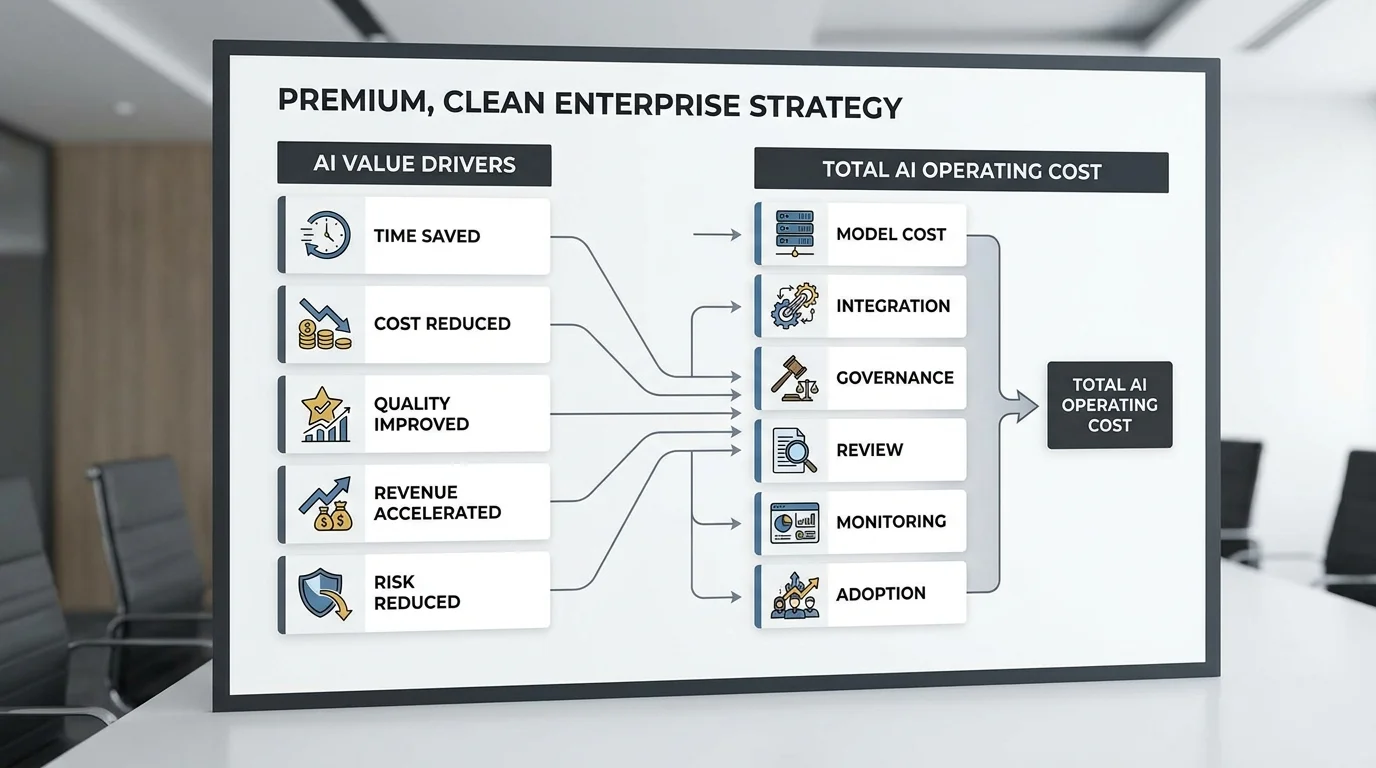
The five value drivers that should be measured
Enterprise AI ROI should not be measured with one metric. It should be measured with a scorecard that matches your organization's maturity stage (Atlassian — Enterprise AI ROI framework).
1. Time saved
This is the most obvious AI value driver.
Examples:
- analysts summarize reports faster,
- support teams draft replies faster,
- developers write boilerplate faster,
- legal teams review standard clauses faster,
- operations teams classify tickets faster.
But time saved is only valuable if it becomes usable capacity. If a task becomes 30% faster but the workflow still waits three days for approval, the enterprise value may be small.
Measure:
- hours saved per task,
- task volume per month,
- percentage of saved time converted into productive capacity,
- reduction in queue time,
- reduction in cycle time.
2. Cost reduced
AI can reduce cost when it lowers manual effort, reduces rework, improves routing, or avoids expensive model usage.
Measure:
- cost per ticket,
- cost per document processed,
- cost per successful answer,
- cost per workflow completion,
- cost per customer interaction,
- cost per internal request,
- cost per generated asset,
- cost per reviewed output.
The key is to measure cost per successful outcome, not cost per AI call.
A cheap AI call that produces unusable output is expensive. A more expensive model that solves a high-value task correctly may be economical.
3. Quality improved
AI ROI is not only about speed. In many enterprise workflows, better quality is the value.
Examples:
- fewer support escalations,
- more complete compliance documentation,
- better knowledge retrieval,
- more consistent sales responses,
- higher first-contact resolution,
- fewer coding defects,
- better decision support.
Measure:
- error rate,
- hallucination rate,
- answer acceptance rate,
- citation quality,
- rework rate,
- review pass rate,
- customer satisfaction,
- policy violation rate.
4. Revenue accelerated
Some AI use cases create value by increasing throughput or conversion.
Examples:
- faster proposal generation,
- better lead qualification,
- faster product launches,
- more personalized customer journeys,
- improved sales enablement,
- quicker response to RFPs,
- faster content operations.
Measure:
- conversion lift,
- response time reduction,
- revenue per rep,
- proposal turnaround time,
- campaign cycle time,
- launch velocity,
- pipeline influenced.
Revenue impact should be handled carefully. AI may contribute to revenue, but it is rarely the only factor. Attribute conservatively.
5. Risk reduced
In regulated, sensitive, or high-stakes workflows, risk reduction may be the strongest value driver.
Examples:
- fewer policy violations,
- less sensitive data exposure,
- better audit readiness,
- stronger permission controls,
- improved documentation,
- safer human review paths.
Measure:
- number of sensitive workflows governed,
- percentage of AI requests with policy enforcement,
- audit log coverage,
- blocked or reviewed risky requests,
- compliance review time,
- severity and frequency of AI incidents.
Risk reduction is hard to express as a simple ROI number, but it matters for enterprise decision-making.
Why usage metrics mislead AI leaders
Usage metrics are useful, but they are not enough.
A dashboard that says “10,000 prompts used this month” does not tell you whether those prompts created value. To bridge the usage visibility gap, organizations need to measure AI ROI using real usage data mapped to outcomes, not just subscription counts (Worklytics — Generative AI ROI framework).
The better questions are:
- Which workflows used AI?
- Which teams adopted it repeatedly?
- Which tasks improved?
- Which outputs were accepted without rework?
- Which model paths were used?
- What was the cost per successful task?
- Which workflows used sensitive data?
- Which outputs required human review?
- Which teams abandoned AI after trial?
- Which use cases moved from experiment to production?
AI usage becomes useful only when it is connected to workflow outcomes.
For example:
| Weak metric | Better metric |
|---|---|
| Number of AI users | Active users by workflow and business unit |
| Number of prompts | Cost per successful task |
| Tokens consumed | Token cost per accepted output |
| Documents summarized | Review time reduced per document |
| Chatbot conversations | Resolved cases without escalation |
| Code generated | Lead time reduction and defect impact |
| AI licenses purchased | Utilization and value by team |
The goal is to move from AI activity tracking to AI operating measurement.
Workload-level ROI: the missing layer
The biggest mistake in enterprise AI ROI calculation is averaging everything together.
AI ROI should be calculated by workload type.
A company may have low ROI from generic writing assistants but high ROI from support triage. It may have poor ROI from one agentic workflow but strong ROI from internal knowledge retrieval. It may save money by moving routine tasks to smaller models while keeping frontier models for complex reasoning.
A workload-level view separates AI work into categories:
| Workload type | ROI question |
|---|---|
| Routine repetitive work | Can AI reduce effort at acceptable quality? |
| Knowledge retrieval | Can AI improve answer speed and accuracy with trusted sources? |
| High-volume content or classification | Can cheaper or private models handle the task? |
| Complex reasoning | Does a frontier model improve decision quality enough to justify cost? |
| Sensitive data workflows | Does the deployment path meet privacy and governance needs? |
| Customer-facing workflows | Can quality, escalation, and review be controlled? |
| Agentic workflows | Is autonomy worth the added complexity and monitoring cost? |
This is where AI ROI becomes an operating problem.
The enterprise does not need one AI strategy. It needs a workload classification, benchmarking, routing, and monitoring strategy.
Model choice affects ROI more than most teams realize
Many companies calculate AI ROI without asking whether the model path is appropriate.
That is a mistake.
A frontier model may be necessary for complex reasoning, strategic analysis, ambiguous documents, coding, or multi-step tasks. But it may be wasteful for routine summarization, classification, extraction, tagging, formatting, or high-volume repetitive work. With enterprise generative AI spend rising rapidly, teams must navigate complex buy-vs-build decisions and select appropriate model pathways (Menlo Ventures — State of Generative AI in Enterprise).
ROI improves when model choice matches workload requirements.
Key model-selection questions:
- Does the task require frontier-level reasoning?
- Is the task sensitive or regulated?
- Is latency important?
- Is output quality more important than cost?
- Is the task high volume?
- Can a smaller model meet the quality threshold?
- Should the workload use RAG?
- Should the workload run in a private or controlled environment?
- Is human review required?
- What is the fallback path if the model fails?
This is why model benchmarking matters. You cannot calculate AI ROI accurately if you do not know whether the chosen model is overpowered, underpowered, too slow, too expensive, or unsafe for the task. Performing a structured Model Benchmarking Assessment ensures you evaluate and choose the right models for each workflow.
The role of model routing in AI ROI
Model routing means sending each AI request to the right model, tool, retrieval path, or review workflow based on the task.
In a mature enterprise AI operating model, routing can consider:
- task type,
- data sensitivity,
- user role,
- business unit,
- cost threshold,
- quality requirement,
- latency requirement,
- context size,
- compliance rule,
- fallback requirement.
For example:
| Request | Poor routing | Better routing |
|---|---|---|
| Summarize a public policy document | Frontier model by default | Lower-cost model with summary QA |
| Analyze sensitive HR notes | Public AI tool | Private model or governed secure path |
| Answer customer support question | Generic chatbot | RAG with permission-filtered sources |
| Generate executive strategy memo | Small model only | Frontier model with human review |
| Classify thousands of product records | Expensive general model | Batch private model or cheaper inference path |
Routing is not only a technical feature. It is an ROI control. Routing is most effective when integrated into a unified Managed AI Efficiency Layer that coordinates requests across the enterprise.
Without routing, enterprises overspend on simple tasks, underperform on complex tasks, and expose sensitive work to inconsistent controls.

RAG and context efficiency also change ROI
Retrieval-augmented generation can improve AI value by grounding answers in trusted company information. But RAG can also hurt ROI if it is poorly designed.
RAG cost and quality depend on:
- source quality,
- document freshness,
- chunking strategy,
- retrieval precision,
- permission filtering,
- reranking,
- context size,
- citation quality,
- evaluation process,
- human feedback loops.
Bad RAG creates hidden cost. It retrieves too much context, sends oversized prompts, produces weak answers, and increases review work.
Good RAG improves ROI by reducing search time, improving answer quality, lowering rework, and making AI more useful in real workflows. For more details on designing these workflows, see our Enterprise RAG Implementation Guide.
For ROI purposes, measure:
- answer acceptance rate,
- retrieval precision,
- citation accuracy,
- average context size,
- cost per answered query,
- escalation rate,
- review time,
- answer latency.
A RAG system should not be judged by whether it exists. It should be judged by whether it improves workflow outcomes.
A practical enterprise AI ROI calculation framework
Use this seven-step framework before scaling AI investment.
Step 1: Choose the workload
Do not start with “AI across the company.”
Start with one workflow.
Examples:
- support ticket triage,
- sales proposal drafting,
- internal policy search,
- compliance documentation,
- product content generation,
- invoice classification,
- software test generation,
- customer onboarding,
- field service troubleshooting.
Define the workflow clearly.
Step 2: Establish the baseline
Measure the current state before AI.
Baseline metrics may include:
- monthly task volume,
- average handling time,
- current cost per task,
- error rate,
- rework rate,
- escalation rate,
- cycle time,
- customer satisfaction,
- compliance review time,
- current software/tool cost.
Without a baseline, ROI becomes storytelling.
Step 3: Estimate the full operating cost
Include:
- model or tool cost,
- integration cost,
- infrastructure cost,
- RAG/context cost,
- human review cost,
- monitoring cost,
- governance cost,
- training cost,
- maintenance cost.
For high-volume AI, small per-request costs can become material. For sensitive AI, governance and review may be larger than model cost.
Step 4: Estimate value created
Calculate value based on realistic improvements.
Examples:
- 20% reduction in handling time,
- 15% reduction in rework,
- 10% reduction in escalations,
- 30% faster document review,
- 25% faster sales proposal turnaround,
- 40% reduction in manual classification effort.
Use ranges instead of single numbers:
- conservative case,
- expected case,
- upside case.
This prevents the business case from depending on best-case assumptions.
Step 5: Adjust for adoption
AI ROI depends on whether people actually use the system correctly.
Adjust for:
- percentage of users who adopt,
- frequency of usage,
- training completion,
- manager support,
- workflow fit,
- trust in outputs,
- review burden,
- user satisfaction.
A technically good AI workflow with poor adoption will produce weak ROI.
Step 6: Adjust for quality and risk
Speed gains should be discounted if quality drops.
Include:
- review pass rate,
- error severity,
- policy violations,
- hallucination rate,
- customer impact,
- compliance risk,
- human escalation requirement.
For sensitive workflows, safe AI may be slower but more valuable than fast AI.
Step 7: Monitor after deployment
ROI should not be calculated once and forgotten.
Track:
- cost per successful task,
- model spend by workflow,
- accepted output rate,
- review time,
- escalation rate,
- latency,
- quality score,
- user adoption,
- incident rate,
- business outcome movement.
AI systems drift. Workflows change. Models change. Pricing changes. Governance requirements change.
AI ROI is not a one-time spreadsheet. It is an operating discipline.
Example: calculating AI ROI for a support workflow
Imagine an enterprise support team handles 40,000 tickets per month.
Current state:
- Average handling time: 8 minutes
- Fully loaded support cost: $45/hour
- Monthly labor cost for this workflow: about $240,000
- Escalation rate: 18%
- Rework rate: 12%
AI workflow:
- AI triages tickets,
- retrieves relevant policy and account context,
- drafts responses,
- routes complex cases to humans,
- flags sensitive cases for review.
Expected improvement:
- 25% reduction in average handling time,
- 10% reduction in rework,
- 5% reduction in escalations,
- $35,000/month AI operating cost including model usage, integration, review, and monitoring.
Estimated value:
- Time savings: $60,000/month
- Rework reduction: $12,000/month
- Escalation reduction: $8,000/month
- Total monthly value: $80,000
- Monthly AI operating cost: $35,000
- Net monthly value: $45,000
ROI:
($80,000 - $35,000) / $35,000 = 129% monthly ROI on that workflow
But this estimate is only useful if the team tracks actual performance after deployment. If adoption is weak, retrieval quality is poor, or reviewers spend too much time correcting AI output, the realized ROI will fall.
That is why the operating model matters as much as the AI model.
Where enterprise AI ROI fails
AI ROI usually fails for one of seven reasons.
1. The use case is too vague
“Improve productivity” is not a use case.
A measurable use case sounds like:
“Reduce average support ticket handling time by 20% while maintaining CSAT and escalation quality.”
2. The baseline is missing
If you do not know the current cost, time, quality, and volume of a workflow, you cannot prove improvement.
3. The wrong model is used
Using the most powerful model for every task increases cost. Using a weak model for complex tasks increases rework. Both hurt ROI.
4. AI is not integrated into the workflow
If employees need to copy and paste between systems, AI may add work instead of removing it.
5. Review cost is ignored
Human review is necessary in many workflows, but it must be designed into the business case.
6. Governance is added too late
If privacy, access, audit, and compliance rules are not designed upfront, AI systems may get blocked before reaching production.
7. There is no operating owner
AI ROI needs ownership across product, engineering, finance, security, and business teams. Without ownership, pilots drift.
Enterprise AI ROI checklist
Use this checklist before approving a new AI initiative.
Business value
- What workflow is being improved?
- What measurable business outcome should change?
- What is the current baseline?
- What is the expected improvement?
- What is the conservative case?
Cost
- What is the model or tool cost?
- What is the integration cost?
- What is the human review cost?
- What is the governance cost?
- What is the monitoring and maintenance cost?
- What is the cost per successful task?
Model and architecture
- Which model path is being used?
- Has the workload been benchmarked against alternatives?
- Is RAG required?
- Is private or on-prem deployment required?
- What is the fallback path?
- How will latency be measured?
Governance
- What data can the AI access?
- Which users can access the workflow?
- What outputs require human review?
- Are prompts and outputs logged?
- Are policy decisions auditable?
- Are sensitive workflows separated?
Adoption
- Who will use the workflow?
- How often will they use it?
- What training is required?
- How will user trust be measured?
- What happens if users reject the workflow?
Monitoring
- What metrics will be reviewed weekly?
- Who owns performance?
- What triggers rollback or redesign?
- How will cost, quality, latency, privacy, and adoption be monitored?
How AgenixHub helps teams move from AI usage to AI ROI
AgenixHub helps companies move from scattered AI adoption to managed AI operating efficiency.
That starts by identifying where AI usage is creating value, where it is creating waste, and where operating decisions around model choice, routing, privacy, context, and monitoring can improve.
For ROI-focused teams, the path usually looks like this:
1. Estimate the business case
Use the AI ROI Calculator to model baseline operating effort, potential efficiency gains, and rough implementation assumptions.
This gives leadership a starting point, not a final promise.
2. Audit current AI usage
The AI Operating Efficiency Audit maps usage waste, risk exposure, model routing gaps, cost leakage, RAG/context inefficiency, and private/open-model suitability.
This helps teams avoid scaling the wrong patterns.
3. Benchmark model paths
The Model Benchmarking Assessment compares models by workload fit, cost, quality, latency, privacy, and deployment path.
This is important because AI ROI depends on using the right model path for each workload.
4. Design the operating layer
For companies that need governed AI at scale, the Managed AI Efficiency Layer helps classify, route, monitor, and govern AI usage across teams, models, tools, and workflows.
5. Operate and improve
Managed AI Operations keeps AI systems under review after deployment, tracking cost, quality, latency, privacy, usage, and performance changes over time.
Where AgenixCore fits
AgenixCore is relevant when a company’s AI ROI problem is no longer about one use case, but about managing AI demand across the organization.
As AI usage spreads, enterprises need a governed layer between employees, applications, agents, models, tools, and data sources. That layer needs to enforce access rules, route requests, control context, monitor spend, and capture audit logs.
This is where an AI control plane becomes part of ROI.
It helps answer questions like:
- Who is using AI?
- What data is being used?
- Which model handled the request?
- Was the right model path selected?
- Was the request approved, reviewed, or blocked?
- What did the request cost?
- Was the output accepted?
- Is usage aligned with policy?
- Which workflows are producing value?
Without that control layer, AI ROI remains fragmented across subscriptions, teams, dashboards, and anecdotes.
Limitations and review notes
Enterprise AI ROI should be calculated carefully.
Not every workload should use AI. Not every workload needs a frontier model. Not every workload should move to a private or open model. Not every productivity gain becomes financial value. Not every cost reduction is immediate. Not every AI output should bypass human review.
AI ROI depends on:
- workload volume,
- baseline cost,
- model choice,
- context size,
- data quality,
- review requirements,
- latency needs,
- user adoption,
- security requirements,
- integration depth,
- monitoring discipline.
The safest approach is to model ROI conservatively, test with real workloads, and scale only when the operating evidence is strong.

FAQ
What is enterprise AI ROI calculation?
Enterprise AI ROI calculation is the process of measuring the financial and operational return from AI investments by comparing AI-created value against the full cost of implementation, integration, governance, monitoring, and ongoing operation.
What is the best AI ROI formula?
The basic formula is: AI ROI = (AI value created - total AI operating cost) / total AI operating cost. For enterprise AI, the hard part is defining value and cost correctly at the workload level.
Why do AI projects fail to show ROI?
AI projects often fail to show ROI because they are measured by adoption instead of business outcomes, are poorly integrated into workflows, use the wrong model path, lack governance, or require more human review than expected.
What costs should be included in AI ROI?
Include tool licenses, API usage, model hosting, integration, data preparation, RAG/context management, human review, governance, training, monitoring, maintenance, and failure/rework cost.
How does model routing improve AI ROI?
Model routing improves AI ROI by matching each task to the right model or deployment path based on cost, quality, latency, privacy, and complexity. This prevents expensive models from handling routine work and prevents weak models from handling high-value complex work.
Is AI ROI only about cost savings?
No. AI ROI can include cost savings, time savings, revenue acceleration, quality improvement, risk reduction, customer experience, and capacity creation. For enterprise decisions, hard and soft ROI should be separated.
How long does it take to see AI ROI?
Simple productivity workflows may show value quickly, but enterprise AI ROI often takes longer when integration, governance, data quality, workflow redesign, and adoption are required. Teams should use conservative timelines and track leading indicators before claiming full ROI.
What should companies do before scaling AI?
Before scaling AI, companies should audit current usage, classify workloads, benchmark model paths, define governance rules, measure baselines, estimate full operating cost, and monitor cost, quality, latency, privacy, and adoption after deployment.
Conclusion
Enterprise AI ROI is not won by buying more tools or pushing more employees to use AI.
It is won by operating AI well.
That means choosing the right workloads, measuring real baselines, selecting the right model paths, designing secure context, governing sensitive use cases, tracking cost per successful task, and continuously improving after deployment.
The companies that win with AI will not be the ones with the most scattered experiments. They will be the ones that turn AI into a managed operating layer.
Start by estimating the business case with the AI ROI Calculator. Then validate the assumptions with an AI Operating Efficiency Audit before scaling investment.
Recommended Follow-Up
- Operating Audit: Learn how an AI Operating Efficiency Audit maps workflow inefficiencies.
- Operations Guide: Explore how Managed AI Operations ensures safety and compliance.
- Capabilities Map: Review our AI Capabilities to understand modular integration patterns.
- ROI Tool: Use our AI ROI Calculator to model your integration savings.
- RAG Guide: Read our Enterprise RAG Implementation Guide to design efficient retrieval systems.
- Custom vs Off-the-Shelf: Compare paths in Custom AI vs Off-the-Shelf AI.
- AI Platforms: Explore the Ultimate Guide to AI Platforms.