What is AI Project Failure?
AI project failure refers to the inability of artificial intelligence implementations to deliver meaningful business impact, measurable ROI, or sustained operational value despite significant investment in technology, data, and resources. It describes how organizations experience project abandonment, minimal value delivery, or indefinite suspension due to strategic misalignment, poor technical foundations, expertise gaps, and the disconnect between AI capabilities and actual business needs.
Quick Answer
95% of AI implementations fail to deliver meaningful business impact—not because the technology doesn't work, but because organizations make three predictable mistakes: (1) treating AI as a technology project instead of a business initiative (misalignment with strategy), (2) building on poor technical foundations with siloed data and broken processes, and (3) lacking specialized expertise in data engineering, workflow redesign, and change management. Success requires business-first strategy, deep integration with existing systems, and specialized expertise. Organizations following this approach reduce failure probability from 95% to 20% or less and achieve ROI within 6-12 months.
If your AI pilot looked impressive in demos but never delivered business results, you're not alone.
Common Questions About AI Project Failure
What percentage of AI projects actually fail?
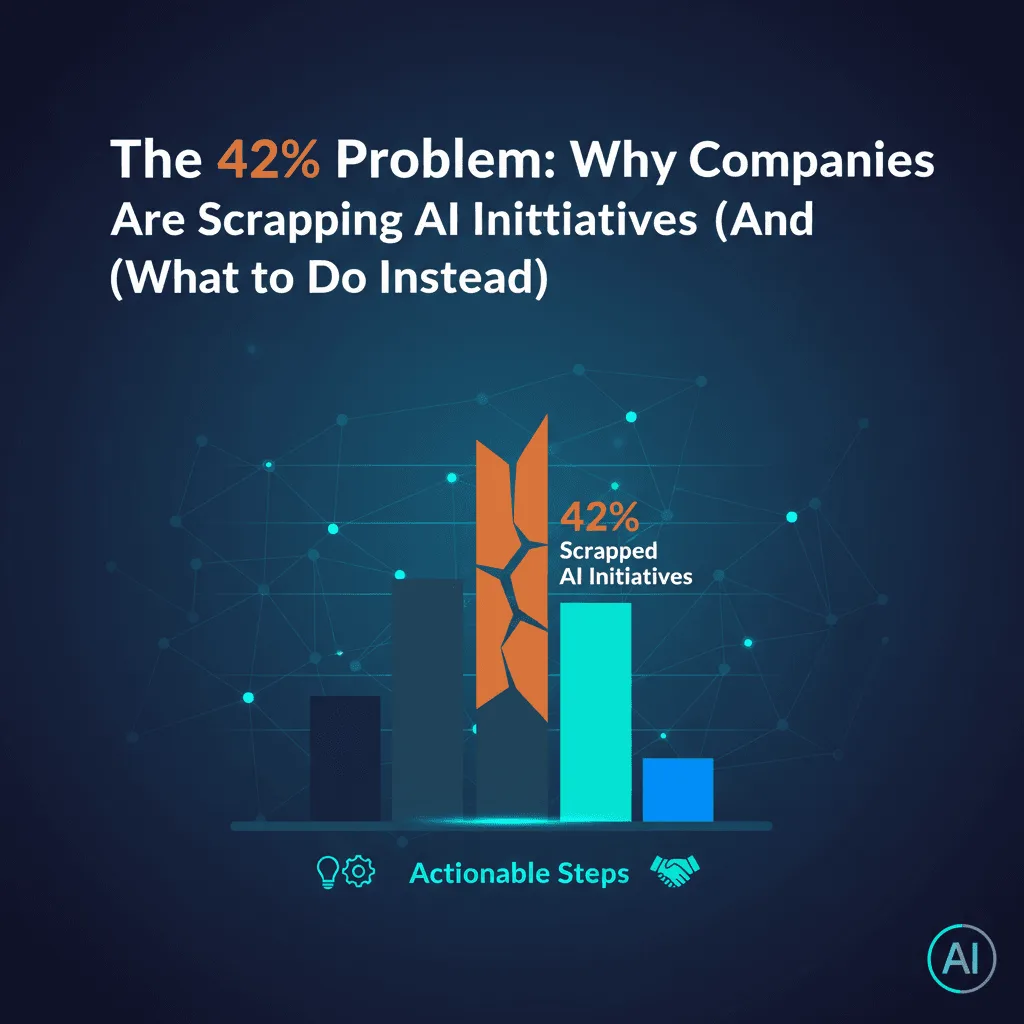
Research shows 95% of AI implementations fail to deliver meaningful business impact, with nearly half of all enterprises scrapping their initiatives entirely due to predictable strategic and technical mistakes.
- 42% Failure: Projects completely scrapped or indefinitely suspended.
- 53% Stagnation: Delivering minimal value compared to the initial AI implementation cost.
- 5% Success: Achieving measurable ROI and business transformation.
Why this matters: Despite the pressure to "do something with AI," most organizations fall into the implementation gap between hype and reality, resulting in $200K-$1M+ in wasted investment.
Why do most AI projects fail despite huge investments?
AI projects fail because organizations treat them as software installations rather than business transformations, often building on siloed data and broken processes that generic tools cannot solve.
- Strategic Misalignment: Projects solve theoretical problems instead of core business needs (e.g., a chatbot that can't access your CRM data).
- Poor Technical Foundations: Bolting AI onto crumbling legacy systems or disconnected data silos (causes 30% of failures).
- Expertise Gaps: Lacking specialized skills in data engineering and custom model development.
Critical Root Cause: Relying on generic, off-the-shelf software and "renting" AI instead of treating it as a custom engineering challenge.
What are the warning signs of a failing AI project?
The most common red flags of a failing AI project include vague objectives, inability to access real-time data, and solutions requiring extensive manual workarounds to function.
- Strategic Red Flag: No clear answer to "What specific KPI are we moving?"
- Execution Red Flag: Pilot works in a demo but fails with proprietary business data.
- Adoption Red Flag: Teams avoid the system because it doesn't fit their actual workflow.
Mid-Project Warning: If integration is taking 3x longer than planned or accuracy remains below acceptable thresholds (e.g., <95% for automation), the project is likely heading for the 95% failure pile.
How can we prevent AI project failure?
Preventing AI failure requires a "business-first" approach that replaces generic tools with custom solutions integrated directly into your existing data architecture and workflows.
- Phased Approach: Start with a single high-impact use case to prove value before scaling.
- Deep Integration: Fix foundational data issues as part of the implementation via secure APIs.
- Specialized Expertise: Partner with AI implementation experts who understand both data science and business strategy.
ROI Timeline: Organizations following this structured methodology typically see measurable AI ROI within 6-12 months.
What's the difference between successful and failed AI projects?
Successful AI projects treat implementation as a custom engineering transformation centered on specific financial KPIs, while failed projects rely on vague "innovation" goals and generic software.
| Aspect | Failed Projects (95%) | Successful Projects (5%) |
|---|---|---|
| Starting Point | "Let's try AI" | "Reduce support costs 30%" |
| Approach | Buy off-the-shelf tool | Build custom integration |
| Team | Internal IT only | Specialized experts + IT |
| Integration | Bolt-on to existing | Deep system integration |
| ROI | Never materialized | 300-500% within 12-18mo |
Example of Success: A national logistics company replaced a failing generic predictor with a custom model integrated into their dispatch system, achieving a 25% delivery improvement and ROI in 11 months.
The Antidote: Custom, Integrated AI Implementation
Why Custom Integration Succeeds
Off-the-shelf fails, custom succeeds because:
-
Handles your complexity: Generic tools assume clean data and standard processes. Custom solutions are designed for your specific data, workflows, and constraints.
-
Deep integration: Not bolted on—embedded into your core systems via secure APIs and modern connectors.
-
Specialized expertise: Data engineers, workflow strategists, and change management experts working together.
-
Business-driven: Every decision traces back to specific business metrics, not technology for its own sake.
AgenixHub's Success Framework
AgenixHub's custom integration methodology addresses each root cause of failure:
Solving Misalignment:
- Start with: "What business metric are we moving?"
- Map workflows and identify bottlenecks
- Define financial KPIs before any solution design
- Ensure AI solves real, high-value business problems
Solving Poor Foundations:
- Thorough data architecture assessment
- Fix foundational issues as part of the project
- Secure APIs and modern connectors
- Build reliable bridges to legacy systems
Solving Expertise Gaps:
- Multi-disciplinary team (data scientists, engineers, strategists)
- Work with your teams as transparent partners
- Knowledge transfer ensures adoption
- Ongoing support and optimization
Results:
- 80%+ success rate (vs 5% industry average)
- 6-12 months to measurable ROI
- 300-500% ROI within 12-18 months
- Sustainable competitive advantage
Why E-Commerce & D2C AI Initiatives Fail
While enterprise consulting projects suffer from coordination and data silos, e-commerce and D2C brands experience AI failure on a different front: visual dilution and mechanical copy.
When store owners deploy generic, rigid AI engines, their creative assets quickly look cheap and indistinguishable from competitors. Without a persistent Brand DNA to guide visual composition, lighting angles, and voice tones, AI platforms spin out generic stock-like product shots and robotic captions that actively destroy customer trust.
Furthermore, traditional AI tools lock brands into expensive monthly subscriptions. When sales fluctuate, the "subscription tax" becomes a massive financial burden, forcing owners to cancel their access and lose all their learned brand kits.
[!IMPORTANT] Beat the E-Commerce Odds: Stop wasting money on standard, off-the-shelf templates that dilute your brand. Ingest your Shopify store DNA dynamically with AgenixSocial's Pay-As-You-Go creative studio. Reclaim your marketing week, generate on-brand lifestyle shots quickly, and scale without a subscription tax. Start free with 3 signup credits →
Key Takeaways
Remember these 3 things:
-
95% failure rate is preventable - The failures stem from predictable mistakes: strategic misalignment, poor foundations, and expertise gaps. Address all three simultaneously to beat the odds.
-
Business-first, not technology-first - Start with "what business metric are we moving?" before discussing AI. Successful projects solve real business problems, not theoretical ones.
-
Custom integration outperforms off-the-shelf - Generic tools fail when they meet your complexity. Custom solutions designed for your specific data, workflows, and constraints deliver 300-500% ROI within 12-18 months.
Related Articles
Next Steps: Avoid Becoming a Statistic
Don't become part of the 95%. Here's how to ensure AI success:
- Request a free consultation with AgenixHub to audit your current approach
- Get honest assessment of why past initiatives may have failed
- Explore custom integration tailored to your specific business needs
- Calculate realistic ROI using our AI ROI Calculator
Avoid the 95% failure rate: Schedule a free consultation to build an AI strategy that delivers ROI.
Calculate Your AI Success: Use our AI ROI Calculator to project returns from properly implemented AI.
Your AI success starts with understanding why others fail—and choosing a fundamentally different approach. Contact AgenixHub today.