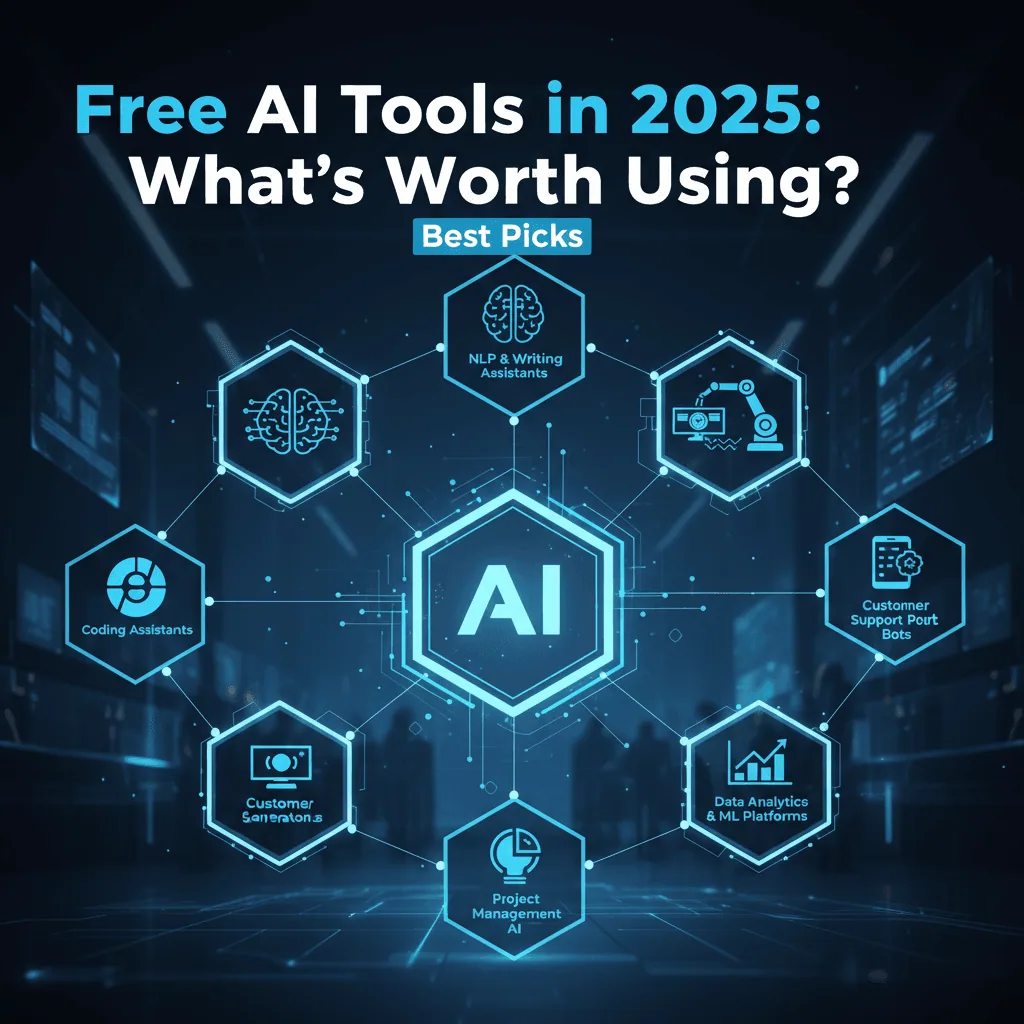
Free AI Tools in 2025: What's Worth Using vs Enterprise Solutions
Key Takeaways
- The Prosumer Gap: Free AI tools like ChatGPT are effective for brainstorming and non-critical drafts but lack the security, accuracy, and integration required for mission-critical enterprise operations.
- Security & Privacy Risks: Using free public models exposes sensitive proprietary data to third-party training sets, creating significant legal and security liabilities for professional organizations.
- Accuracy Limitations: Free tools typically plateau at 80% accuracy due to their generic training data, whereas custom AI solutions trained on proprietary data achieve 99%+ precision.
- Hidden Costs: The "free" price tag often masks high costs associated with manual rework, potential copyright infringement, and the inability to automate core business workflows.
What are Free AI Tools?
Free AI tools refer to publicly available artificial intelligence applications and platforms that require no upfront payment for basic usage. They describe software services like ChatGPT, Google Gemini, and various AI generators that provide natural language processing, content creation, and image generation capabilities to individual users without subscription fees, typically monetizing through premium tiers, data collection, or advertising while imposing usage limits and feature restrictions.
Quick Answer
Free AI tools (ChatGPT, Gemini, etc.) are powerful for low-stakes individual productivity but introduce critical "Prosumer Gaps" in data security, accuracy, and legal compliance for enterprise use.
While free tools offer approximately 80% accuracy on generic tasks, professional organizations require custom AI solutions to achieve 99%+ precision, full data ownership, and seamless integration with existing CRM/ERP systems. For business-critical operations, "free" often translates to hidden costs in manual rework and security risks.
Quick Facts
| Factor | Free AI Tools | Custom Enterprise AI |
|---|---|---|
| Typical Accuracy | 75% – 85% (Generic) | 99%+ (Data-Specific) |
| Security Risk | High (Third-party training) | Low (Private/Secure Env) |
| Integration | None (Siloed) | Deep (CRM/ERP/API) |
| Ownership | Ambiguous | Full (Company Owned) |
| Primary Use | Brainstorming/Drafting | Mission-Critical Ops |
Key Questions
- What are the core limitations of free AI for business?
- When should I use free tools vs. custom solutions?
- What is the "Prosumer Gap"?
- How does custom AI provide better ROI?

Common Questions About Free AI Tools for Business
What are the limitations of free AI tools for enterprise use?
Free AI tools have five critical limitations for enterprise applications: (1) Data Privacy and Security Risks—when teams input sensitive information (customer lists, business strategies, product details) into free tools, that data goes to third parties with no guarantee of how it's stored, secured, or used, sending intellectual property outside your control with potential for breaches, unauthorized access, or competitive intelligence leaks, (2) Inaccurate and Generic Outputs—free models trained on public internet have zero knowledge of your specific business context, brand voice, customer data, or industry nuances, producing generic outputs by design requiring 50-80% manual rework to be usable, achieving only 80% accuracy at best (vs 99%+ needed for automation), (3) Legal and Copyright Ambiguity—unclear who owns AI-generated content, whether images/text created using copyrighted material, commercial use restrictions varying by tool, exposing companies to significant legal liability and potential lawsuits, (4) No Integration Capabilities—free tools exist in complete silos, cannot connect to your CRM, ERP, inventory management, or any business systems, making true end-to-end workflow automation impossible, requiring manual copy-paste and context switching, and (5) No Scalability—fail with volume and complexity, rate limits restrict usage, performance degrades with business-critical workloads, vendor controls features and availability. Hidden costs emerge: massive rework time (50-80% of output needs editing), legal exposure (copyright infringement, ownership disputes), security breaches ($10M+ average cost), missed opportunities (can't automate core processes), competitive disadvantage (competitors using custom solutions pull ahead).
Free Tools vs Custom Solutions:
| Factor | Free AI Tools | Custom AI (AgenixHub) | Winner |
|---|---|---|---|
| Upfront Cost | "Free" | Higher investment | Free tools |
| Data Privacy | High risk (third-party) | Full control (your environment) | Custom |
| Accuracy | 80% (generic) | 99%+ (your data) | Custom |
| Integration | None (silos) | Deep, seamless | Custom |
| Ownership | Ambiguous (vendor owns) | Clear (you own everything) | Custom |
| Scalability | Limited (vendor constraints) | Built for your needs | Custom |
| Long-term ROI | Hidden costs, rework | Predictable, superior | Custom |
| Commercial Use | Legally risky | Guaranteed | Custom |
When should businesses use free AI tools vs custom solutions?
Free AI tools are appropriate for: (1) Low-Stakes Experimentation—exploring AI capabilities, learning what's possible, building internal AI literacy, proof-of-concept demonstrations (not production), (2) Non-Critical Tasks—brainstorming ideas, creating first drafts of internal documents, generating concept art for presentations, summarizing public information, (3) Individual Productivity—helping employees work faster on personal tasks, quick research and information gathering, learning and skill development, (4) Public-Facing Content—when data is already public, no proprietary information involved, legal risks are acceptable, and (5) Budget Constraints—very small businesses or startups with limited resources, temporary solutions while building business case for custom. Custom AI solutions are required for: (1) Core Business Processes—any workflow critical to revenue, operations, or customer experience, processes handling sensitive data, automation requiring 99%+ accuracy, (2) Proprietary Data—customer information, business strategies, product designs, financial data, competitive intelligence, (3) Integration Needs—connecting AI to CRM, ERP, inventory, or any business system, end-to-end workflow automation, real-time data processing, (4) Compliance Requirements—HIPAA (healthcare), GDPR (data protection), PCI-DSS (payments), SOC 2 (security), industry-specific regulations, (5) Competitive Advantage—differentiated capabilities competitors can't replicate, proprietary AI models trained on your unique data, scalable solutions growing with business, and (6) Measurable ROI—clear business outcomes and KPIs, predictable returns on investment, long-term strategic assets. Rule of thumb: if failure would cost money, damage reputation, or violate regulations, use custom AI.
Use Case Decision Matrix:
| Use Case | Free Tools | Custom AI | Rationale |
|---|---|---|---|
| Brainstorming ideas | ✅ Appropriate | ❌ Overkill | Low stakes, no proprietary data |
| Internal memo drafts | ✅ Appropriate | ❌ Overkill | Non-critical, public information |
| Customer support automation | ❌ Risky | ✅ Required | Critical process, customer data, accuracy needed |
| Fraud detection | ❌ Inadequate | ✅ Required | Mission-critical, requires 99%+ accuracy, integration |
| Marketing personalization | ❌ Generic | ✅ Required | Competitive advantage, proprietary customer data |
| Contract data extraction | ❌ Risky | ✅ Required | Sensitive data, legal implications, accuracy critical |
| Concept art for pitch | ✅ Appropriate | ❌ Overkill | Low stakes, exploratory |
| Production quality control | ❌ Inadequate | ✅ Required | Critical process, integration needed, 99%+ accuracy |
What is the "Prosumer Gap" and why does it matter?
The "Prosumer Gap" describes the dangerous disconnect between tools designed for consumers/prosumers (individuals, freelancers, small projects) and the requirements of professional enterprises. Free AI tools excel for consumer use cases: quick tasks, low stakes, no compliance requirements, generic outputs acceptable, no integration needed, individual productivity. However, enterprise requirements are fundamentally different: mission-critical processes where failure costs millions, sensitive proprietary data requiring security/compliance, 99%+ accuracy needed for automation (vs 80% "good enough"), seamless integration with existing systems mandatory, clear ownership and legal rights essential, scalable to handle business volumes, predictable performance and availability. The gap creates five critical failures: (1) Security Breaches—consumer tools lack enterprise-grade security, leading to data leaks costing $10M+ average, (2) Compliance Violations—HIPAA, GDPR, PCI-DSS violations resulting in massive fines ($50K+ per violation), (3) Operational Failures—80% accuracy means 20% errors requiring expensive manual correction, destroying automation ROI, (4) Legal Liability—copyright infringement lawsuits, ownership disputes, commercial use violations, and (5) Competitive Disadvantage—while you struggle with free tools, competitors using custom AI pull ahead with superior automation, personalization, and efficiency. Real-world example: marketing team used free AI for campaign (looked like win initially), but legal flagged images for potential copyright infringement, sales reported copy too generic and not converting (didn't understand customer profiles), hidden costs emerged destroying perceived savings.
Prosumer Gap Breakdown:
| Requirement | Consumer/Prosumer Need | Enterprise Need | Gap Impact |
|---|---|---|---|
| Security | Basic protection | Enterprise-grade, compliance | Data breaches, $10M+ costs |
| Accuracy | 80% "good enough" | 99%+ for automation | 20% errors, manual rework |
| Integration | Standalone tool | Deep system integration | No automation, manual processes |
| Ownership | Unclear, vendor-controlled | Clear, company-owned | Legal liability, disputes |
| Scalability | Personal use volumes | Business-critical workloads | Performance failures, limits |
| Support | Community forums | Professional SLAs | Downtime, no recourse |
How does AgenixHub's custom approach deliver superior ROI?
AgenixHub delivers superior ROI through integration-first methodology that turns AI capabilities into measurable business outcomes: (1) Analyze Business Process, Not Tool—start by asking "what business outcome do we need?" not "what free tool can we use?", map existing workflows to find specific bottlenecks where AI delivers most value, focus on measurable impact (cost reduction, revenue increase, efficiency gains), (2) Architect for Your Data and Systems—deep dive into your data infrastructure, design custom architecture with secure APIs and data connectors bridging AI model and core systems (modern or legacy), free tools can't do this, (3) Build for Your Business Context—use best-in-class AI models as foundation but fine-tune/train specifically on your proprietary data, ensures AI understands your products, customers, brand voice, delivers 99%+ accuracy needed for true automation (vs 80% generic requiring rework), (4) Prioritize Security, Compliance, and Ownership—maintain full ownership and control over your data, AI operates within your secure environment, designed from ground up to meet industry compliance standards (HIPAA, GDPR, SOC 2), you own the model and all outputs, (5) Deploy, Measure, and Iterate—establish clear KPIs before project begins (cost per transaction, lead conversion rate, customer satisfaction), track relentlessly after deployment to prove financial impact, continuous monitoring and retraining ensures sustained value. Real-world example: CPG company wanted personalized marketing, tried free AI content tools (output too generic, failed to resonate with diverse customer segments). AgenixHub built custom Generative AI engine integrated directly with their CRM and historical sales data—system analyzes purchasing habits and preferences of different segments, automatically generates hyper-targeted email and social media content. Result: 30% increase in customer engagement, 15% lift in conversion rates from targeted campaigns, full ownership of secure proprietary marketing asset.
AgenixHub ROI Drivers:
| ROI Driver | How It Works | Business Impact | Timeline |
|---|---|---|---|
| 99%+ Accuracy | Train on your proprietary data | True automation (vs 80% requiring rework) | 6-9 months to ROI |
| Deep Integration | Secure APIs to existing systems | End-to-end workflow automation | 6-12 months to ROI |
| Data Control | Operates in your secure environment | Lower breach exposure and stronger compliance control | Immediate (risk reduction) |
| Clear Ownership | You own model and outputs | No legal ambiguity, competitive advantage | Long-term strategic asset |
| Continuous Optimization | Ongoing monitoring and retraining | Sustained and improving value | Increasing returns over time |
Real-World ROI Example:
- Problem: Generic marketing content not converting
- Free Tool Attempt: 80% accuracy, too generic, legal concerns
- AgenixHub Solution: Custom GenAI integrated with CRM/sales data
- Investment: $150K custom development
- Results: 30% engagement increase, 15% conversion lift
- Annual Value: $500K+ additional revenue
- ROI: 233% year one, increasing over time
Next Steps: Move from Free Tools to Strategic AI
Ready to implement enterprise-grade AI? Here's how:
- Request a free consultation with AgenixHub to assess your AI needs
- Audit current AI usage - identify where free tools create risks
- Map business processes - find high-impact automation opportunities
- Calculate ROI using our AI ROI Calculator
- Build custom solution with integration-first approach
Move beyond free tools: Schedule a free consultation to discuss custom AI solutions delivering measurable ROI.
Estimate Your Custom AI ROI: Use our AI ROI Calculator to compare custom solutions vs free tool hidden costs.
Learn more: Explore AI Capabilities and The Ultimate Guide to AI Platforms
Don't let "free" tools create expensive problems. Implement custom AI solutions that deliver secure, accurate, integrated business outcomes. Contact AgenixHub today.