Automotive AI is no longer a side experiment. Machine learning now shapes perception, prediction, driver assistance, diagnostics, software-defined vehicle workflows, and connected operations across the vehicle lifecycle.
That creates a harder compliance problem than a standard software release. ISO 26262 still matters, but automotive teams cannot treat AI safety as a narrow documentation task. They need to connect hazard analysis, datasets, model behavior, operating boundaries, fallback logic, software updates, cybersecurity, and field monitoring into one defensible evidence chain.
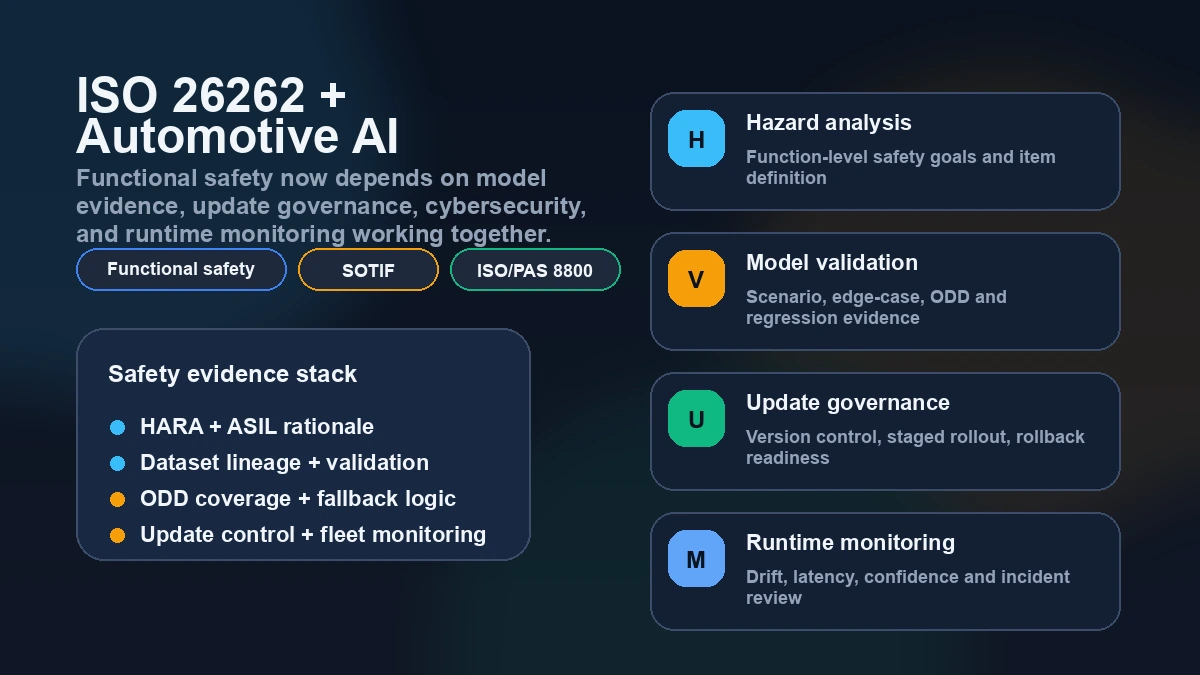
Quick answer: What is ISO 26262 AI compliance?
ISO 26262 AI compliance means applying automotive functional safety principles to AI or machine learning systems that can influence vehicle safety. That still includes hazard analysis, ASIL classification, safety requirements, verification, validation, traceability, and safety-case evidence. But AI systems also need evidence about datasets, model behavior, operating boundaries, confidence thresholds, fallback logic, updates, cybersecurity, and runtime monitoring.
ISO describes ISO 26262 as a framework for functional safety across automotive electrical and electronic systems, focused on hazards caused by malfunctioning behavior over the lifecycle. (ISO) AI complicates that picture because model outputs are data-dependent and probabilistic, and academic work from Rick Salay and Krzysztof Czarnecki notes that ISO 26262 was not originally designed around machine learning development patterns. (arXiv)
Why ISO 26262 becomes harder with AI
Traditional safety engineering works best when system behavior can be decomposed into requirements, architecture, code, hardware assumptions, and well-scoped failure modes.
AI changes the evidence burden:
- A model can perform well overall and still fail in a rare but safety-critical edge case.
- Dataset coverage becomes part of the safety argument, not just a development input.
- Model confidence, fallback logic, and operating boundaries matter as much as aggregate accuracy.
- Retraining, fine-tuning, or threshold changes can materially change the safety case.
- Monitoring after launch becomes part of maintaining safety confidence, not just an operations best practice.
This is why ISO 26262 AI compliance should be treated as an operating discipline across safety engineering, AI development, data governance, update control, and production review.
ISO 26262 does not work alone for automotive AI
ISO 26262 remains foundational, but it does not cover every AI safety risk by itself.
| Standard or regulation | Main concern | Why it matters for automotive AI |
|---|---|---|
| ISO 26262 | Functional safety of automotive E/E systems | Covers hazards from malfunctioning behavior and the functional safety lifecycle. |
| ISO 21448 / SOTIF | Safety of the intended functionality | Covers unsafe outcomes caused by functional insufficiency or foreseeable misuse, even without a classic malfunction. |
| ISO/PAS 8800 | Safety and artificial intelligence in road vehicles | Extends safety thinking into AI-specific properties, assurance, and operational evidence. |
| ISO/SAE 21434 | Road vehicle cybersecurity engineering | Covers cybersecurity risk management across the E/E lifecycle. |
| UNECE R155 | Cybersecurity management system | Matters when vehicle programs need type-approval-aligned cybersecurity governance in adopting markets. |
| UNECE R156 | Software update management system | Matters when software and model updates need controlled rollout, traceability, and review. |
ISO's SOTIF page explicitly distinguishes hazards from functional insufficiencies and reasonably foreseeable misuse from the faults covered by ISO 26262. (ISO) ISO/SAE 21434 defines cybersecurity engineering requirements across the vehicle E/E lifecycle. (ISO) ISO/PAS 8800 directly addresses safety and artificial intelligence in road vehicles and frames AI safety as an extension of established automotive safety approaches. (ISO) UNECE R155 and R156 define the regulatory structures for cybersecurity management and software update management where those regulations apply. (UNECE R155, UNECE R156)
For teams mapping the cyber and software-update side in more detail, the companion guide on UNECE WP.29 automotive AI regulations expands the R155 and R156 side of the stack.
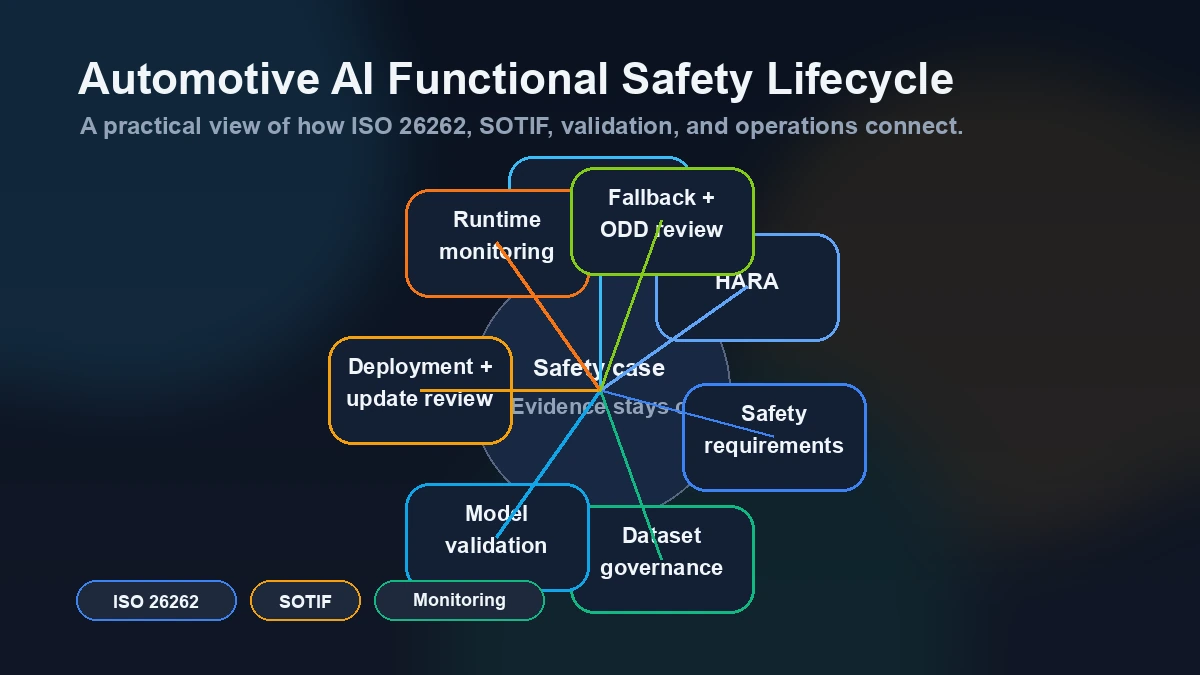
Where AI creates new safety evidence requirements
AI does not replace traditional safety work products. It adds new evidence layers that are hard to reconstruct later if teams do not plan for them from the start.
1. Dataset evidence
For AI systems, the dataset is part of the safety argument. Teams need to show what the data represents, what it does not represent, how it was labeled, and how it maps to the intended operating conditions.
Useful dataset evidence includes:
- Data source inventory
- Labeling and review process
- Scenario coverage and ODD coverage
- Bias, imbalance, and limitation analysis
- Dataset version history
- Training, validation, and test split rationale
- Field data collection plan after deployment
2. Model behavior evidence
AI safety cannot be reduced to one accuracy score. Teams need evidence about false positives, false negatives, edge cases, degraded conditions, threshold behavior, and regression across model versions.
Useful model behavior evidence includes:
- Scenario-level performance metrics
- Confidence-threshold rationale
- Out-of-distribution detection strategy
- Edge-case replay and robustness testing
- Regression testing between model versions
- Residual-risk assessment linked to safety goals
3. Operating-boundary evidence
ADAS and other safety-relevant AI functions need a clear view of when the function is valid, how boundary violations are detected, and what the system does when confidence drops.
Useful operating-boundary evidence includes:
- Operational design domain definition
- Boundary detection logic
- Safe-state and fallback strategy
- Driver alert and transfer-of-control assumptions
- Degraded-mode behavior
- Scenario-based validation for boundary cases
4. Model update evidence
Any meaningful change to model weights, thresholds, training data, calibration, or deployment configuration can affect the safety case.
Useful update evidence includes:
- Model version records
- Training-data change logs
- Safety-impact analysis
- Regression results against prior versions
- Update approval records
- Rollback plan and deployment scope
- Post-update watch-period plan
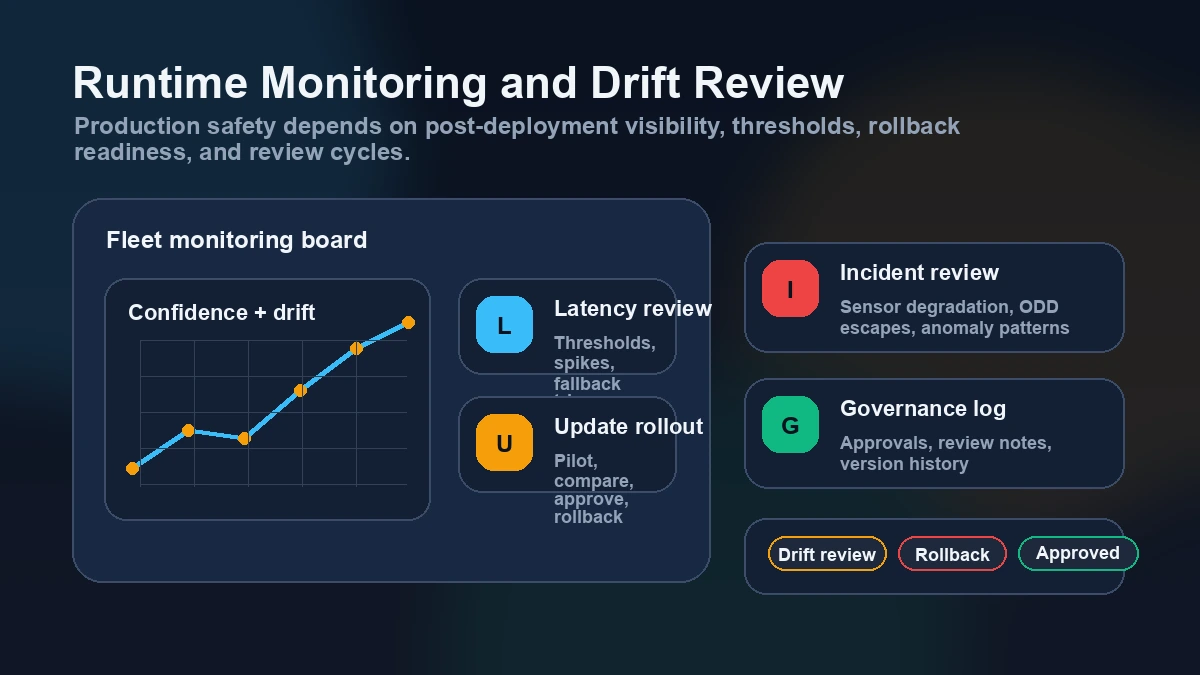
5. Runtime monitoring evidence
Safety confidence must survive contact with the field. Teams should monitor for drift, confidence shifts, anomaly patterns, fallback activations, incident clusters, and update effects over time.
Useful monitoring evidence includes:
- Confidence distributions by scenario
- Anomaly and out-of-distribution signals
- Fallback activation rates
- Version-specific performance trends
- Latency and availability metrics
- Incident-review outcomes
- Human-review queue findings
This is where Managed AI Operations becomes relevant. After launch, the operating question is whether teams can continuously review cost, quality drift, model changes, routing decisions, and incident patterns rather than treating the initial validation package as the end of the job.
ISO 26262, ASIL, and AI
ISO 26262 still classifies safety rigor through ASIL, but the classification begins with the hazardous event and the vehicle function, not with the model in isolation. (ISO)
For AI systems, the better question is not "what ASIL is this model?" It is:
What hazardous event can occur if this AI-enabled function fails, behaves insufficiently, or produces an unsafe output in its intended context?
That distinction matters because the same model architecture can support functions with very different safety implications depending on:
- The vehicle-level function it supports
- Severity of potential harm
- Exposure to the relevant operating scenario
- Controllability by the driver or fallback system
- Dependence on AI output
- Availability of independent safety mechanisms
- Operating-boundary assumptions
ISO 26262 vs SOTIF for AI systems
One of the most important distinctions in automotive AI is the difference between malfunction and insufficiency.
ISO 26262 focuses on hazards caused by malfunctioning E/E behavior. SOTIF focuses on hazards caused by performance limitations or foreseeable misuse even when the system is operating as designed. ISO's SOTIF guidance explicitly frames this as the absence of unreasonable risk due to functional insufficiencies of intended functionality. (ISO)
That means an AI perception model can create two very different kinds of safety issues:
| Risk type | Example | Better analytical lens |
|---|---|---|
| Malfunction | Sensor fault or corrupted component produces unsafe input or output. | ISO 26262 |
| Performance limitation | Model fails in glare, rain, rare objects, or unusual road markings despite operating as designed. | SOTIF / ISO 21448 |
| AI-specific insufficiency | Dataset does not cover enough of the target ODD. | ISO/PAS 8800 plus SOTIF |
| Cybersecurity compromise | Model, data pipeline, or update path is attacked or manipulated. | ISO/SAE 21434 plus UNECE R155 |
| Unsafe update | New model version changes behavior without enough review or rollback readiness. | UNECE R156 plus safety-case update |
AI programs that collapse all of these issues into one bucket usually end up with weak evidence and confusing ownership.
Why ISO/PAS 8800 matters for automotive AI
ISO/PAS 8800 matters because it directly addresses AI-enabled safety-related systems in road vehicles. ISO says the document applies to safety-related systems using AI technology and describes safety-related properties of AI systems that can support a convincing safety assurance claim. (ISO)
That matters for questions classic software processes do not answer well on their own:
- How should datasets be treated as safety artifacts?
- How should AI-specific robustness be demonstrated?
- How should AI safety requirements be derived and linked?
- How should assurance claims incorporate model behavior and field monitoring?
- How should AI elements outside the vehicle, such as field monitoring or external AI elements with safety impact, be handled?
In practice, ISO/PAS 8800 is best understood as a companion to ISO 26262 and SOTIF, not a replacement for them.
The AI safety case: what should be connected?
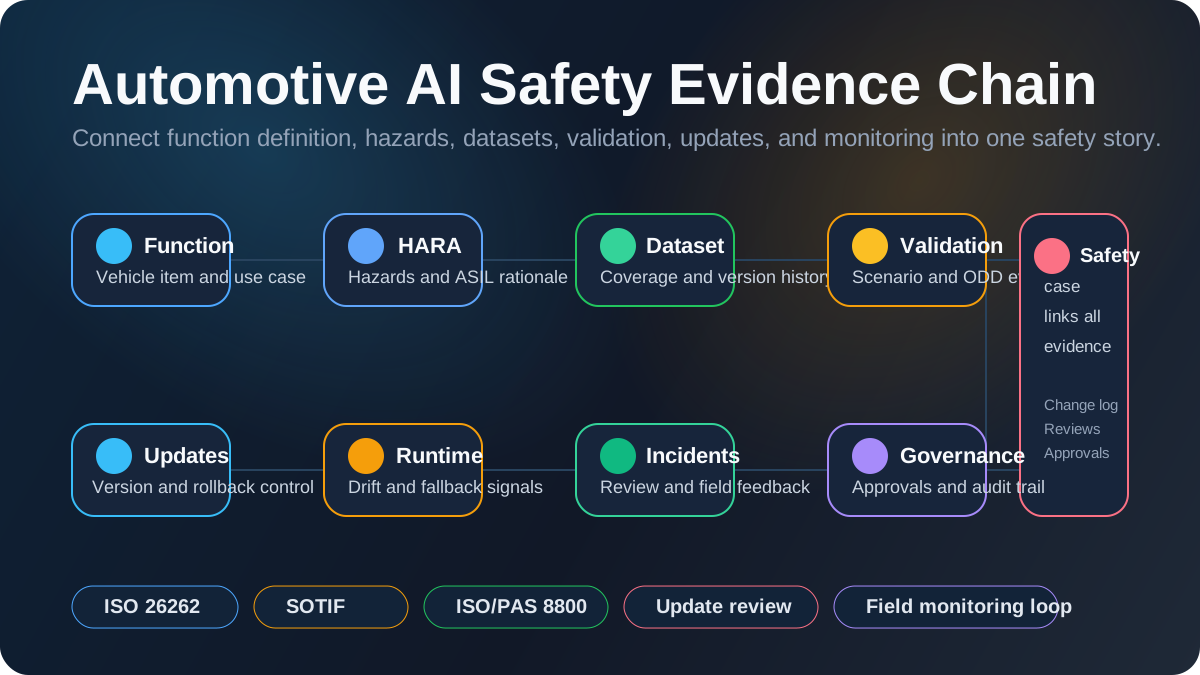
For automotive AI, the safety case is only credible if the evidence is connected across engineering and operations.
The evidence chain should connect:
- Vehicle-level function
- Item definition
- Hazard analysis and risk assessment
- ASIL classification
- Safety goals
- Functional and technical safety requirements
- AI safety requirements
- Dataset requirements and version history
- Model training and validation records
- Scenario and ODD coverage
- Runtime monitoring design
- Update governance and rollback readiness
- Cybersecurity treatment
- Incident-review history
- Safety-case change history
The fragmentation risk is practical, not theoretical. Safety, AI, software, data, cybersecurity, suppliers, and compliance teams often store evidence in different tools and review cycles. When those threads are not connected, the safety case becomes difficult to defend.
Common ISO 26262 AI compliance mistakes
1. Treating model accuracy as safety evidence
High aggregate performance can still hide failure in critical edge cases. Safety evidence needs scenario-level coverage, not only a summary metric.
2. Treating the dataset as a technical asset instead of a safety artifact
If the dataset cannot be traced, versioned, and mapped to the ODD, the safety case is weaker no matter how polished the model demo looks.
3. Ignoring SOTIF
Many AI failures are not classic malfunctions. They come from insufficiency, weak situational awareness, or operating outside safe assumptions.
4. Updating models without updating the safety case
Every meaningful model, data, or threshold change should trigger impact analysis.
5. Separating cybersecurity from AI safety
Connected vehicles, APIs, update paths, training pipelines, telemetry, and model artifacts create cybersecurity risks that can affect safety outcomes. (ISO, UNECE R155)
6. Waiting until audit time to assemble evidence
Evidence should be generated as part of engineering and operations. Reconstructing it at the end is slower, weaker, and easier to challenge.
Practical framework
1. Classify AI-enabled functions by safety relevance
Start with the vehicle function, not the model. Identify where AI output influences alerts, driver assistance, automated intervention, diagnostics, or safety-relevant decision paths.
2. Separate malfunction risk from insufficiency risk
Run two views in parallel: what can malfunction, and where can the system behave as intended but still be unsafe?
3. Build dataset traceability
Create a dataset record that answers what scenarios are covered, what is missing, how labels were reviewed, which dataset trained which model, and how coverage maps to the ODD.
4. Define measurable AI safety requirements
Examples include minimum performance in target ODD slices, false-negative limits for safety-critical classes, fallback trigger conditions, latency bounds, and regression thresholds.
5. Create scenario-based validation
Validation should cover normal, degraded, edge-case, and boundary conditions across simulation, closed-course testing, real-world evaluation where appropriate, and regression review after updates.
6. Connect cybersecurity and update governance
Model weights, data pipelines, APIs, deployment configurations, telemetry, and update packages are all assets that need review under the broader cybersecurity and software-update framework. (ISO, UNECE R156)
7. Monitor AI after launch
Production monitoring should cover drift, anomalies, fallback rates, incident patterns, and the effect of updates on system behavior. This is the operational bridge between a launch-ready AI system and a continuously reviewable one.
What teams should audit before scaling automotive AI
Before scaling AI across automotive programs, teams should audit the controls around the operating layer as well as the model itself.
| Area | What to check | Why it matters |
|---|---|---|
| Safety relevance | Which AI outputs influence safety-related decisions? | Prevents treating all AI workloads the same. |
| Evidence chain | Are requirements, datasets, models, tests, updates, and monitoring connected? | Weak traceability weakens the safety case. |
| Operating boundary | Is the ODD defined, monitored, and enforced? | AI needs clear conditions for safe use. |
| Update governance | Do model or software changes trigger safety review? | Prevents silent regressions. |
| Runtime monitoring | Can teams see drift, anomalies, fallback, and incident patterns? | Safety confidence must be maintained after launch. |
For teams that want that review formalized before scaling spend or deployment scope, the AI Operating Efficiency Audit is the cleanest commercial entry point from this topic.
Where AgenixHub fits
AgenixHub does not replace assessors, homologation authorities, certification bodies, or legal counsel. Automotive AI compliance still needs qualified functional safety, cybersecurity, regulatory, and legal review.
Where AgenixHub fits is the operating problem around production AI:
- Which AI workloads are safety-relevant or sensitive?
- Where are review paths weak or missing?
- Which workflows need controlled or private deployment?
- Where is runtime monitoring insufficient?
- Where are update approvals, drift review, or incident review fragmented?
That aligns with AgenixHub's AI Operating Efficiency Capabilities, which focus on workload classification, model routing, context optimization, private and open deployment paths, monitoring, and governance. It also aligns with Managed AI Operations once the program needs recurring performance review, model-change review, and operational reporting after launch.
Where AgenixCore fits
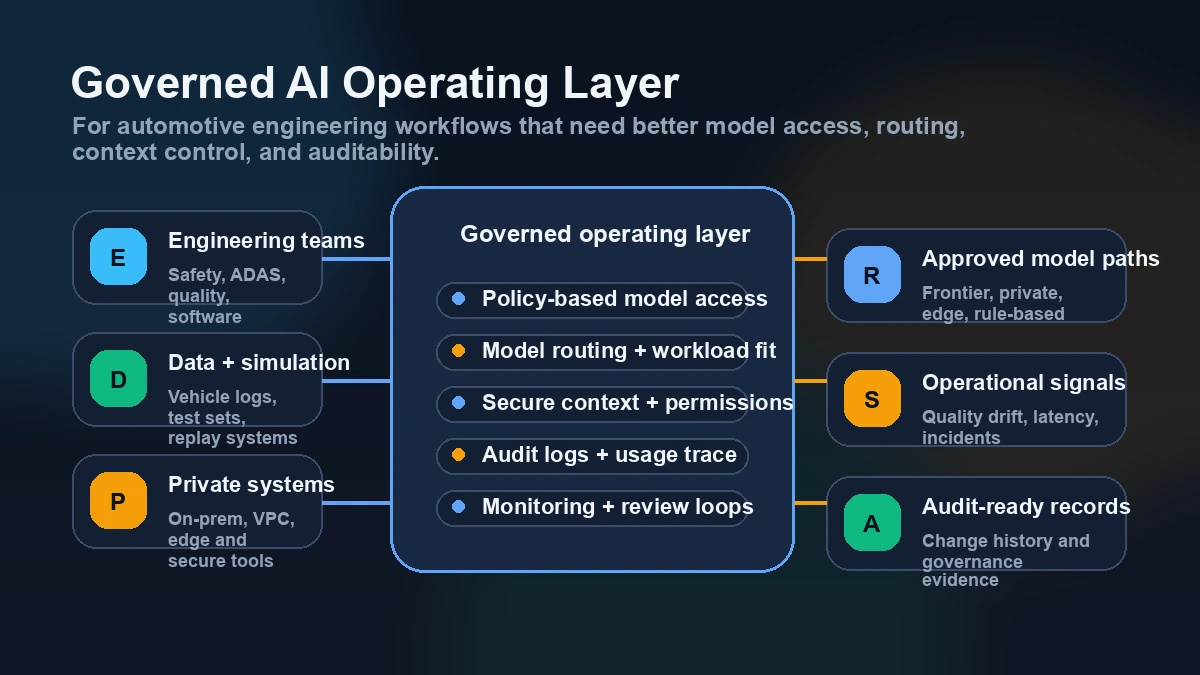
AgenixCore should not be positioned as a certification product. It is more useful as an operating-layer pattern for governed AI usage.
The relevant questions are operational:
- Who can access the workflow?
- Which model path is approved for which workload?
- What context can be used?
- Which actions require human review?
- What audit logs are captured?
- How are model usage and changes observed?
- Which paths should run through a Managed AI Efficiency Layer with stronger routing, policy, and review discipline?
AgenixCore is described across AgenixHub as a governed layer between people, models, tools, and data sources, focused on access governance, model routing, secure context, cost control, and auditability. (AgenixCore)
What this does not guarantee
ISO 26262-aligned development does not guarantee that an AI-enabled system will never fail. SOTIF does not eliminate every unknown scenario. ISO/PAS 8800 does not remove the need for engineering judgment. Cybersecurity controls do not make future attacks impossible. Monitoring does not fix drift automatically.
The goal is not a claim of perfect safety. The goal is a defensible, traceable, continuously reviewed safety and operating model for AI systems that can affect vehicle behavior.
For safety-critical automotive AI, independent review, supplier coordination, human oversight, and formal program governance remain essential.
FAQ
Does ISO 26262 directly cover AI and machine learning?
ISO 26262 applies to safety-related automotive E/E systems, but it was not originally designed specifically around machine learning workflows. AI systems usually need additional treatment for data, model behavior, scenario coverage, operating boundaries, updates, and field monitoring. ISO/PAS 8800 and SOTIF help address those AI-specific gaps. (ISO, ISO, arXiv)
Is ISO 26262 mandatory?
ISO 26262 is an international standard rather than a universal law in itself. In practice, OEM requirements, supplier contracts, safety expectations, and procurement processes often make it effectively necessary for safety-related automotive programs. Synopsys summarizes this industry reality directly: widely expected even when not independently legislated. (Synopsys)
What is the difference between ISO 26262 and SOTIF?
ISO 26262 focuses on hazards from malfunctioning E/E behavior. SOTIF focuses on hazards from functional insufficiency or reasonably foreseeable misuse even when the system is operating as designed. Automotive AI often needs both because unsafe outcomes can come from model limitations without a classic software or hardware fault. (ISO)
What is ISO/PAS 8800?
ISO/PAS 8800 is a road-vehicle safety and artificial intelligence specification. ISO says it applies to safety-related systems using AI technology and helps construct a convincing safety assurance claim for the absence of unreasonable risk in AI systems. (ISO)
How does ISO/SAE 21434 relate to automotive AI safety?
ISO/SAE 21434 covers cybersecurity engineering across the road-vehicle E/E lifecycle. It matters for AI because model artifacts, data pipelines, APIs, telemetry, and update paths can all be attacked or manipulated in ways that affect safety. (ISO)
What evidence matters most for AI safety?
The critical evidence is usually the connected chain: hazard analysis, ASIL rationale, AI safety requirements, dataset traceability, scenario coverage, model validation, fallback behavior, update history, cybersecurity treatment, runtime monitoring, and incident review. No single metric replaces that chain.
Can AI models be ISO 26262 compliant?
It is more accurate to say that an AI-enabled function or system can be developed within an ISO 26262-aligned lifecycle. A model by itself is not the full safety case. The safety case depends on the function, architecture, data, requirements, validation, monitoring, and fallback logic around it.
What should automotive teams do before scaling AI?
They should classify AI use cases by safety relevance, operating boundary, data sensitivity, model dependency, update frequency, cybersecurity exposure, and monitoring need. Then they should connect requirements, datasets, models, tests, updates, and runtime review into one evidence chain before scaling deployment.
Conclusion
ISO 26262 remains essential for automotive functional safety, but AI changes how safety evidence has to be built, reviewed, and maintained.
The strongest automotive AI teams will not be the ones that deploy models fastest. They will be the ones that can govern datasets, validate behavior, define operating boundaries, control updates, monitor runtime performance, and defend the evidence behind every safety-relevant workflow.
If that operating layer is still fragmented, start with an AI Operating Efficiency Audit. If the review is already clear and the next need is continuous operational oversight, move into Managed AI Operations.