
Automotive AI is moving from isolated features to continuously updated, software-defined vehicle systems. ADAS, automated driving functions, in-cabin monitoring, predictive maintenance, fleet analytics, and connected-vehicle services now depend on models, data pipelines, software updates, supplier components, and post-deployment monitoring.
That changes the compliance problem.
UNECE WP.29 is not only a topic for homologation and regulatory teams anymore. For AI-enabled vehicles, it increasingly touches cybersecurity, software update governance, model versioning, operational monitoring, auditability, and cross-functional engineering control.
The practical question is no longer just: "Does the vehicle meet the regulation?"
It is also:
Can the organization prove how AI-enabled vehicle software is built, secured, updated, monitored, reviewed, and governed across its lifecycle?
Quick answer: what does UNECE WP.29 mean for automotive AI?
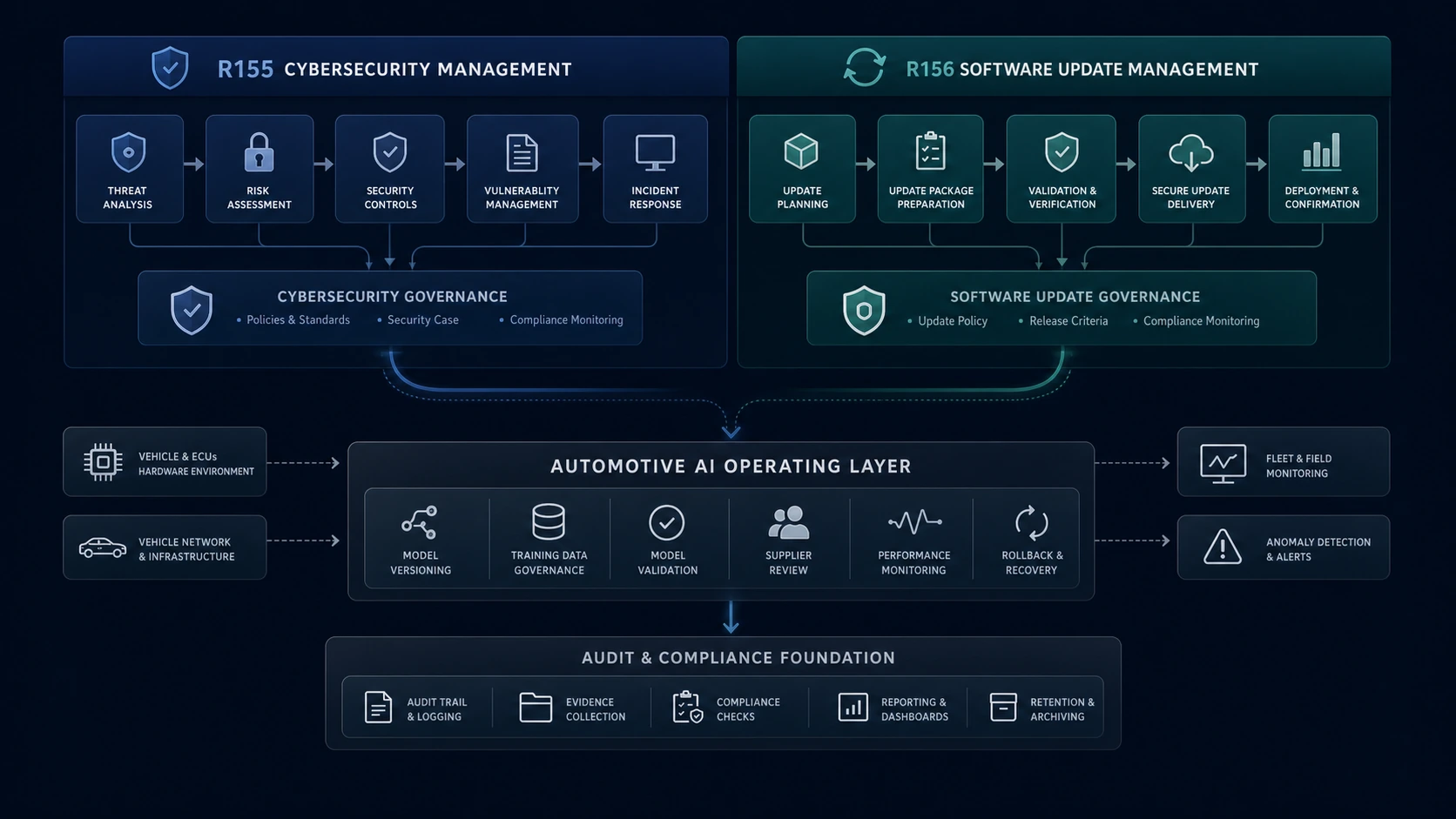
UNECE WP.29 is the World Forum for Harmonization of Vehicle Regulations. For automotive AI, the most relevant rules today are UN Regulation No. 155 for vehicle cybersecurity and cybersecurity management systems, and UN Regulation No. 156 for software updates and software update management systems. AI adds complexity because models, data, sensors, update pipelines, and monitoring must be governed across the vehicle lifecycle. (UNECE)
In 2025, UNECE also established an AI Informal Working Group under WP.29 to examine AI use cases, terms, definitions, standards, practices, and guiding questions for AI in regulated automotive safety systems. That makes automotive AI governance a live and evolving regulatory topic, not a future abstraction. (UNECE)
What is UNECE WP.29?
UNECE WP.29, formally the World Forum for Harmonization of Vehicle Regulations, is a global regulatory forum for vehicle regulations. Its work supports harmonized technical requirements for vehicle safety, environmental performance, energy efficiency, anti-theft performance, and increasingly software-defined and connected vehicle systems. (UNECE)
For automotive AI teams, WP.29 matters because modern vehicles are no longer static mechanical products. They are connected, sensor-heavy, software-defined systems. A vehicle may include:
- camera, radar, lidar, ultrasonic, and telemetry data streams;
- driver assistance and automated driving functions;
- cloud-connected diagnostics and fleet systems;
- over-the-air software updates;
- model updates;
- supplier-provided software and AI components;
- cybersecurity monitoring;
- post-market performance analysis.
This creates a lifecycle governance problem. AI-enabled vehicle functions need evidence, traceability, and monitoring from design through operation.
The two WP.29 regulations automotive AI teams must understand first
The two most important WP.29 regulations for connected and AI-enabled vehicle systems are:
| Regulation | Focus | Why it matters for automotive AI |
|---|---|---|
| UN Regulation No. 155 | Cybersecurity and Cybersecurity Management System | AI systems, data pipelines, sensors, software dependencies, model artifacts, and connected services can become cybersecurity attack surfaces. |
| UN Regulation No. 156 | Software updates and Software Update Management System | AI model updates, software patches, OTA releases, configuration changes, and rollback processes need disciplined update governance. |
UN Regulation No. 155 is the official regulation covering vehicle cybersecurity and cybersecurity management systems. UN Regulation No. 156 covers vehicle software updates and software update management systems. (UNECE)
The UK Vehicle Certification Agency explains the practical relationship clearly: R155 maps closely to ISO/SAE 21434 for road-vehicle cybersecurity engineering, while R156 maps closely to ISO 24089 for software update engineering. (Vehicle Certification Agency)
Why AI makes WP.29 compliance harder
Traditional vehicle software already requires serious engineering discipline. AI adds several extra layers of operational risk.
1. AI systems depend on data, not only code
A deterministic software function can be reviewed through code, tests, and requirements. AI behavior also depends on training data, validation data, labeling quality, sensor conditions, model architecture, thresholds, operating domain, and post-deployment drift.
That means automotive AI governance has to track more than source code. It has to track:
- model version;
- training and validation data version;
- evaluation results;
- scenario coverage;
- known limitations;
- monitoring signals;
- data lineage;
- supplier model provenance;
- approved deployment conditions.
2. AI models may change after vehicle launch
Software-defined vehicles increasingly rely on post-sale updates. R156 matters because the update process itself becomes part of the compliance and safety story. ISO 24089 specifies requirements and recommendations for software update engineering at both organizational and project levels, including vehicles, systems, ECUs, infrastructure, and software update package deployment. (ISO)
When an AI model is updated, the organization should be able to answer:
- What changed?
- Why was the change made?
- Which vehicles or systems are affected?
- Was the model revalidated?
- What risks changed?
- Is rollback possible?
- Who approved release?
- What monitoring is required after rollout?
3. AI expands the cybersecurity surface
Automotive AI systems can introduce security risks that are different from ordinary software risks. Examples include sensor spoofing, adversarial inputs, model extraction, training-data poisoning, model inversion, unauthorized model replacement, and compromise of connected update infrastructure.
ISO/SAE 21434 defines engineering requirements for cybersecurity risk management across the lifecycle of road-vehicle electrical and electronic systems, from concept through development, production, operation, maintenance, and decommissioning. (ISO)
For AI-enabled vehicle systems, this cybersecurity lifecycle has to include model artifacts, ML pipelines, third-party models, data processing, and runtime monitoring.
4. AI complicates supplier governance
OEMs rarely build every AI-related component themselves. AI-enabled systems may depend on Tier-1 software, sensor suppliers, data-labeling vendors, simulation tools, MLOps platforms, cloud infrastructure, model libraries, and open-source dependencies.
A practical WP.29 operating model has to include supplier evidence. That evidence may cover security practices, software update controls, vulnerability handling, model provenance, validation methods, and incident response processes.
5. AI governance now intersects with broader AI regulation
In Europe, AI systems used as safety components of regulated products may trigger high-risk AI obligations under the EU AI Act if the product is covered by listed Union harmonisation legislation and requires third-party conformity assessment. The EU AI Act Annex I includes motor vehicle type-approval legislation such as Regulation (EU) 2019/2144. (AI Act Service Desk)
This does not mean every automotive AI workflow is automatically treated the same way. It does mean automotive AI leaders need a governance model that can connect vehicle regulation, cybersecurity, software updates, AI risk management, and product safety evidence.
R155: Cybersecurity Management System for AI-enabled vehicles
UN Regulation No. 155 focuses on cybersecurity and cybersecurity management systems. In practical terms, automotive organizations need a management system that can identify, assess, mitigate, monitor, and respond to cybersecurity risks across the vehicle lifecycle. (UNECE)
For AI-enabled vehicles, R155 is not only about protecting ECUs, networks, and backend APIs. It also touches the systems around AI development and operation.
AI-relevant R155 control areas
| R155 control theme | AI-specific interpretation |
|---|---|
| Cybersecurity governance | Define who owns AI security risk across vehicle programs, suppliers, data teams, software teams, and operations. |
| Threat analysis and risk assessment | Include AI-specific threats such as model tampering, adversarial inputs, data poisoning, and model extraction. |
| Secure development | Apply security controls to ML pipelines, model repositories, dependency chains, and validation environments. |
| Supplier management | Require evidence from model, data, sensor, software, cloud, and tooling suppliers. |
| Incident monitoring | Monitor cybersecurity signals that may affect AI-enabled functions or connected services. |
| Vulnerability management | Track vulnerabilities in AI libraries, dependencies, model-serving infrastructure, vehicle software, and cloud services. |
| Audit evidence | Preserve decisions, approvals, risk assessments, test results, version history, and remediation records. |
A useful way to think about R155 for AI is this:
R155 pushes automotive AI teams to treat AI components as part of the vehicle cybersecurity lifecycle, not as isolated data-science artifacts.
That includes the model, the data pipeline, the update path, the runtime environment, and the connected backend systems supporting the vehicle.
R156: Software Update Management System for AI model updates
UN Regulation No. 156 focuses on software updates and software update management systems. UNECE's R156 document defines a Software Update Management System as a systematic approach covering organizational processes and procedures for software update compliance. (UNECE)
For automotive AI, this matters because model updates are operationally similar to software updates. Even if the regulatory classification of a specific change depends on the system and jurisdiction, the operating discipline should be similar: version, validate, approve, release, monitor, and retain evidence.
AI-relevant R156 control areas
| R156 control theme | AI-specific interpretation |
|---|---|
| Software identification | Track model versions, software versions, dependencies, configuration, and affected vehicle populations. |
| Update package governance | Treat model files, weights, configurations, and runtime changes as governed release artifacts. |
| Safety and cybersecurity impact review | Review how a model update affects cybersecurity, functional behavior, safety, performance, and compliance evidence. |
| Rollout planning | Use staged deployment, monitoring, and rollback readiness for AI-related updates. |
| User and authority communication | Maintain clear documentation of update purpose, affected functions, and required disclosures where applicable. |
| Post-update monitoring | Track whether the new model/software version behaves as expected in the field. |
| Audit trail | Preserve approval history, validation evidence, release notes, update status, and rollback decisions. |
ISO 24089 is the most relevant engineering reference here because it covers road-vehicle software update engineering at organizational and project levels. (ISO)
The operating question is simple:
Can you prove which AI-enabled software version is running, why it changed, how it was validated, who approved it, where it was deployed, and how it is performing now?
If the answer is no, the organization has an AI operations problem, not only a compliance-documentation problem.
WP.29 and AI: what changed in 2025?
The most important recent development is that WP.29's AI work has become more explicit.
UNECE states that in 2025, the AI Informal Working Group was established under WP.29 to compile AI developments in road vehicles, identify use cases, create terms and definitions, review standards and practices, define target AI systems, and develop guiding questions for AI in regulated automotive safety systems. (UNECE)
That does not instantly create a single finished "WP.29 AI regulation." But it does signal direction.
Automotive AI teams should expect increasing attention on:
- AI use-case classification;
- target AI system definitions;
- AI datasets;
- validation and testing;
- safety case evidence;
- cybersecurity and data governance;
- operational monitoring;
- model updates;
- explainability and traceability where relevant;
- post-deployment performance review.
This is why automotive companies should avoid treating AI governance as an isolated compliance checklist. The direction is toward lifecycle accountability.
How UNECE WP.29 relates to ISO/SAE 21434, ISO 24089, ISO 26262, and SAE J3016
WP.29 does not exist in isolation. Automotive AI governance usually requires several frameworks to work together.
| Framework / regulation | Primary role | AI relevance |
|---|---|---|
| UNECE WP.29 R155 | Cybersecurity and CSMS | Governs cybersecurity management for connected/software-defined vehicle systems, including AI-related attack surfaces. |
| UNECE WP.29 R156 | Software updates and SUMS | Governs software-update management, relevant to AI model updates, OTA releases, rollback, and version control. |
| ISO/SAE 21434 | Cybersecurity engineering | Provides lifecycle cybersecurity engineering requirements for road-vehicle E/E systems. |
| ISO 24089 | Software update engineering | Provides software-update engineering requirements and recommendations for vehicles and vehicle systems. |
| ISO 26262 | Functional safety | Relevant when AI-enabled systems interact with safety-related vehicle functions. |
| SAE J3016 | Driving automation terminology | Defines levels of driving automation and helps teams use precise terminology for ADAS and automated driving. |
| EU AI Act | AI risk regulation in the EU | May affect automotive AI systems used as safety components of regulated products in the EU. |
SAE J3016 provides taxonomy and definitions for levels of driving automation, which is important because vague terms like "autonomous" can create confusion in engineering, regulatory, legal, and public communication. (SAE International)
For AI governance, terminology discipline matters. A Level 2 driver assistance feature, a Level 3 conditional driving automation system, and a Level 4 automated driving system create very different evidence, monitoring, and safety expectations.
For a deeper safety-specific view, see our guide to ISO 26262 and automotive AI compliance.
Automotive AI use cases and their operating controls
Not every AI use case creates the same regulatory or safety exposure. A practical operating model starts by classifying AI workloads.
| AI use case | Risk level | Key controls |
|---|---|---|
| Marketing content, internal productivity, documentation support | Low to medium | Access control, data handling rules, human review, logging |
| Predictive maintenance analytics | Medium | Data lineage, model validation, drift monitoring, supplier governance |
| Customer support or connected-service chatbot | Medium | Privacy controls, retrieval governance, escalation, audit logs |
| Driver monitoring or in-cabin safety AI | High | Safety review, bias/performance testing, privacy controls, cybersecurity review |
| ADAS perception or decision-support model | High | Scenario testing, model validation, cybersecurity, update governance, traceability |
| Automated driving model or safety-critical function | Very high | Safety case, extensive validation, cybersecurity, update governance, operational monitoring, regulator-ready evidence |
This classification prevents two common mistakes.
The first mistake is treating every AI workflow as a safety-critical vehicle function. That creates unnecessary overhead.
The second mistake is treating every AI workflow like an ordinary enterprise chatbot. That creates unacceptable risk.
Automotive AI needs workload-aware governance.
The operating-layer checklist for WP.29-ready automotive AI
AgenixHub's recommended approach is to treat automotive AI governance as an operating layer across people, models, software, data, suppliers, and updates.
1. Inventory every AI-enabled workflow
Start with visibility.
You cannot govern what you cannot see. Build an inventory of AI usage across:
- vehicle functions;
- engineering workflows;
- simulation and validation;
- software update pipelines;
- supplier-provided components;
- connected-vehicle services;
- fleet analytics;
- customer support;
- compliance documentation;
- internal productivity.
The inventory should include business owner, technical owner, data sources, model type, deployment environment, user group, risk level, and affected systems.
2. Classify AI workloads by risk and regulatory exposure
Classify each workflow by:
- safety impact;
- cybersecurity exposure;
- data sensitivity;
- customer impact;
- update frequency;
- supplier dependency;
- model complexity;
- explainability need;
- monitoring requirement;
- rollback requirement.
This is where many AI programs fail. They classify models by technical type but not by operating risk.
3. Map cybersecurity controls to AI components
For R155 alignment, extend cybersecurity controls to AI-specific assets:
- model repositories;
- training and validation datasets;
- labeling workflows;
- simulation environments;
- AI libraries and dependencies;
- model-serving infrastructure;
- OTA update infrastructure;
- vehicle-cloud APIs;
- telemetry pipelines;
- supplier artifacts.
The goal is not to turn every AI engineer into a cybersecurity auditor. The goal is to ensure AI artifacts enter the same lifecycle discipline as other vehicle software assets.
4. Treat model updates as governed software releases
For R156 alignment, model updates should have:
- version identifiers;
- release notes;
- validation evidence;
- cybersecurity review;
- affected-system mapping;
- staged rollout plan;
- rollback plan;
- monitoring thresholds;
- approval history;
- post-release review.
A model update without evidence is a future incident report waiting to be written.
5. Monitor model behavior after deployment
AI systems can drift. Sensor distributions can change. Edge cases can emerge. Supplier components can change. New vulnerabilities can be discovered.
Post-deployment monitoring should track:
- model quality;
- false positives and false negatives;
- scenario-specific performance;
- latency;
- incident signals;
- update success/failure;
- fallback usage;
- user complaints;
- cybersecurity alerts;
- data distribution shift;
- supplier change events.
AgenixHub's Managed AI Operations offering is relevant here because it focuses on continuous monitoring, quality drift, model changes, routing actions, cost behavior, and operational review after launch. (AgenixHub)
6. Preserve audit-ready evidence
Evidence should not be assembled manually only when an audit, investigation, or executive review happens.
Automotive AI teams should continuously preserve:
- model lineage;
- data lineage;
- validation results;
- risk assessments;
- policy decisions;
- access logs;
- update approvals;
- supplier attestations;
- exception approvals;
- incident history;
- monitoring dashboards;
- rollback decisions.
This is where AI operating layers become important. The issue is not only whether controls exist. The issue is whether the organization can see and prove that controls are being applied consistently.
Where AgenixCore fits
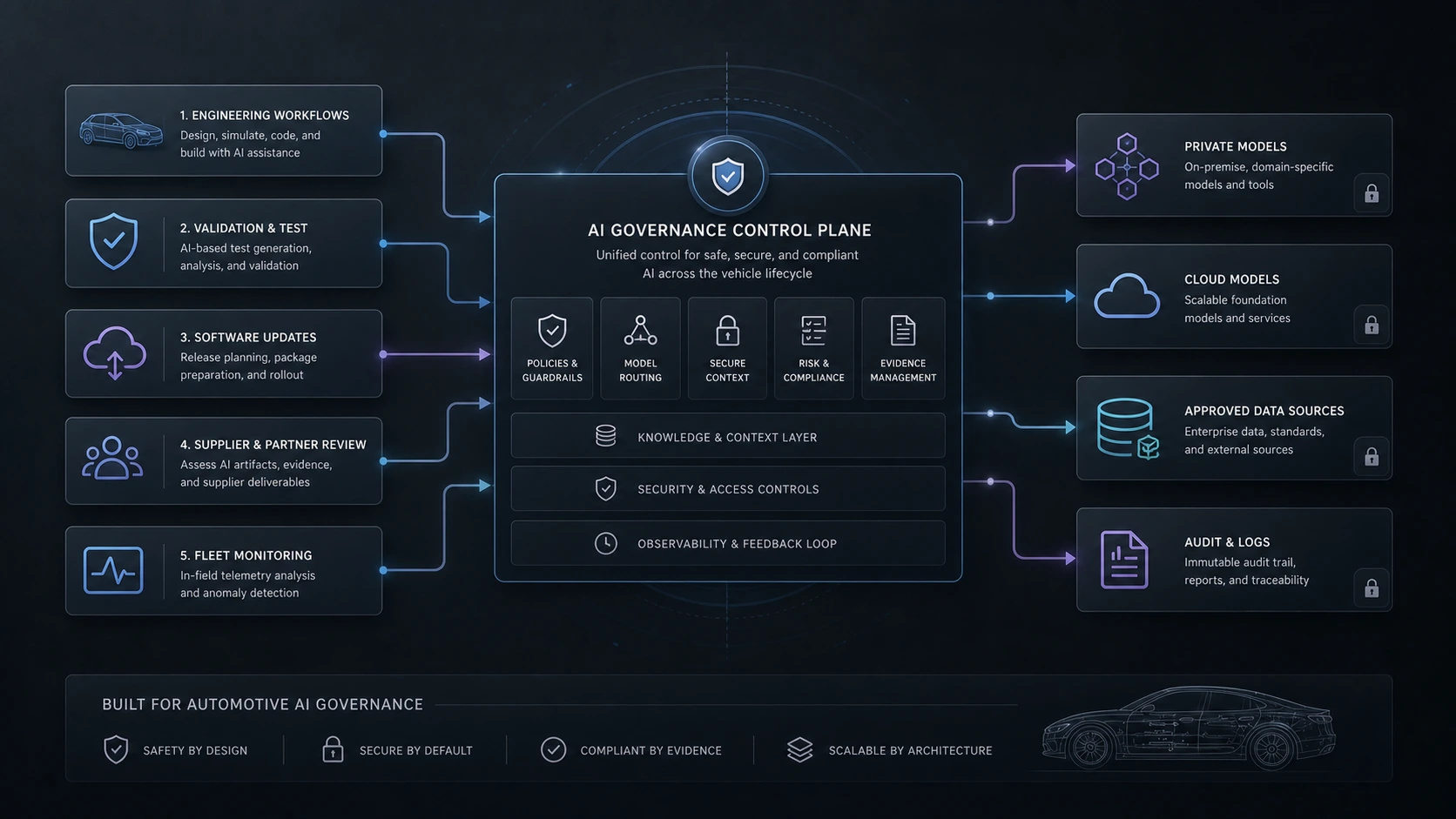
AgenixCore is relevant to this topic because automotive AI governance increasingly requires a control layer across users, models, tools, data, context, policy, cost, and audit logs.
AgenixCore is positioned as an AgenixCore AI control plane and enterprise AI gateway. It sits between people, applications, AI agents, APIs, models, tools, and enterprise data. Its product page describes access governance, model routing, secure context, cost controls, and audit logs as core platform capabilities. (AgenixHub)
For automotive organizations, AgenixCore is most relevant around enterprise AI operating workflows such as:
- governing internal AI usage across engineering, compliance, support, and operations;
- controlling which users and systems can access which models and tools;
- routing AI requests based on workload sensitivity, cost, and quality needs;
- assembling secure context from approved sources;
- logging AI interactions and policy decisions;
- maintaining visibility for security, finance, operations, and leadership.
It should not be positioned as a replacement for vehicle type approval, CSMS certification, SUMS certification, ISO/SAE 21434 work, ISO 26262 safety engineering, legal review, or regulatory authority engagement.
The right positioning is sharper:
AgenixCore helps automotive teams operate AI usage with governance, visibility, and control. It supports the operating discipline around AI workflows; it does not replace formal regulatory approval processes.
How AgenixHub helps automotive AI teams
AgenixHub's role is to help companies move from scattered AI adoption to managed AI operations.
For this article, the strongest AgenixHub offer mapping is:
| Reader problem | AgenixHub fit |
|---|---|
| "We do not know where AI is already being used across engineering, support, compliance, and operations." | AI Operating Efficiency Audit |
| "We need a governed AI operating layer across models, tools, data, and users." | AgenixCore / Managed AI Efficiency Layer |
| "We need to compare model paths for sensitive, high-quality, or private workflows." | Model Benchmarking Assessment |
| "We need AI workflows monitored after launch." | Managed AI Operations |
| "We need implementation help across RAG, private AI, model routing, and workflow orchestration." | Capabilities / Inward Deployed AI Engineers |
The Managed AI Efficiency Layer is especially relevant when teams need governance across access, routing, context, cost, audit, and observability. (AgenixHub)
Teams comparing private and public model paths for sensitive automotive workflows can also use the Model Benchmarking Assessment to evaluate where private models, cloud models, and workflow-specific routing make sense.
AgenixHub's broader AI Operating Efficiency capabilities also cover workload classification, model routing, RAG/context optimization, private/open-model deployment, and monitoring/governance. That matters when automotive teams need to decide which AI workflows should use cloud APIs, private models, controlled retrieval, or human review. (AgenixHub)
Practical automotive AI governance framework
Use this framework to operationalize WP.29-aware AI governance.
| Step | Question | Output |
|---|---|---|
| 1. Inventory | Where is AI being used? | AI workflow register |
| 2. Classify | What is the safety, cybersecurity, privacy, and business risk? | Risk tier per workflow |
| 3. Assign ownership | Who owns the model, data, system, supplier, and release decision? | RACI and approval map |
| 4. Control access | Who can use or modify the system? | Identity and entitlement policy |
| 5. Govern context | What data can the system access? | Approved context and data-source policy |
| 6. Validate | How do we know performance is acceptable? | Evaluation plan and validation evidence |
| 7. Secure | What threats apply to the system? | AI-aware threat model and controls |
| 8. Update | How are software/model changes released? | Versioning, approval, rollout, rollback plan |
| 9. Monitor | What changes after deployment? | Quality, latency, drift, incident, and update monitoring |
| 10. Audit | Can we prove decisions later? | Logs, evidence, review history, exception records |
This is the operating layer missing from many automotive AI programs.
A team may have regulatory experts. It may have AI engineers. It may have cybersecurity tooling. It may have cloud infrastructure. But if the controls are scattered across spreadsheets, ticketing tools, model notebooks, supplier portals, and disconnected dashboards, governance becomes reactive.
Common mistakes to avoid
Mistake 1: Treating WP.29 as only a cybersecurity problem
R155 is cybersecurity-focused, but automotive AI governance also touches data, models, validation, updates, suppliers, monitoring, and audit evidence.
Mistake 2: Treating model updates like ordinary content updates
An AI model update can change system behavior. That requires release discipline, testing, monitoring, rollback planning, and documentation.
Mistake 3: Using "autonomous" loosely
Use SAE J3016 terminology where possible. A driver assistance system and an automated driving system should not be described as if they carry the same operating assumptions. (SAE International)
Mistake 4: Assuming private AI automatically solves compliance
Private AI or on-prem deployment can improve control in some workflows, but it can also add operational burden. The right deployment path depends on safety exposure, data sensitivity, latency, cost, model quality, infrastructure maturity, and monitoring requirements.
Mistake 5: Waiting until approval or audit to assemble evidence
Evidence should be generated continuously as part of the operating workflow. Retroactive evidence assembly is expensive, slow, and risky.
Limitations and review notes
This article is an operating guide, not legal advice. Automotive companies should consult qualified regulatory, legal, cybersecurity, safety, and type-approval experts for specific vehicle programs.
Also:
- Not every automotive AI workflow is safety-critical.
- Not every AI model update has the same regulatory impact.
- Not every AI workload should use a frontier model.
- Not every sensitive workflow should automatically move on-prem.
- RAG and generative AI workflows require their own data-access and human-review controls.
- AI governance must be tested against real systems, not only policy documents.
- Regulatory expectations are evolving, especially around AI in regulated automotive safety systems.
FAQ
What is UNECE WP.29?
UNECE WP.29 is the World Forum for Harmonization of Vehicle Regulations. It is a global forum for technical vehicle regulations, including areas such as safety, environmental performance, cybersecurity, and connected or automated vehicle systems. (UNECE)
What is UN Regulation No. 155?
UN Regulation No. 155 covers vehicle cybersecurity and cybersecurity management systems. For AI-enabled vehicles, it is relevant because AI models, sensors, update infrastructure, vehicle-cloud APIs, and supplier components can all introduce cybersecurity risks. (UNECE)
What is UN Regulation No. 156?
UN Regulation No. 156 covers software updates and software update management systems. It is relevant to automotive AI because model updates, OTA releases, configuration changes, and software patches need controlled versioning, validation, rollout, rollback, and audit evidence. (UNECE)
Does R156 apply to AI model updates?
R156 covers software update management. Whether a specific AI model change is treated as a regulated software update depends on the system, vehicle function, jurisdiction, and approval context. Operationally, automotive AI teams should treat model updates with the same discipline as governed software releases: versioning, validation, approval, rollout, monitoring, and rollback readiness. (UNECE)
How does ISO/SAE 21434 relate to R155?
ISO/SAE 21434 defines cybersecurity engineering requirements for road-vehicle electrical and electronic systems across the lifecycle. It is commonly used as an engineering framework that supports R155 cybersecurity management expectations. (ISO)
How does ISO 24089 relate to R156?
ISO 24089 specifies requirements and recommendations for road-vehicle software update engineering at the organizational and project level. It is closely related to the software update management concerns covered by R156. (ISO)
Is there a dedicated WP.29 AI regulation?
WP.29 has been developing AI-focused work. UNECE states that an AI Informal Working Group was established in 2025 to compile vehicle AI use cases, terminology, standards, practices, regulations, and guiding questions for AI in regulated automotive safety systems. This signals active development, but teams should still treat R155, R156, ISO/SAE 21434, ISO 24089, ISO 26262, and applicable AI laws as part of today's operating context. (UNECE)
Where does AgenixCore fit?
AgenixCore fits where automotive organizations need a governed operating layer for AI usage: access governance, model routing, secure context, cost controls, observability, and audit logs. It should support AI operating discipline; it should not be positioned as a replacement for formal vehicle type approval, CSMS/SUMS certification, or legal/regulatory review. (AgenixHub)
Conclusion
UNECE WP.29 is becoming more important as vehicles become connected, software-defined, and AI-enabled. R155 and R156 already force automotive organizations to think in lifecycle terms: cybersecurity management, software update governance, supplier accountability, version control, incident response, and evidence.
AI raises the bar.
Models change. Data changes. Sensor environments change. Threats change. Suppliers change. Vehicle software changes after launch. Compliance cannot be managed only through static documentation.
Automotive AI teams need an operating layer that makes AI usage visible, governed, monitored, and auditable across the lifecycle.
That is where AgenixHub's AI Operating Efficiency approach fits: classify the workflows, understand the risk, choose the right model path, govern sensitive usage, monitor performance, and keep evidence available before a review, audit, release, or incident forces the question.
If your automotive AI usage is spreading across engineering, validation, support, software updates, and operations, start with an AI Operating Efficiency Audit. AgenixHub can help map where AI creates value, where it creates risk, and where a governed operating layer like AgenixCore can improve visibility, control, and readiness.