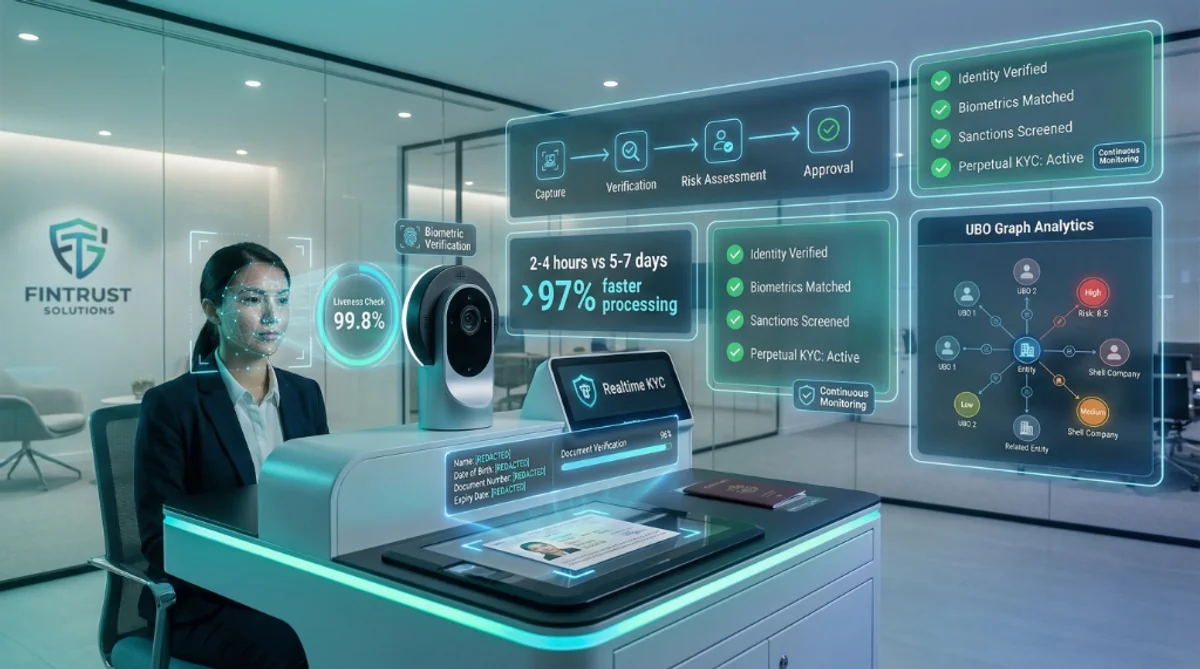
Key Takeaways
- Efficiency Gains: AI automation reduces KYC/AML processing times from 5-7 days down to just 2-4 hours, representing a 97% improvement in efficiency.
- Cost Reduction: Automated verification drives the cost per compliance check down from $30-$50 to under $5, saving mid-sized institutions millions annually.
- pKYC Shift: Moving from periodic reviews to Perpetual KYC (pKYC) enables 24/7 continuous monitoring, triggering alerts only when a customer's risk profile actually changes.
- Accuracy Improvement: AI fuzzy matching and Graph Neural Networks identify complex laundering rings and sanctioned entities with 99.2% document extraction accuracy.
What is KYC and AML Automation?
Quick Answer
KYC and AML automation utilizes artificial intelligence to reduce customer onboarding times by 97%, moving financial institutions from manual periodic reviews to 24/7 perpetual monitoring. By integrating biometric liveness checks, intelligent document processing, and Graph Neural Networks, firms can identify complex money laundering rings with 99.2% accuracy while reducing false positives by over 90% and cutting total compliance costs by 30-50%.
Quick Facts
- Processing Time: 2-4 hours vs. 5-7 days
- False Positive Reduction: 90%+
- Compliance Cost Reduction: 30-50%
- Document Accuracy: 99.2%
- Annual Savings (Mid-size): $1M-$4.9M
Key Questions
How does AI reduce the time for KYC approvals?
AI automates document extraction, biometric liveness checks, and adverse media screening simultaneously, allowing for instant "low-risk" approvals in seconds rather than days of manual cross-referencing.
What is Perpetual KYC (pKYC)?
Perpetual KYC is a shift from checking a customer every few years to 24/7 continuous monitoring, where AI triggers alerts only when significant risk changes—such as a sanctions hit or a change in corporate ownership—occur.
Can AI detect "Deepfake" IDs?
Yes, sophisticated AI defense models use pixel-level frequency analysis and "Active Flash" biometrics to detect artifacts and metadata inconsistencies that indicate an image or video was generated by a generative adversarial network (GAN).
Common Questions
Why is KYC taking so long manually?
Because it's a scavenger hunt. A human analyst must:
- Check the ID photo.
- Verify the address proof.
- Search Google for "Bad News" (Adverse Media).
- Check Sanctions lists (OFAC, UN, EU).
- Determine Ultimate Beneficial Ownership (UBO) for corporate clients.
AI does all 5 steps simultaneously in seconds.
How much does this save?
Millions. For a mid-sized institution, the cost of compliance checks is often $30-$50 per new customer. Automation drives this under $5.
Learn more about AI implementation costs.
- Case Study: A tier-1 bank reduced its manual review team by 40% while handling 2x the volume of applications.
- Savings: $1M - $4.9M annually for mid-sized firms.
Does it approve more customers?
Yes. Manual processes are slow and annoying. 30-40% of customers abandon the sign-up process if it takes more than 24 hours. Instant AI approval captures that lost revenue.
Deep Dive: The AI Compliance Stack
1. Intelligent Document Processing (IDP)
AI doesn't just "scan" a PDF; it understands it.
- Capability: Reads a blurred driver's license, detects if it's Photoshopped (Fraud check), and extracts the data.
- Accuracy: 99.2% document extraction accuracy.
2. Biometric Verification
Liveness detection ensures the person holding the phone is real.
- Test: "Blink twice" or "Turn your head."
- Prevention: Stops "spoofing" attacks using masks or Deepfakes.
3. Graph Analytics for AML
Money laundering involves complex webs of shell companies.
- Graph AI: Maps relationships: "Customer A shares an address with Company B, which is owned by Sanctioned Individual C."
- Result: Finds hidden risks that linear database searches miss.
4. Fuzzy Matching & Watchlist Screening
Legacy systems fail at spelling.
- Problem: Check list for "Osama bin Laden."
- Reality: Input says "Usama Ladin."
- AI Solution: Levenshtein Distance algorithms. It calculates the "phonetic similarity" of names. It knows that "Robert" and "Bob" are the same person, closing loopholes for sanctioned actors.
5. The Paradigm Shift: From Periodic to Perpetual KYC (pKYC)
The old model is broken.
- Legacy: You check a customer when they join. You check them again in 3 years.
- Risk: What if they get sanctioned on Day 2? You are exposing the bank for 2 years and 364 days.
- pKYC: The "Digital Twin" of the customer is monitored 24/7.
- Trigger: A change in corporate directorship.
- Trigger: A new adverse media article.
- Action: The system only alerts you when risk changes. No more "periodic reviews" of clean customers.
Technical Deep Dive: Detecting the Fake
How does AI spot a fake ID when a human can't?
- Microprint Analysis: Real IDs have text so small you need a microscope. High-res mobile cameras + AI can verify this pattern.
- Hologram Reflection: The AI asks recent phones to "tilt" the screen. It measures the light bounce off the hologram.
- EXIF Data Forensics: "Did this image come from a camera, or was it created in Photoshop?" The AI checks the metadata history.
Revolut: Speed as a Feature
Revolut onboarded 20 million customers rapidly.
- The Secret: "Passive Liveness." They don't make you do complex head movements. The AI analyzes the video stream frame-by-frame to ensure you are a 3D human, not a 2D screen.
- Impact: Customer acquisition cost (CAC) dropped to <$5.
Wise (formerly TransferWise): Global Coverage
Wise operates in 170 countries.
- The Challenge: Identifying a Ugandan Driver's License vs a Vietnamese Passport.
- The AI: Trained on a dataset of 3,500 distinct ID document types.
- Result: They can verify documents in languages their support team doesn't speak.
Tier-1 Global Bank: Clearing the Backlog
- Crisis: The regulator found a gap in historical files. The bank had to "re-KYC" 5 million existing customers.
- Manual Estimate: 5 years.
- AI Solution: They ran the entire database through an "OCR + Screening" engine.
- Execution: Completed in 4 months.
8. Implementation Roadmap: 8 Weeks to Automation
Phase 1: API Integration (Weeks 1-2)
- Mobile SDK: Embedding the camera capture tool into your iOS/Android app.
- Webhooks: Setting up the listeners (e.g.,
on.verification_completed).
Phase 2: Policy Configuration (Weeks 3-4)
- Risk Matrix: Defining "Who is High Risk?" (e.g., Politically Exposed Persons (PEPs) = High).
- Thresholds: "If Facial Match Score is < 80%, reject."
Phase 3: Analyst Training (Weeks 5-6)
- Dashboard Setup: Giving analysts a view where they see the ID, the Selfie, and the AI's risk score side-by-side.
- SOPs: Writing the Standard Operating Procedures for manual review.
Phase 4: Shadow to Live (Weeks 7-8)
- Shadow Mode: Run AI in parallel with humans. Compare results.
- Go Live: Turn on Auto-Approval for Low Risk customers.
7. The Math Behind the Savings
How do we justify the ROI? Here is the formula.
The Cost of Manual Review
Cost = (Volume * False_Positive_Rate * Review_Time * Hourly_Wage)
- Volume: 100,000 checks/month.
- False Positive: 15% (Standard legacy system).
- Review Time: 15 minutes.
- Wage: $40/hr (Senior Analyst).
- Monthly Cost:
100,000 * 0.15 * 0.25 * 40= $150,000/month.
The Cost with AI
- False Positive: 2% (AI optimization).
- Monthly Cost:
100,000 * 0.02 * 0.25 * 40= $20,000/month. - Annual Savings: $1.56 Million.
8. Audit Preparedness Checklist
When the regulator knocks, show them this.
- Data Lineage Map: Proof of where every data point on the customer (Address, ID) came from.
- Model Validation Report: A 3rd party certification that your AI isn't biased against specific nationalities.
- Decision Logs: An immutable record of why Customer X was approved. (e.g., "Approved by Rule 4: Facial Match > 95%").
- Change Management Log: Evidence that no code was changed without CCO approval.
Frequently Asked Questions
Is AI KYC compliant with FINRA Rule 3310?
Yes. Key regulators (FINRA, OCC) allow for the use of "Automated technology" as long as the models are validated and there is an audit trail. AI provides a better audit trail than humans, logging every check performed.
How does AI handle corporate KYC (KYB)?
It automates the "Unwrapping." AI agents can crawl corporate registries (like Companies House) to automatically build the ownership tree, identifying the Ultimate Beneficial Owners (UBOs) without manual digging.
Can AI detect "Deepfake" IDs?
It's an arms race. Sophisticated AI defense models look for pixel-level artifacts and metadata inconsistencies that indicate an image was generated or manipulated, often spotting fakes the human eye accepts.
What happens when the AI is unsure?
Human-in-the-Loop. The system provides a confidence score.
- 90%+: Auto-Approve.
- 10-90%: Route to Analyst (with notes on what is suspicious).
- Less than 10%: Auto-Reject.
9. Vendor Landscape: The Identity Titans
Who should you partner with?
1. The Document Specialists (Onfido, Jumio)
- Strength: Computer Vision. They are the best at spotting a fake passport.
- Use Case: Global verification (Travel, Uber, Neo-banks).
2. The Data Aggregators (Socure, LexisNexis)
- Strength: "Passive" Identity. They know that "John Smith" lives at "123 Main St" because they have 500 databases saying so.
- Use Case: US Banking, Credit Card origination (Low friction).
3. The Orchestrators (AgenixHub, Alloy)
- Strength: Logic.
- Role: We don't just verify the ID; we decide which vendor to call.
- Logic: "If the user is in the US, call Socure (Cheap). If the user is in Vietnam, call Onfido (Better coverage)."
- Benefit: Reduces total cost by 40% by routing traffic intelligently.
10. The Human Factor: Saving Your Analysts
Compliance has the highest turnover rate in banking. Why? Burnout.
The Old Way (Burnout Factory)
- Task: "Alert 40994: Name Match."
- Analyst: Opens Google. Searches name. Finds nothing. Closes alert. (Repeat 200 times/day).
- Result: "Alert Fatigue." Real misses happen because the analyst is a zombie.
The AI Way (Super-Analyst)
- Task: "Alert 40994: High Risk."
- AI: "I flagged this because his address matches a known shell company in Panama (Score: 92%). Here is the link to the Panama Papers database."
- Analyst: "Good catch. Escalating."
- Result: Purpose-driven work. Higher retention.
11. The Future: Decentralized Identity (Web3)
The ultimate solution to KYC is... not doing it.
- Concept: Self-Sovereign Identity (SSI).
- Flow:
- User verifies ID once with a Government provider.
- User gets a "Verified Token" in their digital wallet.
- User goes to Bank A.
- Bank A asks: "Do you have a Token?"
- Wallet says: "Yes."
- Bank A: "Welcome."
- Impact: Zero data storage for the bank. Zero friction for the user. (Coming 2027+).
The enemy is innovating.
Attack Vector 1: The "Morph"
- Technique: Fraudsters merge two faces (Criminal + Innocent) into one photo.
- Result: The ID looks like the Criminal to the human eye, but the AI recognition engine matches it to the Innocent person.
- Defense: "Pixel-level frequency analysis" to detect image blending.
Attack Vector 2: The "Presentation Attack"
- Technique: Holding a high-res iPad screen with a video of a stolen face in front of the camera.
- Defense: "Active Flash." The phone screen flashes a random color sequence (Red, Blue, Green) and measures the reflection on the skin. Screens reflect differently than skin.
Attack Vector 3: Synthetic Identity Farms
- Technique: Using real SSNs of children (who have no credit history) combined with fake names.
- Defense: Analyzing "Data Consistency." Is this 8-year-old applying for a Platinum Amex?
10. Global Variations: One World, Many Rules
You cannot deploy one model globally.
Europe (GDPR)
- Constraint: You cannot store biometric data (the face vectors) indefinitely.
- Solution: You must hash the data or delete it after verification (Data Minimization).
USA (Patriot Act)
- Constraint: You MUST store the ID copy for 5 years.
- Conflict: This directly opposes the EU's "Right to be Forgotten." You need region-specific data buckets.
Asia (Aadhaar / SingPass)
- Trend: Government-backed Digital IDs.
- Impact: KYC is instant because you just ping the Govt API. AI is less about verification and more about "Consent Management."
11. Glossary of Compliance AI
- Liveness Detection: The technology that proves a user is present, alive, and not a recording.
- Sanctions Screening: Checking a name against lists like OFAC (Office of Foreign Assets Control).
- Adverse Media: Negative news (e.g., "John Doe arrested for fraud").
- PEP (Politically Exposed Person): A government official. They are high risk for bribery, so they trigger Enhanced Due Diligence (EDD).
- UBO (Ultimate Beneficial Owner): The human who actually owns the company, hiding behind layers of shell corps.
- False Positive Rate: The % of good customers who are flagged as bad. (Industry average: 15-30%. AI Target: <2%).
12. Case Study: The Cost of Failure
Why does this matter?
- The Incident: In 2023, a major crypto exchange was fined $4.3 Billion.
- The Failure: They allowed users to trade without KYC ("VIP" accounts). They bypassed their own controls to chase growth.
- The Lesson: Compliance is not optional. It is the "License to Operate." If you turn off the AI to grow faster, you will lose the entire company.
13. The Blockchain Future: An Immutable Truth
Why Blockchain matters for AML.
- Problem: Banks have siloed databases. Bank A doesn't know that Customer X laundered money at Bank B.
- Solution: A shared, private blockchain (Permissioned Ledger) for "Bad Actors."
- Mechanism:
- Bank A flags Customer X. hash of the suspicious activity is put on the chain.
- Customer X tries to open an account at Bank B.
- Bank B checks the chain. "Hit found." Account denied.
- Privacy: Zero-Knowledge Proofs ensure Bank B knows that X is bad, without knowing why (preserving privacy).
Summary
In summary, automating KYC and AML with AI is a strategic necessity for financial institutions looking to balance rapid growth with rigorous compliance. By moving to perpetual monitoring and automated document verification, banks can deliver a frictionless onboarding experience while significantly reducing the risk of regulatory fines and money laundering.
Recommended Follow-up:
- Financial Services AI Implementation Guide
- Financial Services Regulatory Compliance Guide
- Financial Services Fraud Detection
Stop slowing down your good customers: Contact AgenixHub to deploy Frictionless KYC.
Modernize your identity and laundering defenses. Implement autonomous KYC/AML with AgenixHub.