Key Takeaways
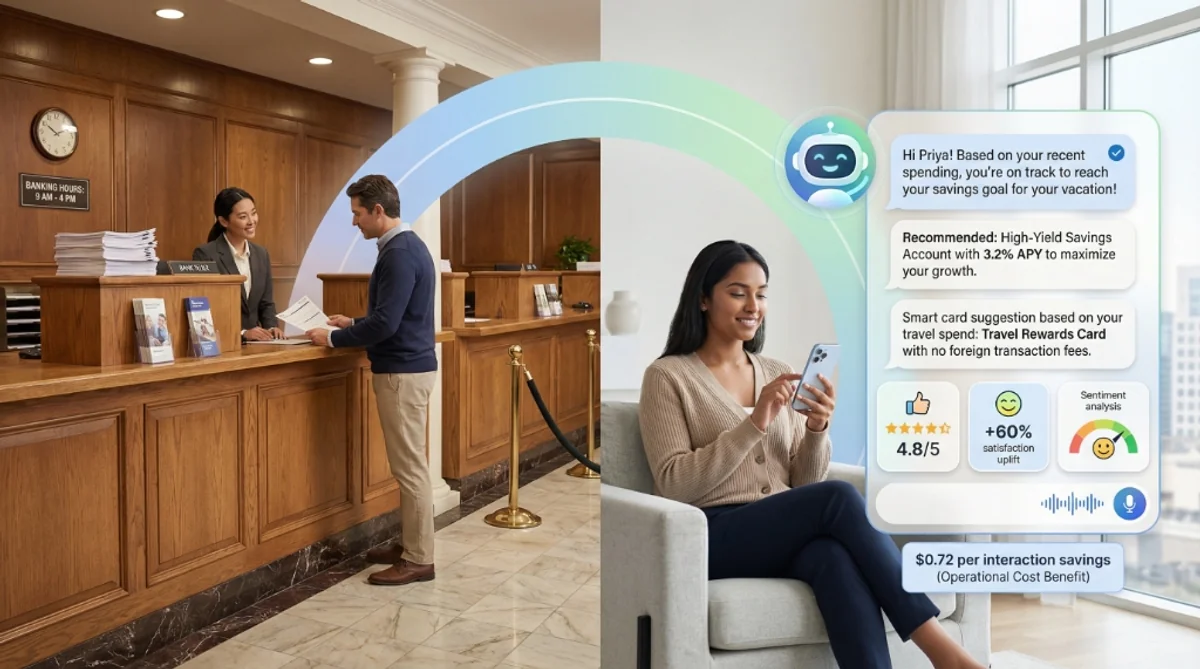
- Operational Savings: AI-driven interactions cost approximately $0.72 each, delivering a 30-50% reduction in support costs compared to manual call center engagements ($6-$12/call).
- Hyper-Personalization: Shifting from demographic segmentation to "N-of-1" personalization increases engagement rates by 80% by utilizing real-time transaction and clickstream data.
- Improved Retention: Real-time sentiment analysis of customer interactions can detect frustration early, allowing banks to reduce churn by up to 25% through proactive intervention.
- Efficiency Gains: AI resolves 85% of routine queries quickly, reducing typical resolution times from 11 minutes down to approximately 2 minutes per interaction.
What is AI Banking Customer Experience?
AI banking customer experience refers to the application of artificial intelligence technologies—including generative AI, predictive analytics, and conversational interfaces—to enhance how financial institutions interact with and serve their customers. It describes the systematic use of machine learning algorithms to analyze customer data, automate service delivery, personalize financial recommendations, and create seamless digital banking interactions across multiple channels.
Quick Answer
AI is transforming banking customer experience (CX) by replacing reactive support with proactive, hyper-personalized financial advice that resolves 85% of queries quickly. By shifting from broad segmentation to individual "N-of-1" modeling, financial institutions can achieve a 60% increase in customer satisfaction scores while reducing operational support costs by 30-50% and typical resolution times from 11 minutes down to 2 minutes.
Quick Facts
- Chatbot Cost Savings: ~$0.72 per interaction
- CSAT Score Increase: ~60%
- Support Cost Reduction: 30-50%
- Churn Reduction: 25%
- Resolution Time: ~2 minutes (AI) vs 11 minutes (Manual)
Key Questions
How do AI chatbots reduce banking operational costs?
AI chatbots handle up to 85% of routine queries like password resets and balance checks, reducing interaction costs from $6-$12 (human) to just pennies per engagement.
What is hyper-personalization in banking?
Hyper-personalization is the "N-of-1" marketing approach where AI analyzes individual spending habits and lifecycle events to offer specific, real-time nudges—like travel alerts or personalized loan rates—rather than generic segment-based offers.
Can AI help prevent customers from leaving my bank?
Yes, AI-driven sentiment analysis monitors calls and chats to detect frustration in real-time. By flagging "Churn Risk" early, banks can proactively offer fee waivers or tailored products to reduce churn by 25%.
Common Questions
How much money do AI chatbots save?
Learn more about AI implementation costs.
Approximately $0.72 per interaction. While a traditional call center interaction costs between $6 and $12, an AI interaction costs pennies.
- Volume: A typical bank handles millions of calls.
- Impact: Gartner estimates the banking industry will save $80 billion annually by 2025 through conversational AI.
They like solving problems. Customers often prefer digital self-service for simple tasks like password resets, especially when it saves them a 20-minute hold time. Progress depends on a seamless hand-off where AI transfers full context to a human agent when complexity exceeds its capabilities.
- Acceptance: 77% of customers prefer digital self-service for simple tasks.
- The Key: Seamless hand-off. The AI must know when to say, "I can't handle this, let me get a human," passing the full context so the user doesn't have to repeat themselves.
What is "Hyper-Personalization"?
It's the "Netflix Effect" for banking. Instead of sending the same credit card offer to everyone, AI analyzes spending habits.
- Scenario: The AI sees you purchase a flight.
- Action: It sends a notification: "You're traveling next week! Do you want to enable travel mode on your card to prevent unnecessary blocks?"
- Result: 80% higher engagement rates than generic marketing.
The Death of Segmentation (N=1)
Marketing used to be about "Segments" (e.g., "Males, 25-34, Urban").
- Problem: Not all 28-year-old males want the same thing. One wants a motorbike loan; the other wants a mortgage.
- Solution: N-of-1 Personalization. The AI treats every single customer as a unique market of one.
- Data Points: It combines Transaction History + Clickstream Data (what you looked at on the app) + External Data (Interest rates) to predict your specific next need.
Technical Deep Dive: The Engines of Empathy
How does software understand human needs?
1. Large Language Models (LLMs) vs. Legacy Chatbots
- Legacy (2015-2022): "Decision Trees." You had to guess the keyphrase.
- User: "I got overcharged."
- Bot: "I didn't understand. Did you mean 'Balance Inquiry'?"
- Frustration: High.
- Generative AI (2025): Semantic Understanding.
- User: "I noticed a double tap at Starbucks."
- Bot: "I see two charges for $5.45 at Starbucks today. Would you like me to dispute the duplicate?"
- Technology: Transformer architecture (GPT-4 class models) trained on financial corpuses.
2. Voice AI & Biometrics
- Authentication: "My voice is my password."
- Al analyzes 100+ vocal characteristics (pitch, cadence, throat shape).
- Benefit: Eliminates the "What is your mother's maiden name?" interrogation, stripping 45 seconds off every call.
- Sentiment Detection:
- Real-time analysis of tone. If a customer raises their voice, the AI flashes a "De-escalation Script" on the agent's screen.
3. Next Best Action (NBA) Engines
- Concept: Reinforcement Learning.
- Logic: The AI simulates 1,000 possible offers for you.
- Option A: Mortgage Refi? (Likelihood: 2%).
- Option B: Auto Insurance? (Likelihood: 12%).
- Option C: Increase Savings limit? (Likelihood: 65%).
- Delivery: It presents Option C at the exact moment you log in.
Deep Dive: 3 Pillars of AI Customer Experience
1. Conversational Banking (The New Teller)
Modern AI agents (LLMs) understand intent, not just keywords.
- User: "I lost my card."
- AI: "I'm sorry to hear that. I've locked it to prevent fraud. Would you like me to issue a replacement to your home address?"
- Outcome: Resolution in seconds, zero stress.
2. Robo-Advisory & Wealth Management
Democratizing financial advice for the masses.
- Market: Global assets under management (AUM) by robo-advisors will hit $1.9 Trillion by 2028.
- Tech: Algorithms automatically rebalance portfolios based on market shifts and the client's risk tolerance, a service previously reserved for millionaires.
3. Sentiment Analysis & Churn Prevention
AI listens to calls and reads chats to detect emotion.
- Alert: "Customer John Doe is expressing frustration (Anger Score: 8/10) about fees."
- Action: System flags a "Churn Risk" and prompts a Relationship Manager to call with a fee waiver offer.
- Stats: Companies using this approach reduce customer churn by 25%.
Real-World Case Studies
Bank of America (Erica): 1 Billion Interactions
Erica is the gold standard for Voice AI.
- Scale: 1+ Billion interactions/year.
- Feature: "Spend Path." It predicts your balance 7 days from now based on recurring bills.
- Impact: 98% of users who use it say they feel "more in control" of their finances.
Klarna: The AI Workforce
In 2024, Klarna revealed its OpenAI-powered assistant.
- Volume: Handules 2.3 million conversations (2/3rds of all service chats).
- Equivalence: Does the work of 700 full-time human agents.
- Speed: Reduced resolution time from 11 minutes to 2 minutes.
- Impact: $40 Million USD in estimated profit improvement.
Commonwealth Bank of Australia (CBA): The "Cega" Brain
CBA uses a "Customer Engagement Engine" that makes 30 million decisions per day.
- Function: Every time you tap your card, log in, or call, the engine re-calculates the "Next Best Conversation."
- Result: It can detect if you are dealing with a natural disaster (based on location) and automatically offer emergency overdraft protection before you ask.
Calculate Your Support Savings
See how much you could save by reducing fraud losses and manual review time.
7. Implementation Roadmap: Building the "Customer 360"
Phase 1: The Unified Data Layer (Months 1-3)
- CDP Deployment: Implement a Customer Data Platform (e.g., Salesforce Genie, Adobe MVP).
- Data Federation: Connect Core Banking, Credit Cards, and Mortgage systems.
- Goal: A single view where "John Smith" is one person, not three account numbers.
Phase 2: The Logic Later (Months 3-6)
- Deployment: Install the NBA (Next Best Action) engine.
- Rules: Define "hard rules" (Do not market credit cards to bankrupt users).
- Pilot: Launch on the Mobile App first (Low risk).
Phase 3: The Engagement Layer (Months 6+)
- Omnichannel: Push the same logic to the Call Center, Branch Tablets, and ATM screens.
- Goal: If John declines the offer on the app, the Teller doesn't ask him again 1 hour later.
8. New Metrics: Beyond NPS
Net Promoter Score (NPS) is a lagging indicator. AI moves to:
- Customer Effort Score (CES): How hard was it to solve the problem?
- First Contact Resolution (FCR): Did the bot solve it, or did it escalate?
- Conversation Quality: Automated analysis of "Did the customer say 'Thank you' or 'Finally'?"
5. The Future of Branches: "Phygital" Banking
The branch isn't dead; it's changing.
The Problem
- Nobody goes to a branch to check their balance.
- They go for complex advice (Mortgage, Wealth).
The AI Solution (Smart Branch)
- Arrival: You walk in. Facial recognition (opt-in) identifies you as a "High Net Worth Client."
- Tablet: The heavy tablet in the lobby already knows you started a mortgage application on your phone last night. It displays: "Resume Application?"
- The Human: The banker's iPad shows your "Relationship Map" (Family, Business) so they can ask: "How is your daughter's college fund going?"
6. A Detailed 90-Day Pilot Plan
Don't boil the ocean. Start small.
Month 1: Discovery & Data
- Week 1: Map the "Customer Journey" for one product (e.g., Auto Loan).
- Week 2: Audit data sources. Do we have credit scores? Do we have clickstream data?
- Week 4: Select a vendor (Build vs Buy decision).
Month 2: The Logic
- Week 5: Build the propensity model. "Who is likely to buy a car?"
- Week 7: Design the creative (Email templates / Push Notifications).
Month 3: Execution
- Week 9: A/B Test.
- Group A: Generic "Low Rates" email.
- Group B: AI-personalized "John, here are rates for a 2025 Ford F-150."
- Week 12: Readout results. (Expect 3x conversion in Group B).
Frequently Asked Questions
Will AI replace human financial advisors?
No. It replaces the spreadsheet work. Advisors spend less time analyzing charts and more time understanding their clients' life goals (buying a house, retiring). AI creates the plan; the advisor validates and communicates it.
Is my financial data safe with a chatbot?
Yes. Enterprise banking chatbots rely on Private AI. Your data hits the bank's secure server, is processed, and the answer is returned. It is not sent to public model training sets.
How does AI improve cross-selling?
Relevance. Instead of "Product Push," AI does "Needs Analysis." It notices you have a high balance in a low-interest checking account and suggests a CD or Savings product, increasing "Share of Wallet" by 20-30%.
Can AI handle debt collection?
Surprisingly well. AI agents can negotiate repayment plans via text/chat. Many customers feel less embarrassed talking to a bot about debt than a human, leading to 30-40% higher cure rates.
9. The Psychology of Money: AI Nudges
Behavioral Economics teaches us that humans are irrational. AI can help.
The "Nudge" Theory in Banking
- Problem: People want to save, but buying shoes feels better now.
- AI Solution: "Hyperbolic Discounting Counter-Measures."
- Trigger: You walk into a shoe store (Geolocation).
- Nudge: Phone buzzes. "Hey, you are $50 away from your savings goal of 'Mexico Trip'. If you spend this, the trip moves to November."
- Result*: Reframing the expense vs the goal.
Gamification
- Concept: Making finance addictive (in a good way).
- Execution:
- "You are in the top 10% of savers in your zip code!" (Social Proof).
- "3-day streak of no coffee purchases." (Streaks).
10. Vendor Landscape: Building the Stack
Who builds this stuff?
The Big Clouds (Build)
- AWS Personalize / Google Recommendations AI:
- Pros: Best class algorithms.
- Cons: You need 50 engineers to stitch it together.
The Marketing Clouds (Buy)
- Salesforce Marketing Cloud / Adobe Experience Platform:
- Pros: easy UI for marketers.
- Cons: Expensive and often disconnected from real-time transaction data.
The Hybrids (AginexHub Approach)
- We sit between your Core Banking and your App.
- We ingest the data, run the decisioning, and trigger the generic marketing tool to send the email. The "Brains" are separate from the "Mouth."
11. Glossary of CX AI Terms
- Propensity Model: A score (0-100) indicating how likely a user is to buy Product X.
- Churn Prediction: A score indicating how likely a user is to close their account in 30 days.
- Omnichannel: Ensuring the conversation history is shared between the Chatbot, the Call Center, and the Branch.
- Customer Data Platform (CDP): The database that holds the "Golden Record" of the customer.
- Sentiment Analysis: Using NLP to determine if a text is Positive, Neutral, or Negative.
12. The Creepy Line: Privacy vs. Personalization
When does "Helpful" become "Stalking"?
The Uncanny Valley of Banking
- Good: "You spent $200 on dining this week."
- Bad: "We saw you at the bar on 5th Street at 2 AM."
Best Practices for Privacy
- Transparency: Always tell the user why you made a recommendation. "Because you looked at auto loans..."
- Control: Give users a "Snooze" button on insights.
- Data Minimization: Don't use location data unless strictly necessary (e.g., fraud prevention).
13. UX Design Checklist for AI Features
AI is only as good as the interface.
- Latency Indicators: If the AI takes 3 seconds to think, show a "Thinking..." animation. Don't freeze the screen.
- Confidence Scores: If the AI isn't sure, have it ask clarifying questions ("Did you mean X or Y?").
- Escalation Path: The "Talk to Human" button should be visible at all times. Never trap the user in a bot loop.
- Tone consistency: Ensure the bot sounds like your brand (Professional vs Playful).
Summary
In summary, AI is redefining the banking customer journey by replacing static segments with "N-of-1" hyper-personalization. By leveraging real-time transaction data and conversational AI, banks can resolve issues faster, predict customer needs more accurately, and create a truly empathetic digital banking experience.
Recommended Follow-up:
- Financial Services AI Implementation Guide
- Financial Services Regulatory Compliance Guide
- Healthcare AI ROI Case Studies
Transform your customer journey: Contact AgenixHub to build a roadmap for Hyper-Personalized Banking.
Don't let your customers wait on hold. Implement hyper-personalized AI banking experiences with AgenixHub.