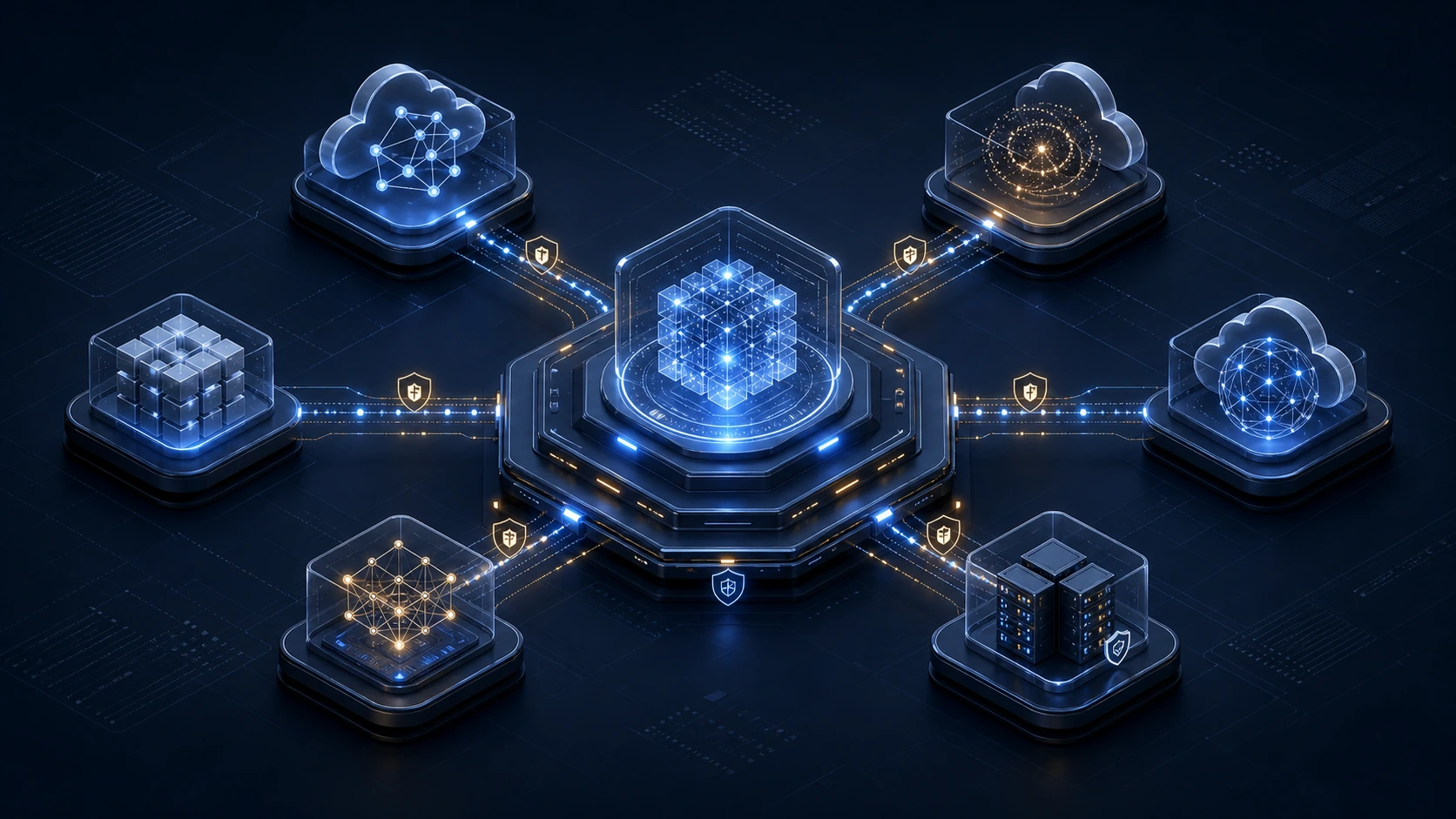
Enterprise AI is moving from experimentation to infrastructure. Teams are no longer asking only, "Which model should we use?" They are asking a harder question:
Where should each AI workload run, who should be allowed to use it, what data can it access, which model path should it take, and how do we monitor it after launch?
That is the real private AI infrastructure problem.
Private AI infrastructure is not just an LLM running on company-owned servers. It is the architecture, policy, routing, retrieval, monitoring, and operating model that lets an organization use AI while keeping sensitive data, access, and business risk under control.
Quick answer: What is private AI infrastructure?
Private AI infrastructure is the controlled environment an enterprise uses to run AI workloads with stronger control over data, access, model paths, retrieval, monitoring, and auditability. It can include private cloud, VPC, on-prem servers, self-hosted models, private RAG systems, secure APIs, vector databases, model-routing logic, and governance controls.
The important point: private AI is not always the same as on-prem AI. On-prem is one deployment option. Private AI is the broader operating decision about which workloads need stricter boundaries and which can safely use managed cloud or public model APIs.
Why private AI infrastructure is becoming an enterprise priority
Most companies adopted AI before they built an operating model for it.
Employees use chat interfaces. Product teams connect model APIs. Engineering teams test RAG systems. Business teams experiment with copilots. Vendors add AI features into existing software. Suddenly, AI is everywhere, but ownership is unclear.
Private AI infrastructure becomes important when AI starts touching:
- customer records,
- employee data,
- financial documents,
- contracts,
- source code,
- regulated knowledge,
- confidential strategy,
- internal policies,
- operational workflows,
- proprietary datasets,
- agent actions across business systems.
At that point, the infrastructure question is no longer only about model quality. It becomes a control question.
Can this data leave the organization's environment?
Which users should be allowed to query it?
Should this request go to a frontier model, a private model, a local model, or a hybrid RAG path?
Should the system store the prompt, response, retrieved documents, and policy decision?
Who reviews failures?
How do security, finance, compliance, and business teams see what is happening?
That is where private AI infrastructure needs to be designed as an operating layer, not just a deployment target.
Private AI vs public AI vs on-prem AI
These terms are often mixed together. They should not be.
| Term | What it means | Best for | Main risk |
|---|---|---|---|
| Public AI API | A managed model API from a third-party provider | Fast prototyping, general workflows, frontier reasoning | Data handling, visibility, vendor dependency |
| Controlled cloud AI | Managed AI inside a cloud account with private networking and enterprise controls | Enterprise apps that need cloud governance | Cloud configuration complexity |
| Private cloud AI | AI stack running in a dedicated private cloud environment | Sensitive workloads needing stronger isolation | Operational ownership |
| VPC-based AI | AI services deployed inside controlled virtual private cloud boundaries | Enterprise workloads needing network-level controls | Architecture and policy design |
| On-prem AI | AI models and infrastructure running inside company-owned data centers | High-sensitivity, sovereignty, latency, or disconnected environments | CapEx, skills, maintenance |
| Private AI infrastructure | The broader control architecture for private, hybrid, and governed AI workloads | Enterprises needing workload-level routing and governance | Poor design if treated as only infrastructure |
Private AI infrastructure may include on-prem AI, but it does not have to. A mature enterprise usually needs a hybrid model: some workloads can use managed APIs, some need controlled cloud paths, and some should stay inside private environments.
Start with the data boundary, not the model
The most common private AI mistake is starting with a model decision.
A team says, "We need a private LLM."
Maybe they do. Maybe they do not.
A better starting point is the data boundary.
Before choosing OpenAI, Azure OpenAI, AWS Bedrock, Claude, Mistral, Llama, vLLM, NVIDIA AI Enterprise, private cloud infrastructure, or on-prem GPUs, classify the actual work.
Ask:
- What data does the workload touch?
- Is the data public, internal, confidential, regulated, or highly restricted?
- Does the model need retrieval from enterprise documents?
- Does the answer need citations?
- Can the prompt or retrieved context leave the environment?
- What level of latency is acceptable?
- What quality threshold is required?
- Does the task need a frontier model?
- Can a smaller private model handle it?
- What needs to be logged for audit or troubleshooting?
This is why private AI infrastructure should begin with workload classification.
A support FAQ summarization workflow is not the same as legal contract review. Internal knowledge search is not the same as financial risk analysis. Batch content classification is not the same as a customer-facing AI agent with tool access.
Private AI is not one big switch. It is a routing map.
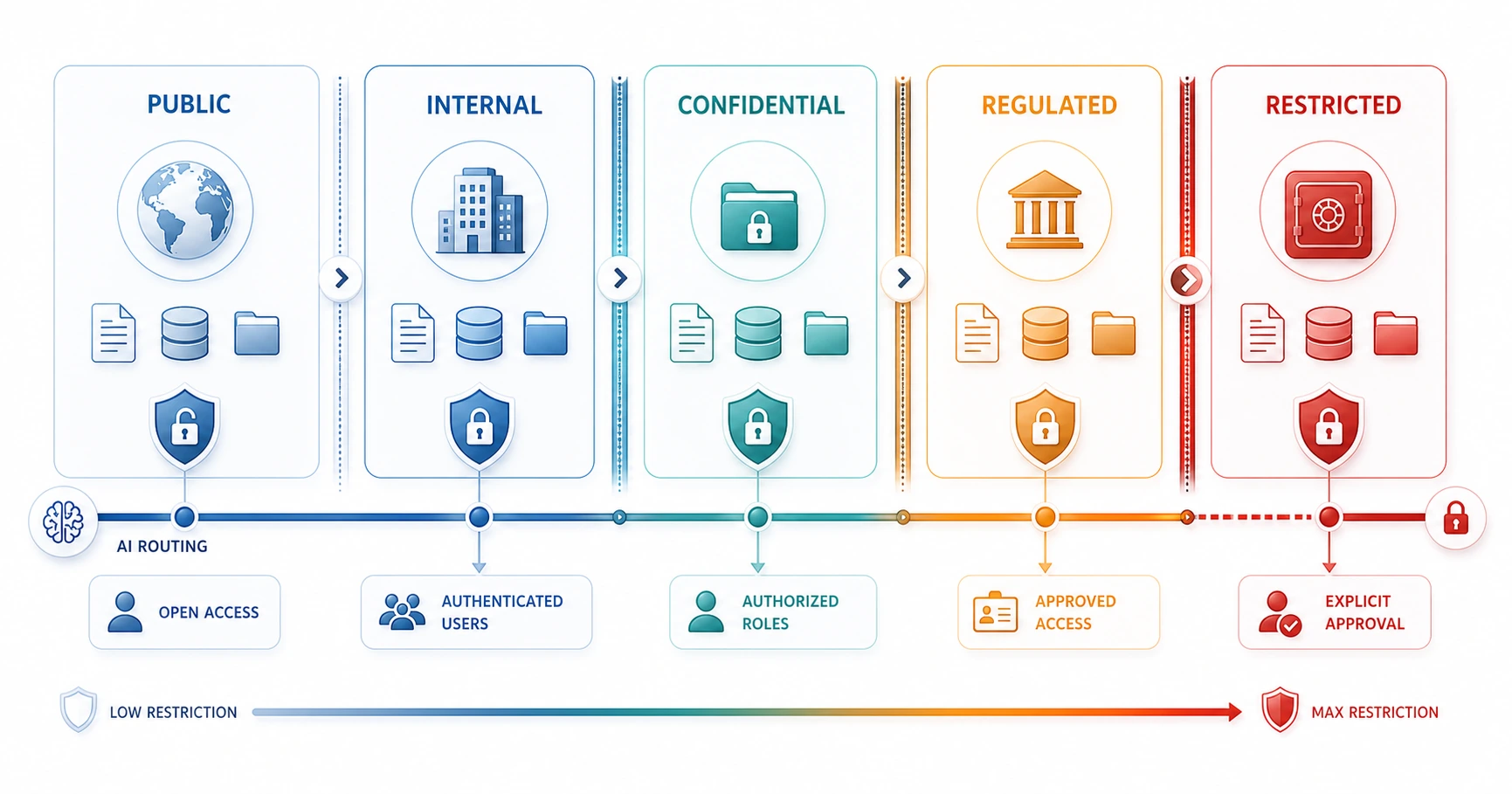
The private AI workload classification framework
Use this framework before choosing infrastructure.
| Workload type | Data sensitivity | Model need | Recommended path |
|---|---|---|---|
| Public content generation | Low | Medium | Managed API or low-cost hosted model |
| Internal policy search | Medium | Medium | Controlled cloud RAG or private RAG |
| Customer support with account data | High | Medium-high | Private RAG with strict access controls |
| Legal or compliance review | High | High | Private or controlled cloud path with human review |
| Source code assistance | Medium-high | Medium-high | Hybrid path with repository controls |
| Regulated knowledge assistant | High | High | Private cloud or on-prem RAG with audit logs |
| High-volume classification | Low-medium | Low-medium | Private or open model for cost efficiency |
| Agentic workflow with business-system actions | High | High | Governed control plane with policy, logging, and approvals |
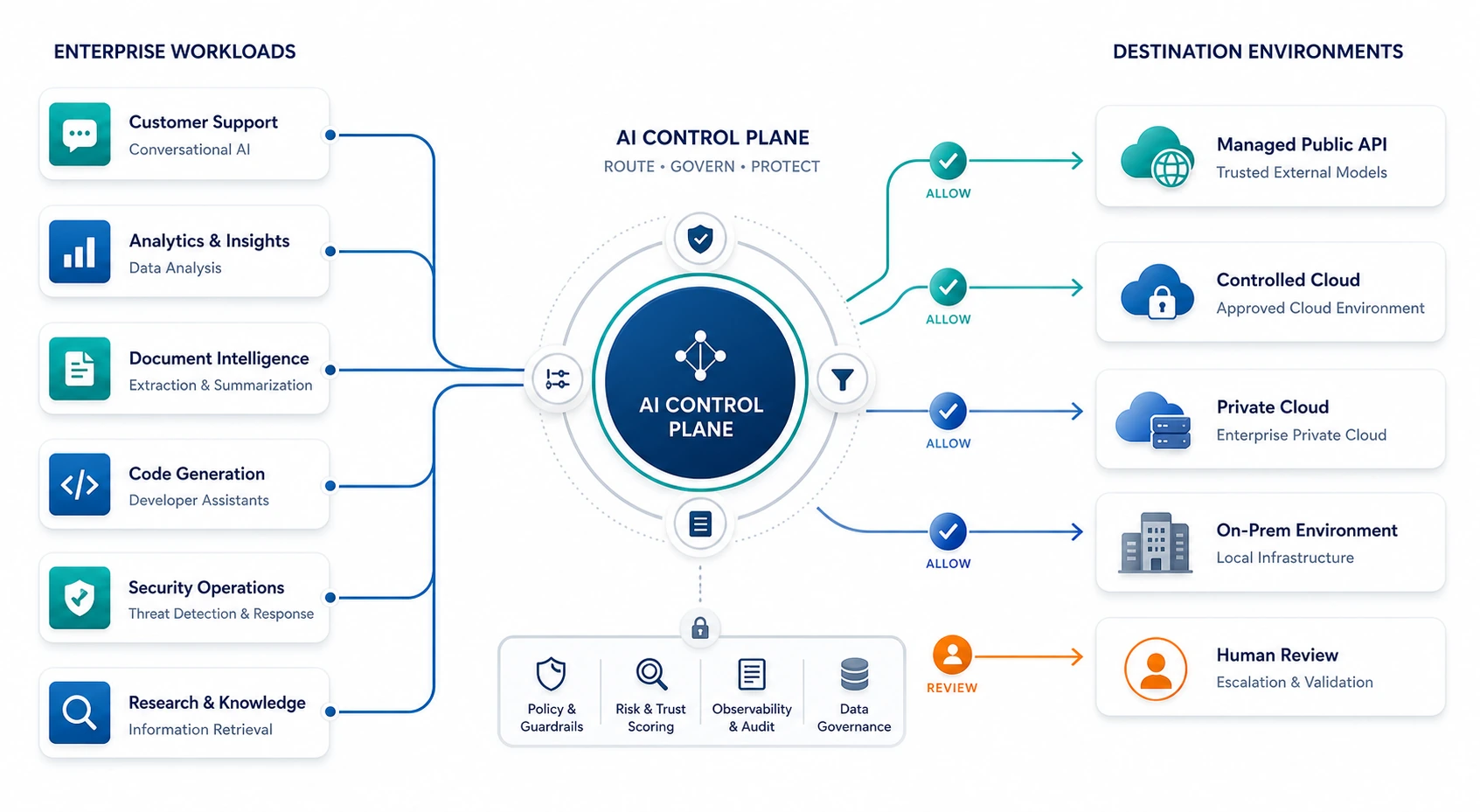
This is the operating idea behind private AI infrastructure: route each workload to the safest, most efficient model path that meets the business requirement.
Some tasks deserve frontier models. Some do not.
Some tasks can use managed APIs. Some cannot.
Some tasks need private retrieval, not private model training.
Some tasks need human review more than they need a larger model.
Core components of private AI infrastructure
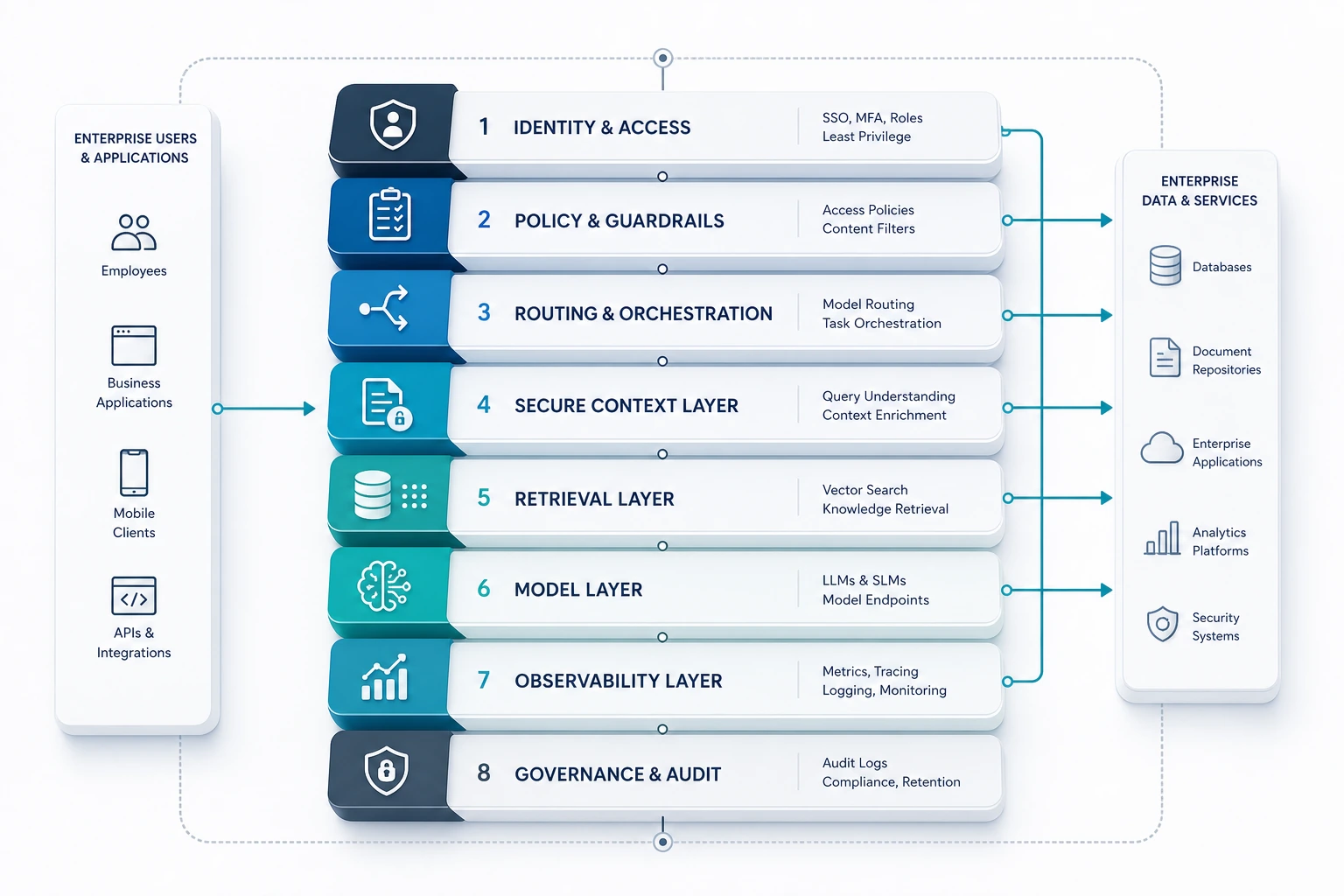
A serious private AI architecture usually includes nine layers.
1. Identity and access layer
Private AI starts with knowing who is making the request.
The system should understand:
- user identity,
- role,
- team,
- permissions,
- data entitlements,
- application context,
- whether the user is allowed to access the requested source.
For RAG systems, this matters because the AI should not retrieve documents the user is not allowed to see. If the retrieval layer ignores permissions, the AI can accidentally become a data leakage engine.
2. Policy layer
The policy layer decides what should happen before a request reaches a model.
It can decide:
- allow,
- block,
- redact,
- route,
- require human review,
- use a specific model,
- use a specific retrieval source,
- apply a spend limit,
- log the request for audit.
This is where private AI moves from "a model running somewhere" to "an enterprise system under control."
3. Model routing layer
Model routing determines which model or model path should handle a request.
Routing can be based on:
- data sensitivity,
- task type,
- cost,
- latency,
- required quality,
- business unit,
- user role,
- regulatory exposure,
- available context,
- fallback requirements.
For example:
- Low-risk summarization can use a smaller private model.
- Complex reasoning may use a frontier model through a governed path.
- Sensitive HR review may stay inside a private model environment.
- RAG search may use one model for retrieval and another for generation.
- Customer-facing agents may require stricter guardrails and audit logs.
Without routing, enterprises often overuse expensive models for routine tasks and under-control sensitive tasks that deserve stricter boundaries.
4. Secure context layer
Most enterprise AI value comes from context.
That context may come from:
- documents,
- knowledge bases,
- databases,
- CRM systems,
- tickets,
- contracts,
- policies,
- code repositories,
- data warehouses,
- internal applications.
Private AI infrastructure needs a secure way to assemble context from trusted sources. This includes document permissions, retrieval filters, PII detection, context limits, redaction, and traceability.
A private model without secure context may still produce weak answers. A public model with uncontrolled context may create data exposure. The right answer is usually governed context assembly.
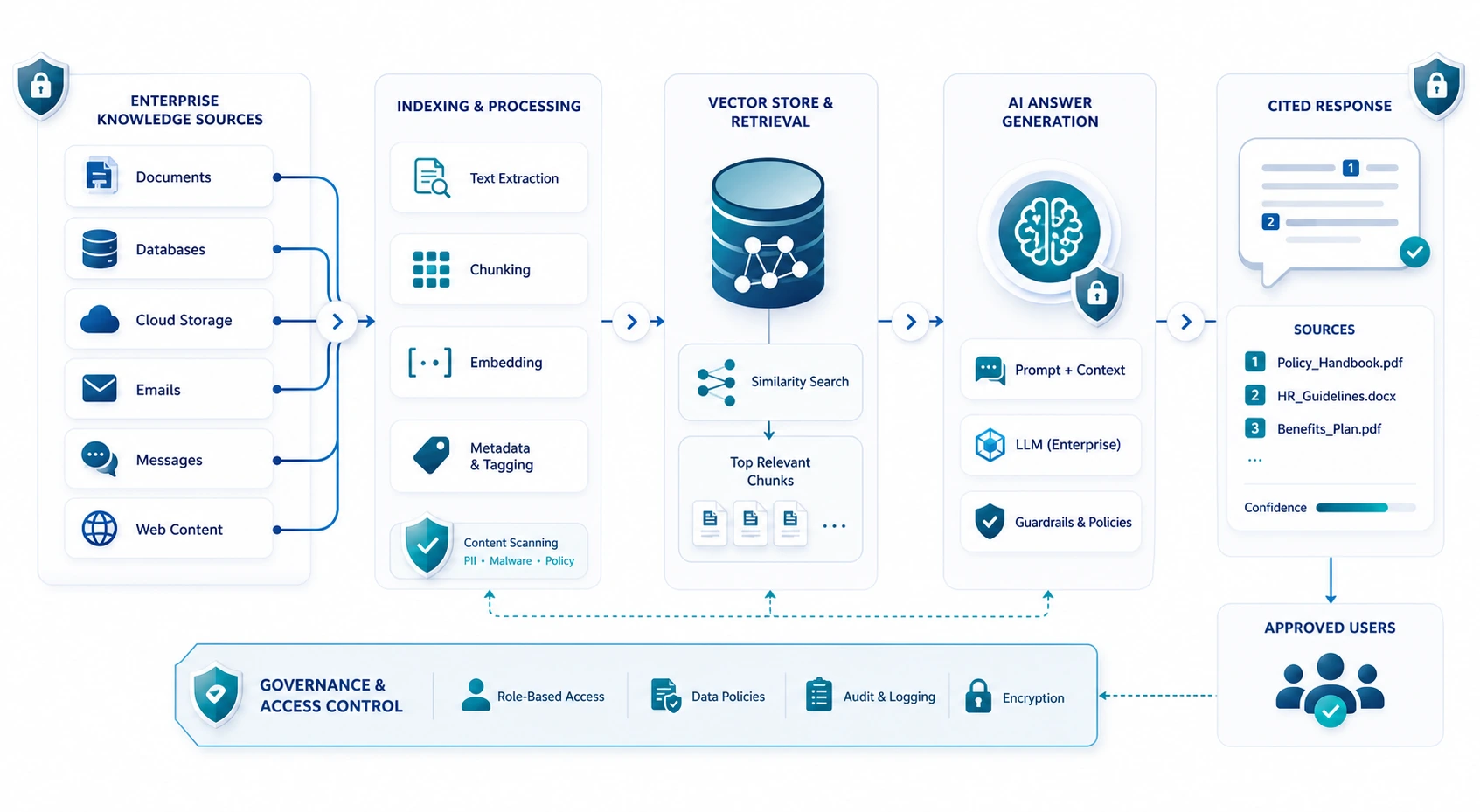
5. Retrieval and RAG layer
Retrieval-augmented generation, or RAG, is often the heart of private AI infrastructure.
A private RAG stack can include:
- source connectors,
- ingestion pipelines,
- document cleaning,
- chunking,
- embeddings,
- vector databases,
- hybrid search,
- reranking,
- permission filters,
- citation generation,
- evaluation loops.
The key design question is not only "Which vector database should we use?" It is "Can the system retrieve the right information for the right user under the right policy?"
6. Inference and serving layer
The inference layer runs the model.
This can include:
- managed model APIs,
- private cloud endpoints,
- self-hosted open models,
- GPU-backed serving,
- vLLM,
- NVIDIA AI Enterprise,
- Triton,
- Kubernetes-based serving,
- autoscaling,
- caching,
- batch inference,
- fallback endpoints.
For private AI, inference design should balance quality, cost, latency, data sensitivity, and operational complexity. NVIDIA's current AI Enterprise deployment guides explicitly cover bare metal, VMware, and cloud deployment patterns, which is a useful reminder that inference architecture is an operations choice, not only a model choice. (NVIDIA AI Enterprise Docs)
On-prem inference can provide stronger control, but it also requires capacity planning, GPU operations, monitoring, upgrades, and skilled ownership.
7. Observability layer
AI systems need observability beyond normal application logs.
Teams should monitor:
- request volume,
- user adoption,
- cost per workflow,
- latency,
- model route,
- retrieval quality,
- answer quality,
- hallucination signals,
- escalation rate,
- blocked requests,
- policy decisions,
- model failures,
- drift,
- security incidents.
A private AI deployment without observability becomes another black box, just hosted closer to home.
8. Audit and governance layer
For sensitive enterprise AI, auditability is not optional.
The system should capture:
- who made the request,
- what workflow triggered it,
- what policy applied,
- what model path was used,
- what data sources were retrieved,
- whether sensitive data was detected,
- whether a response was blocked or reviewed,
- what the final output was,
- who approved or escalated it.
This is essential for security reviews, compliance discussions, incident response, and executive accountability. NIST's AI Risk Management Framework is useful here because it frames AI risk management around trustworthiness and lifecycle controls, not around a one-time model-selection event. (NIST)
9. Human review and operating workflow
Private AI infrastructure should not remove humans from high-risk workflows.
It should make review clearer.
Human review may be required for:
- legal decisions,
- regulated content,
- customer-impacting decisions,
- financial recommendations,
- medical or safety-related outputs,
- agentic actions,
- policy exceptions,
- low-confidence answers.
The private AI system should define when humans review, what they review, and how feedback improves future routing or retrieval.
Deployment options for private AI infrastructure
Private AI can be deployed in several ways.
Option 1: Managed API with strong governance
This is the fastest path.
The company uses a managed model API but applies enterprise controls around data, usage, logging, and routing.
Best for:
- low-sensitivity use cases,
- early pilots,
- general productivity,
- high-quality reasoning needs,
- workloads without restricted data.
Not ideal for:
- highly confidential data,
- strict data residency,
- sensitive RAG,
- workflows requiring full infrastructure control.
Option 2: Controlled cloud AI
This uses cloud AI services with enterprise controls such as private networking, identity management, encryption, logging, and policy controls.
Best for:
- enterprises already standardized on cloud platforms,
- workloads needing better governance than public API usage,
- RAG systems using cloud search and storage,
- teams needing faster deployment without full on-prem ownership.
Not ideal for:
- disconnected environments,
- strict sovereignty needs that cloud cannot satisfy,
- cases where the organization wants full operational isolation.
AWS Bedrock's current documentation is explicit that the shared responsibility model still applies to data protection, identity, TLS, and logging. That matters because "private enough" in cloud AI still depends on your configuration, IAM, and audit setup, not just on the model endpoint existing inside a cloud account. (AWS Bedrock data protection)
Microsoft's current Foundry and Azure OpenAI data privacy guidance is similarly clear that prompts, completions, embeddings, and training data are not used to train foundation models without customer permission or instruction. That is useful for controlled-cloud planning, but it still does not remove the need for workload classification, retrieval permissions, and enterprise policy enforcement. (Microsoft Learn)
Option 3: Private cloud AI
Private cloud AI gives the enterprise stronger isolation while preserving cloud-like management.
Best for:
- regulated or high-control environments,
- organizations with mature platform teams,
- sensitive AI apps that need managed operations,
- hybrid environments.
Not ideal for:
- teams without cloud or platform skills,
- small workloads where infrastructure overhead outweighs benefit.
Option 4: On-prem AI
On-prem AI runs inside company-owned or company-controlled data centers.
Best for:
- strict data sovereignty,
- highly sensitive enterprise knowledge,
- regulated environments,
- low-latency local workloads,
- disconnected or edge environments,
- workloads where external data movement is not acceptable.
Not ideal for:
- low-volume experiments,
- teams without GPU or MLOps capability,
- workloads that need frequent frontier-model upgrades,
- companies expecting on-prem to automatically reduce cost.
Option 5: Hybrid private AI
Hybrid is often the most practical enterprise path.
A hybrid model may route:
- public or low-risk tasks to managed APIs,
- confidential RAG to controlled cloud,
- regulated workflows to private cloud,
- highly sensitive tasks to on-prem models,
- complex reasoning to frontier models with redaction and policy controls,
- high-volume routine work to smaller private or open models.
This is usually more realistic than declaring "everything must be private."
Private AI architecture: a practical reference model
A practical private AI infrastructure stack looks like this:
| Layer | Purpose | Example components |
|---|---|---|
| User or app layer | Employees, apps, agents, APIs | Internal copilots, support tools, workflow agents |
| Access layer | Identity and permissions | SSO, RBAC, ABAC, entitlement checks |
| Policy layer | Decide what is allowed | Allow, block, review, redact, route rules |
| Routing layer | Choose model and path | Frontier API, private model, RAG path, fallback |
| Context layer | Assemble safe context | Connectors, PII controls, source permissions |
| Retrieval layer | Ground answers in enterprise data | Vector DB, search, reranker, citations |
| Model layer | Generate or reason | Managed API, private model, on-prem LLM |
| Observability layer | Track performance and risk | Logs, metrics, traces, evaluation dashboards |
| Governance layer | Review and accountability | Audit logs, reports, approval workflows |
This architecture is more important than any single model choice.
A private model without routing, context controls, and monitoring is not enough.
A cloud AI deployment with strong identity, policy, retrieval filtering, routing, and auditability may be safer than a poorly governed on-prem model.
What should actually be private?
Not everything.
A useful private AI strategy separates workloads into four groups.
1. Safe for managed APIs
Examples:
- public marketing copy,
- generic brainstorming,
- non-sensitive summaries,
- public research,
- low-risk productivity tasks.
These may not need private infrastructure if data handling is clear and enterprise policies are followed.
2. Needs controlled cloud or VPC
Examples:
- internal knowledge search,
- operational reporting,
- employee support,
- code assistance with restrictions,
- customer support summaries without restricted data exposure.
These workloads may need private networking, access control, and retrieval filtering but not necessarily full on-prem deployment.
3. Needs private cloud or on-prem
Examples:
- regulated documents,
- confidential contracts,
- sensitive customer records,
- healthcare, financial, or legal workflows,
- sovereign data,
- high-risk agent actions,
- proprietary datasets.
These are stronger candidates for private AI infrastructure.
4. Should remain human-led
Examples:
- final legal judgment,
- medical diagnosis,
- hiring decisions,
- high-impact financial advice,
- safety-critical actions,
- sensitive disciplinary decisions.
AI can assist, but human accountability should remain explicit.
Private RAG: the most common enterprise use case
For many companies, private AI infrastructure does not start with training a private LLM. It starts with private RAG.
Why?
Because most enterprises do not need a model that "knows everything." They need an AI system that can safely retrieve and reason over their own information.
Private RAG is useful when teams need:
- answers grounded in internal documents,
- citations to source material,
- access controls,
- reduced hallucination risk,
- current information,
- department-specific knowledge,
- secure enterprise search,
- controlled document retrieval.
A private RAG system should be designed around five questions:
- Which sources are allowed?
- Who can access each source?
- How is content chunked and indexed?
- How is retrieval quality measured?
- How are answers logged, reviewed, and improved?
The weakest part of RAG is often not the LLM. It is poor source quality, bad chunking, weak permissions, stale documents, or lack of evaluation. Recent enterprise RAG research supports that point from the opposite direction too: robust private-document RAG systems take considerably more design work than a simple proof of concept. (T-RAG)
Cost considerations: private AI is not automatically cheaper
Private AI can reduce cost for some high-volume workloads, especially when smaller models can handle routine tasks at scale. But it can also add cost.
Private AI may require:
- GPU infrastructure,
- inference optimization,
- platform engineering,
- model serving,
- storage,
- networking,
- security reviews,
- monitoring,
- upgrades,
- MLOps,
- skilled operators.
The right question is not "Is private AI cheaper?" The right question is:
Which workloads justify private AI based on sensitivity, volume, latency, quality, and long-term operating cost?
For low-volume workloads, managed APIs may be more efficient.
For high-volume routine tasks, private or open models may become attractive.
For sensitive workflows, privacy and control may matter more than pure cost.
For complex reasoning, frontier models may still be worth the price.
This is why Model Benchmarking Assessment should happen before standardizing the architecture.
Governance considerations for private AI
Private infrastructure does not automatically mean governed AI.
A model can run inside your data center and still be unsafe if:
- anyone can access it,
- prompts are not logged,
- retrieved documents ignore permissions,
- outputs are not reviewed,
- sensitive data is exposed in context,
- model behavior is not monitored,
- teams bypass approved workflows,
- no one owns production operations.
Governance should cover:
- access rules,
- data classification,
- model selection,
- routing policy,
- prompt and context handling,
- retention,
- logging,
- redaction,
- evaluation,
- escalation,
- audit reporting,
- incident response.
This is where enterprises need an AI operating layer. If you want the operating-side structure around routing, spend, and production control, see AgenixHub's Managed AI Efficiency Layer.
The role of an AI control plane
As AI usage spreads, companies need a control point between users, applications, agents, models, tools, and data.
An AI control plane helps answer:
- Who is using AI?
- Which workflow triggered the request?
- What data is involved?
- Which policy applies?
- Which model should handle it?
- Should the request use RAG?
- Should sensitive context be redacted?
- Should a human review the output?
- What should be logged?
- How much did the request cost?
- Did quality meet the threshold?
For private AI infrastructure, this control plane becomes the difference between isolated deployments and managed AI operations.
Private AI implementation roadmap
Use this sequence before investing heavily in infrastructure.
Step 1: Map AI usage and sensitive data
Identify where AI is already being used and what data it touches.
Include:
- sanctioned tools,
- shadow AI usage,
- model APIs,
- internal copilots,
- vendor AI features,
- workflow automations,
- RAG experiments,
- agent prototypes.
Step 2: Classify workloads
Classify each workload by:
- business value,
- data sensitivity,
- regulatory exposure,
- quality requirement,
- latency requirement,
- volume,
- cost profile,
- human review requirement.
Step 3: Define deployment routes
Create a routing map:
- managed API,
- controlled cloud,
- VPC,
- private cloud,
- on-prem,
- human review,
- blocked.
Step 4: Benchmark model paths
Test real workloads across candidate models and deployment paths.
Measure:
- quality,
- cost,
- latency,
- privacy fit,
- retrieval performance,
- operational complexity.
Step 5: Design secure context and RAG
Decide which data sources are approved, how permissions are enforced, and how retrieval quality will be evaluated.
Step 6: Add governance and observability
Add logging, policy decisions, route tracking, quality metrics, spend monitoring, and review workflows.
Step 7: Roll out by risk and value
Do not start with everything.
Start with one high-value workflow where the data boundary is clear and the business owner is accountable.
Then expand.
Private AI architecture checklist
Before approving private AI infrastructure, ask:
- Have we classified the data?
- Have we classified the workloads?
- Do we know which tasks require private deployment?
- Have we tested model quality on real tasks?
- Have we compared cost per workload?
- Do we know latency requirements?
- Do we have permission-aware retrieval?
- Do we have audit logs?
- Can we monitor model quality?
- Can we detect cost spikes?
- Do we have human review for high-risk outputs?
- Do we know who owns ongoing operations?
- Can we change model paths later?
- Can we support hybrid routing?
- Do we have a rollback plan?
If the answer is no, the organization may not need more infrastructure yet. It may need a better operating plan.
Where AgenixHub helps
AgenixHub helps companies plan private AI infrastructure around the operating questions that should come before deployment.
That includes:
- mapping data boundaries,
- classifying workloads,
- identifying which workflows need private, controlled cloud, or managed API paths,
- benchmarking models against real tasks,
- designing RAG and secure context patterns,
- defining model-routing logic,
- setting operating controls,
- monitoring cost, quality, latency, privacy, and adoption over time.
This matters because private AI infrastructure is not only a technical purchase. It is an operating decision.
Request a Private AI Boundary Review if your team needs to decide which workloads can use managed APIs, which need controlled cloud paths, and which should stay inside private environments.
Where AgenixCore fits
AgenixCore is relevant when private AI needs to become repeatable across teams, models, tools, and data sources.
Instead of allowing every team to build its own AI path, AgenixCore acts as a governed layer between users, applications, AI agents, models, tools, and enterprise data.
For private AI infrastructure, this means AgenixCore can support the operating layer around:
- access governance,
- model routing,
- secure context,
- RAG controls,
- cost controls,
- audit logs,
- policy enforcement,
- visibility across model paths.
The goal is not to force every workload into one private model. The goal is to route each workload to the right path with the right controls.
Limitations and review notes
Private AI infrastructure is powerful, but it is not magic.
Private AI does not automatically improve answer quality.
On-prem AI does not automatically reduce cost.
Open models are not always better than frontier models.
Cloud AI is not automatically unsafe.
RAG does not work well without good source data, retrieval design, permission controls, and evaluation.
Human review remains important for high-risk, regulated, customer-facing, or judgment-heavy workflows.
The right private AI strategy depends on workload tests, data sensitivity, compliance needs, existing systems, user adoption, operating skills, and business goals.
FAQ
What is private AI infrastructure?
Private AI infrastructure is the controlled architecture used to run AI workloads with stronger control over data, access, model routing, retrieval, monitoring, and auditability. It can include private cloud, VPC, on-prem servers, self-hosted models, private RAG, inference runtimes, vector databases, and governance layers.
Is private AI the same as on-prem AI?
No. On-prem AI is one way to deploy private AI. Private AI is broader. It can include private cloud, VPC, controlled cloud environments, hybrid architecture, or on-prem infrastructure depending on data sensitivity and business requirements.
When should an enterprise use private AI?
An enterprise should consider private AI when workloads involve sensitive data, regulated information, proprietary knowledge, strict data residency, low-latency local processing, high-volume inference, or workflows that require stronger auditability and access control.
Does private AI reduce cost?
Sometimes. Private AI can reduce cost for high-volume, repeatable workloads where smaller models perform well. But it can also add infrastructure, engineering, monitoring, and maintenance costs. Cost should be tested by workload, not assumed.
Do private AI systems need RAG?
Not always, but RAG is one of the most common enterprise private AI patterns. Private RAG helps teams ground AI answers in approved internal sources while enforcing access controls and improving traceability.
Can enterprises use both public and private AI?
Yes. Most enterprises should use a hybrid model. Low-risk work can use managed APIs, sensitive work can use private or controlled paths, and complex work may use frontier models with governance, redaction, and audit controls.
What is the biggest mistake in private AI planning?
The biggest mistake is choosing infrastructure before classifying workloads and data boundaries. Private AI should start with sensitivity, retrieval, quality, cost, latency, and governance requirements.
How should a company start?
Start with a boundary review. Map the data, classify workloads, define model paths, benchmark model options, and then design the control layer. Do not begin by buying GPUs or choosing a model before understanding the operating requirement.
Conclusion
Private AI infrastructure is not a yes-or-no decision. It is a routing and governance decision.
The strongest enterprise approach is not "put everything on-prem" or "send everything to public APIs." The strongest approach is to understand the data boundary, classify the workload, benchmark the model path, and operate AI with clear access, context, cost, quality, and audit controls.
If your teams are already using AI across sensitive workflows, start by mapping the boundary.
AgenixHub helps enterprises review which workloads can use managed APIs, which need controlled cloud paths, and which should run inside private environments, then design the operating layer to route and govern those decisions over time.