Healthcare teams are no longer asking whether AI can summarize notes, answer patient questions, draft prior authorizations, search clinical policies, or support administrative workflows. They are asking a harder question:
Can we use AI without creating a privacy, security, compliance, or patient-trust problem?
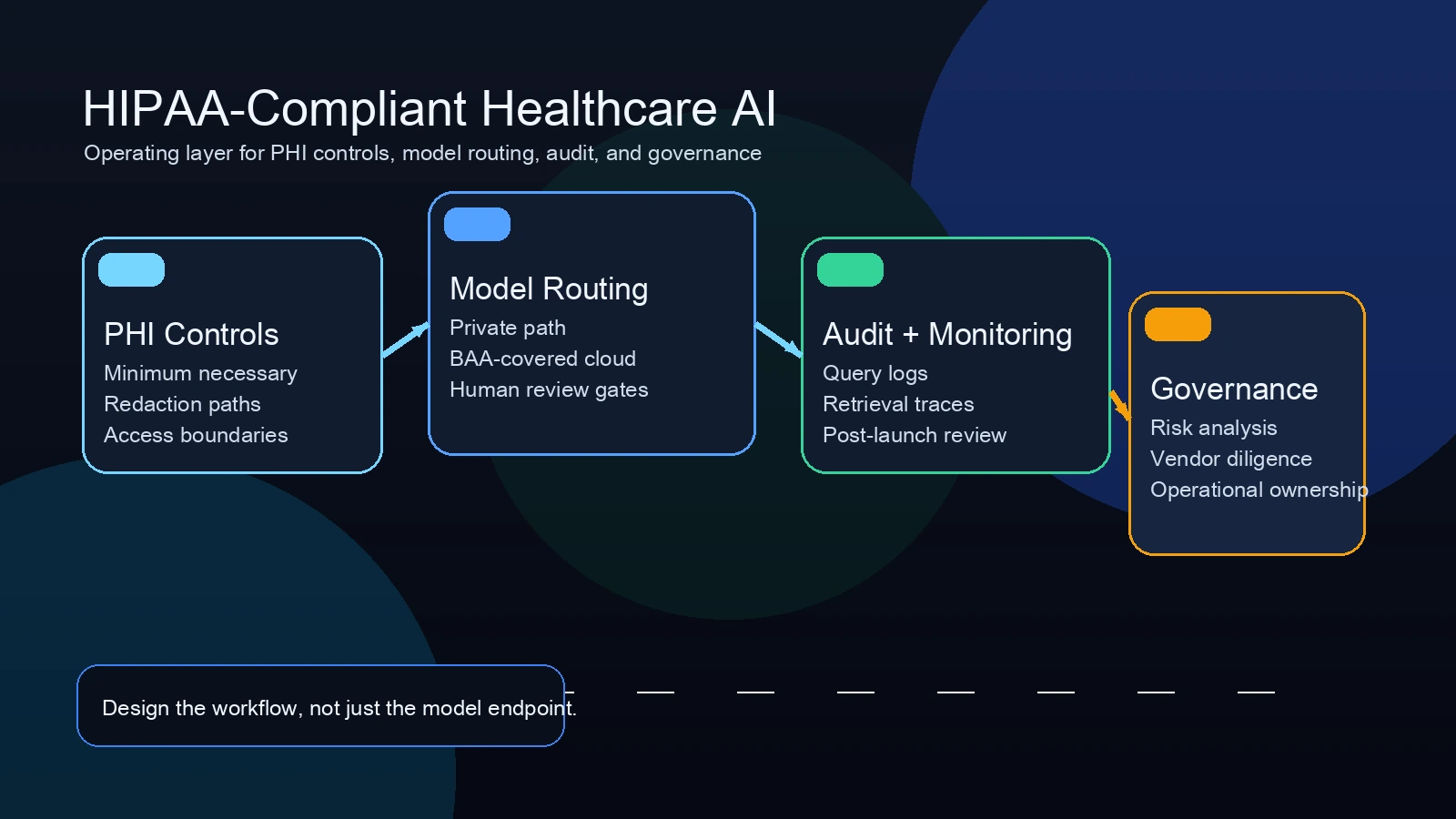
That question cannot be answered by picking a model with a "secure" badge. HIPAA-compliant AI depends on the whole operating environment: what data enters the system, who can access it, where it is processed, which vendors touch it, how outputs are reviewed, how logs are retained, and how the system is monitored after launch.
This article is educational and not legal advice. Healthcare organizations should involve privacy counsel, security teams, and compliance officers before deploying AI systems that process PHI.
Quick answer: what makes AI HIPAA compliant?
HIPAA-compliant AI is healthcare AI that handles protected health information through appropriate privacy, security, vendor, access, audit, and governance controls. A model or cloud provider alone is not "HIPAA compliant" in isolation. The full workflow must follow HIPAA Privacy Rule, Security Rule, business associate, risk analysis, de-identification, breach response, and human oversight requirements.
HHS describes the HIPAA Privacy Rule as a national standard for protecting certain health information, including rules for covered entities, business associates, and protected health information. (HHS.gov) The HIPAA Security Rule applies to electronic protected health information and requires administrative, physical, and technical safeguards for covered entities and business associates. (HHS.gov)
This guide explains how healthcare AI teams should think about HIPAA, PHI, LLMs, RAG systems, AI agents, BAAs, cloud providers, private AI, and ongoing governance.
What does HIPAA-compliant AI mean?
HIPAA-compliant AI means an AI system is designed, deployed, and operated in a way that protects PHI and ePHI according to HIPAA obligations.
That includes:
| Area | What it means for AI |
|---|---|
| Privacy | The AI system should only use or disclose PHI for permitted purposes. |
| Security | ePHI must be protected with administrative, physical, and technical safeguards. |
| Vendor control | Any vendor that creates, receives, maintains, or transmits PHI on behalf of a regulated entity may require a BAA. |
| Minimum necessary | The AI workflow should not expose more PHI than needed for the task. |
| Auditability | Teams need logs showing who accessed what, when, why, and through which system. |
| Risk analysis | The AI workflow should be included in HIPAA risk analysis and risk management. |
| Human oversight | High-risk clinical, administrative, or patient-facing outputs should be reviewed appropriately. |
A key mistake is treating HIPAA as a vendor checkbox. HIPAA alignment is not only about whether a cloud provider or model vendor will sign a BAA. It is about whether the healthcare organization has designed a compliant workflow using the right vendor contracts, technical safeguards, operational procedures, and ongoing monitoring.
When does healthcare AI become a HIPAA concern?
AI becomes a HIPAA concern when it creates, receives, maintains, transmits, analyzes, summarizes, embeds, stores, retrieves, or acts on PHI or ePHI for a covered entity or business associate.
Common examples include:
- An AI scribe summarizing a patient encounter.
- A chatbot answering questions from a patient portal.
- A claims assistant reviewing payer documents.
- A care-navigation tool searching medical records.
- A RAG system retrieving clinical notes, lab results, or discharge summaries.
- An AI agent drafting prior authorization responses.
- A support bot troubleshooting billing issues with patient identifiers.
- A model-evaluation pipeline using historical patient records.
The HIPAA Privacy Rule protects individually identifiable health information held or transmitted by covered entities or business associates in any form or media. (HHS.gov) The Security Rule protects ePHI maintained or transmitted in electronic media. (HHS.gov)
This is why AI compliance cannot stop at the model endpoint. It must include prompts, retrieval context, embeddings, logs, metadata, output storage, integrations, analytics tools, and vendor subprocessors.
The most important HIPAA principle for AI: minimum necessary
The minimum necessary principle matters deeply for AI because LLM applications often send large amounts of context into prompts or retrieval pipelines.
HHS states that covered entities must make reasonable efforts to use, disclose, and request only the minimum amount of PHI needed to accomplish the intended purpose. (HHS.gov)
For healthcare AI, this means teams should ask:
- Does the model need the full medical record, or only the latest encounter?
- Does the chatbot need patient identifiers, or can the request be handled without them?
- Does the RAG system need to retrieve full documents, or only relevant passages?
- Does the AI vendor need to store prompts and outputs?
- Are embeddings, logs, traces, screenshots, or analytics events exposing PHI?
- Can some workloads use de-identified, redacted, or synthetic data?
- Should sensitive workflows be routed to a private model or private cloud environment?
A HIPAA-aware AI system should be designed around PHI minimization by default.
HIPAA controls mapped to healthcare AI architecture
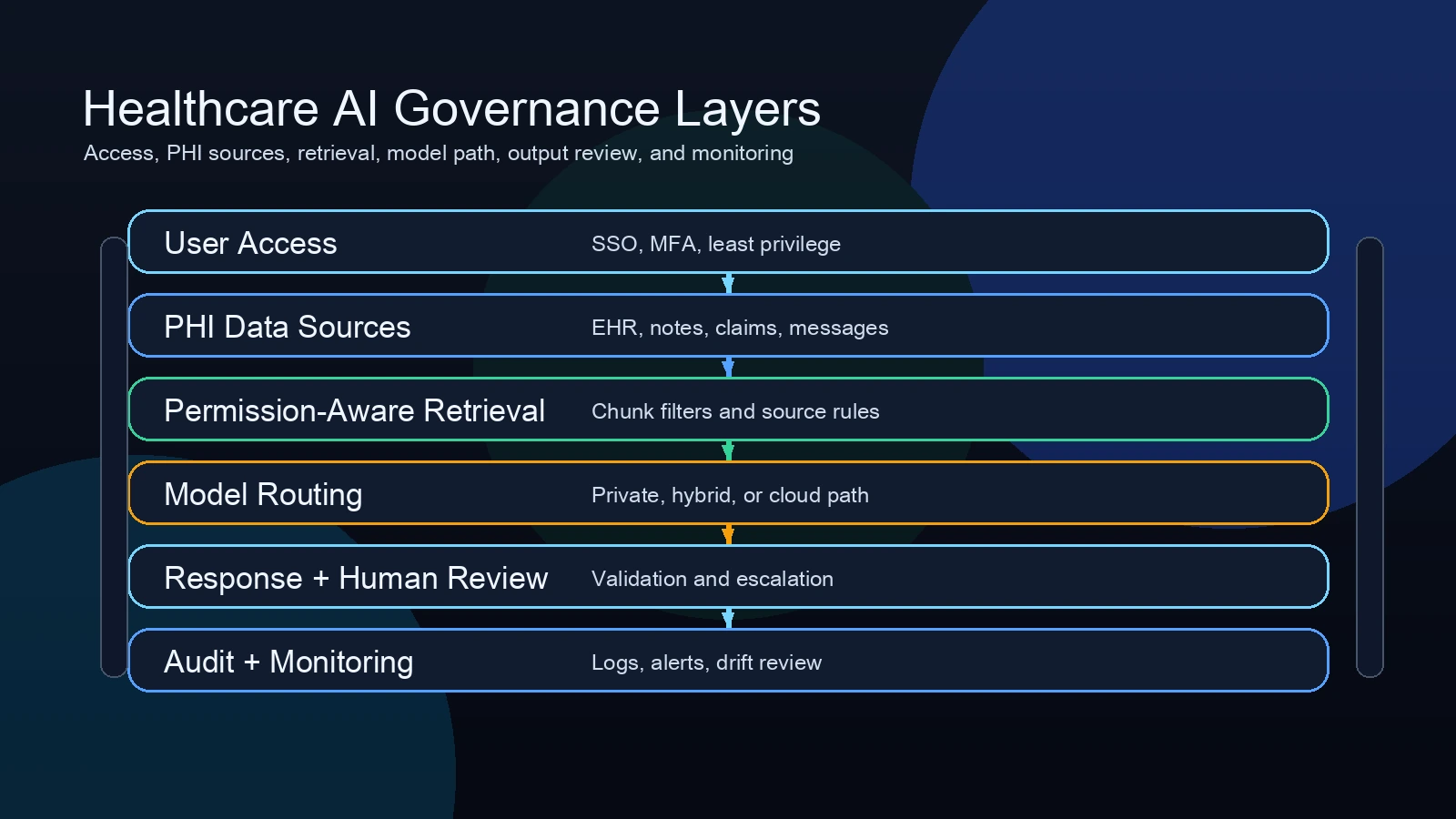
A useful way to design HIPAA-compliant AI is to map HIPAA requirements to AI system layers.
| AI system layer | HIPAA/compliance question | Practical control |
|---|---|---|
| User access | Who can use the AI workflow? | SSO, MFA, role-based access, least privilege |
| Data source | What PHI can the workflow access? | Permission-aware connectors, source-level access controls |
| Retrieval layer | What context is inserted into the prompt? | RAG permission filtering, chunk-level access checks |
| Model layer | Where is PHI processed? | BAA-covered service, private deployment, or de-identified workflow |
| Prompt/context layer | How much PHI is sent? | Data minimization, redaction, context limits |
| Output layer | Who reviews or receives the answer? | Human review, escalation, output validation |
| Logging layer | What is recorded? | Audit logs, PHI-safe telemetry, retention policies |
| Monitoring layer | How is risk detected after launch? | Drift monitoring, anomaly alerts, access reviews |
| Vendor layer | Who touches PHI? | BAAs, subprocessors, data retention review |
| Governance layer | Who owns policy and exceptions? | AI review board, risk register, operating procedures |
This is where healthcare AI increasingly needs an operating layer, not only a model integration. AgenixHub's Managed AI Efficiency Layer is built around access, policy, routing, context, cost, audit, and observability, which are exactly the categories healthcare teams need to coordinate when AI moves from pilots into production.
BAAs: what healthcare AI teams need to verify
A Business Associate Agreement is often one of the first compliance checkpoints for healthcare AI.
HHS states that when a covered entity uses a contractor or non-workforce member to perform services involving PHI, the covered entity must include specified protections in a business associate agreement. (HHS.gov) HHS cloud guidance also states that a cloud service provider that creates, receives, maintains, or transmits ePHI on behalf of a covered entity or business associate is itself a business associate, even if it only stores encrypted ePHI and lacks the encryption key. (HHS.gov)
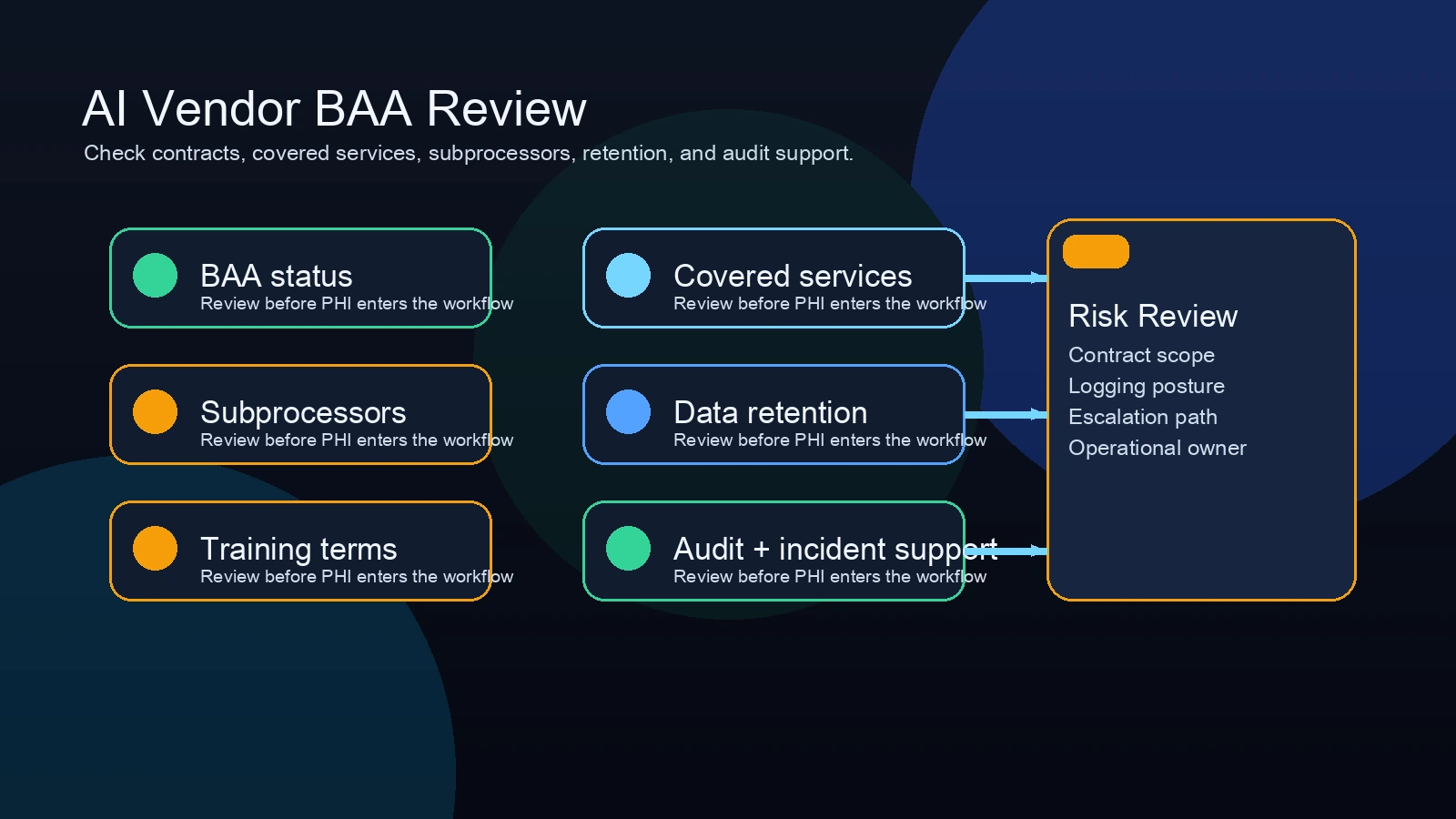
For AI systems, review BAAs across:
- Model providers.
- Cloud platforms.
- Vector databases.
- Data warehouses.
- Logging and observability tools.
- Analytics platforms.
- AI orchestration tools.
- Human-labeling or evaluation vendors.
- EHR integration vendors.
- Any downstream vendor that receives prompts, outputs, traces, documents, embeddings, or logs containing PHI.
A BAA does not make the full system compliant by itself. The stronger operating rule is simple: a signed agreement is necessary when a vendor handles PHI, but the healthcare organization still owns workflow design, access control, configuration, logging, review procedures, and ongoing risk management.
The practical rule: BAA first, architecture second, controls always.
RAG creates a special HIPAA risk
Retrieval-augmented generation is powerful in healthcare because it lets AI systems answer from approved clinical, operational, or policy sources. But RAG also introduces a major compliance risk: the AI can only be as compliant as its retrieval layer.
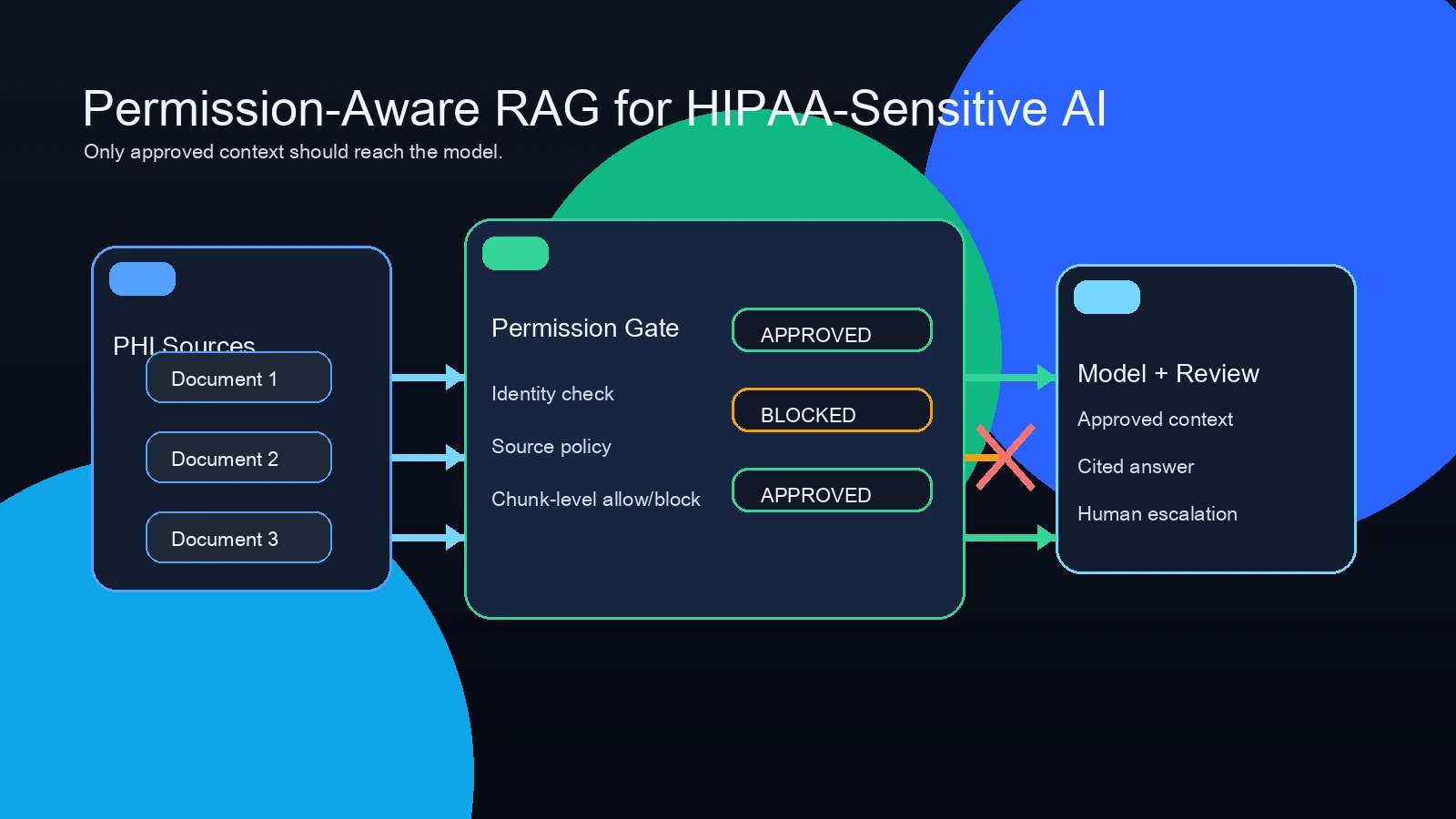
A HIPAA-aware RAG system needs:
- Identity-aware retrieval.
- Permission filtering before context is sent to the model.
- Source-level and chunk-level access rules.
- Audit logs for retrieved documents.
- PHI minimization in retrieved context.
- Separate handling for patient data, policy data, and public knowledge.
- Evaluation for hallucinated or unsupported answers.
- Clear citations for generated responses.
- Logging policies that avoid unnecessary PHI retention.
The failure mode is easy to understand: a user may not have permission to view a document directly, but a badly designed RAG system may retrieve that document and place it into the model context anyway. That is not just a model-quality issue. It is an access-control issue.
AgenixHub's broader AI operating capabilities already cover retrieval systems, RAG optimization, private and open deployment, monitoring, governance, workload classification, and model routing. If you need the retrieval side itself unpacked, the Enterprise RAG Implementation Guide goes deeper into permissions, evaluation, and operating controls. For healthcare AI, those capabilities should be applied with PHI boundaries, identity-aware retrieval, and compliance review from the beginning.
AI agents add another layer of risk
AI agents are more complicated than chatbots because they can take actions: search records, call APIs, draft messages, update systems, submit forms, or trigger workflows.
That creates new HIPAA-relevant questions:
- What tools can the agent call?
- Can the agent access PHI across systems?
- Can the agent send messages externally?
- Can it write back to an EHR, CRM, payer portal, or ticketing system?
- Can it retain memory?
- What happens if a prompt injection attack changes its behavior?
- Who reviews high-risk actions before execution?
- How are agent decisions logged?
OWASP's LLM Top 10 highlights risks including prompt injection, insecure output handling, training data poisoning, model denial of service, supply-chain vulnerabilities, excessive agency, and overreliance. (OWASP) These risks matter more in healthcare because mistakes may expose PHI, mislead staff, or affect patient-facing workflows.
Agentic healthcare AI should use:
- Least-privilege tool access.
- Approval gates for high-risk actions.
- Clear separation between data and instructions.
- Allowlisted tools and destinations.
- Session-bound memory.
- PHI redaction where appropriate.
- Prompt-injection testing.
- Audit logs for every action.
- Human review for clinical or regulated decisions.
De-identification is useful, but not magic
De-identification can reduce HIPAA obligations for certain AI workflows, but it must be done correctly.
HHS guidance explains that the HIPAA Privacy Rule provides two methods for de-identification: Expert Determination and Safe Harbor. (HHS.gov)
In healthcare AI, de-identification may support:
- Model evaluation.
- Prompt testing.
- Synthetic workflow demos.
- Analytics.
- Fine-tuning experiments.
- Quality benchmarking.
But teams should be careful with:
- Free-text clinical notes.
- Rare conditions.
- Dates and locations.
- Small cohorts.
- Unstructured documents.
- Embedded identifiers in PDFs, images, or scanned files.
- Re-identification risk when datasets are combined.
The safe operating principle is: treat de-identification as a controlled process, not a quick text-redaction filter.
HIPAA controls still need broader AI risk management
HIPAA is not the only operating concern for healthcare AI. Teams also have to manage model quality, unsafe automation, hallucinations, drift, overreliance, and human-review breakdowns.
The NIST AI Risk Management Framework gives organizations a practical structure for governing AI across design, deployment, use, and monitoring. NIST states that the AI RMF is intended to improve the ability to incorporate trustworthiness considerations into AI products, services, and systems. (NIST)
For healthcare AI, that means HIPAA safeguards should be paired with:
- use-case risk classification
- model evaluation
- output validation
- human oversight
- incident review
- model-change review
- monitoring for drift and unsafe behavior
Shadow AI is one of the biggest healthcare risks
Shadow AI happens when staff use unsanctioned AI tools outside approved workflows.
Examples:
- Copying patient notes into a consumer chatbot.
- Uploading payer letters to an unsupported summarization tool.
- Using a browser extension that captures PHI.
- Sending screenshots to an AI writing tool.
- Using meeting transcription without a BAA.
- Testing AI tools with real patient records before security review.
Shadow AI usually happens because teams want speed and the approved tools are too slow, too rigid, or unavailable. Banning AI rarely solves this. Healthcare organizations need a governed AI operating layer that gives users safe, approved routes for common work.
That is the operating gap AgenixHub should speak to: classify the workloads, decide which ones can use approved cloud AI, which ones require private deployment, which ones need de-identification, and which ones should not use AI at all.
Cloud AI, private AI, or on-prem AI?
There is no universal answer. The best deployment path depends on workload risk, PHI exposure, latency, model quality, infrastructure maturity, and compliance expectations.
| Deployment path | Best for | Main risk |
|---|---|---|
| BAA-covered cloud AI | Administrative workflows, scalable apps, approved vendor paths | Misconfiguration, unsupported services, logging PHI |
| Private cloud AI | Sensitive workflows needing more control | Operational complexity and cost |
| On-prem AI | Strict sovereignty, high-control environments, offline workflows | Hardware, staffing, model maintenance |
| Hybrid AI | PHI stays controlled, selected tasks use cloud | Complex architecture and data-boundary design |
| De-identified cloud workflow | Analytics, testing, evaluation | Poor de-identification or re-identification risk |
| No-AI workflow | High-risk use cases with unacceptable residual risk | Lost efficiency, but lower compliance exposure |
The right question is not "cloud or on-prem?" The right question is: which workload should use which model path under which controls?
That is where model benchmarking and routing matter. AgenixHub's Model Benchmarking Assessment compares model paths by quality, cost, latency, privacy, and workload fit, which is especially relevant when healthcare teams must decide between cloud AI, private models, or on-prem deployment. If deployment tradeoffs are the main blocker, the companion guide on on-premises vs. cloud AI for healthcare looks at the infrastructure decision in more detail.

A practical HIPAA-compliant AI implementation checklist
Use this checklist before moving healthcare AI into production.
1. Classify the use case
Define whether the AI workflow is:
- Patient-facing or internal.
- Clinical or administrative.
- Advisory or action-taking.
- PHI-processing or PHI-free.
- Low-risk, medium-risk, or high-risk.
- Suitable for AI or better handled by deterministic software.
2. Map PHI exposure
Track where PHI appears:
- Input prompt.
- Retrieved documents.
- Uploaded files.
- Embeddings.
- Vector database.
- Model request.
- Model response.
- Logs.
- Analytics events.
- Human review queues.
- Exports.
- Downstream systems.
3. Verify vendor coverage
Confirm:
- BAA status.
- Covered services.
- Subprocessors.
- Data retention.
- Training and data-use terms.
- Security documentation.
- Incident notification terms.
- Support for audit logs and access controls.
4. Design access controls
Implement:
- SSO.
- MFA.
- Role-based access.
- Least privilege.
- Break-glass access where needed.
- Permission-aware retrieval.
- Service-account control.
- Regular access reviews.
5. Control context and retrieval
For LLM and RAG workflows:
- Minimize context.
- Filter by user permissions.
- Separate patient data from general policy data.
- Avoid sending full records unless justified.
- Use citations.
- Test retrieval quality.
- Log retrieval events.
6. Secure prompts, outputs, and logs
Review:
- Prompt storage.
- Output retention.
- Debug traces.
- Application logs.
- Monitoring tools.
- Analytics scripts.
- Session recordings.
- Error messages.
- Human review tools.
HHS has specifically warned that tracking technologies on websites or apps may disclose PHI to third-party vendors if not controlled properly. (HHS.gov) The same mindset should apply to AI telemetry, logs, and monitoring.
7. Add human oversight
Use human review for:
- Clinical recommendations.
- Patient-facing advice.
- Claims decisions.
- Denials or approvals.
- Sensitive communications.
- High-risk summarization.
- New model releases.
- Agentic actions.
8. Monitor after launch
HIPAA-compliant AI is not a one-time deployment. Monitor:
- Access anomalies.
- Prompt injection attempts.
- Model quality.
- Hallucination patterns.
- Cost spikes.
- Latency.
- User adoption.
- Retrieval errors.
- PHI leakage.
- Vendor changes.
- Model updates.
Managed AI Operations is the right follow-on once a healthcare team needs continuous monitoring, model updates, routing improvements, and operational reporting after deployment.
Where AgenixCore fits
AgenixCore should be treated as the operating-control layer for organizations that need private, governed enterprise AI, especially when healthcare teams are trying to coordinate multiple models, tools, retrieval systems, and internal policies.
For HIPAA-sensitive AI, the important operating-layer questions are:
- Which users can access which AI workflows?
- Which workflows are allowed to touch PHI?
- Which model path should each workload use?
- Which prompts need redaction?
- Which RAG sources can be retrieved?
- Which workflows require human review?
- Which requests should be routed to private models?
- Which logs need to be retained or minimized?
- Which model changes need review?
AgenixCore should not be described as a magic HIPAA certification layer. The stronger and safer positioning is:
AgenixCore supports the governance pattern healthcare AI needs: controlled access, model routing, secure context handling, auditability, and operating visibility across AI workflows.
How AgenixHub helps healthcare teams
AgenixHub helps healthcare and regulated-industry teams move from scattered AI experiments to managed AI operations.
For HIPAA-sensitive AI, AgenixHub can help teams:
- Classify AI workloads by PHI exposure, risk, complexity, and value.
- Decide which workloads need cloud AI, private AI, on-prem AI, or no AI.
- Benchmark model paths by quality, cost, latency, privacy, and workload fit.
- Design RAG systems with permission-aware retrieval and context controls.
- Reduce unnecessary PHI exposure in prompts, embeddings, logs, and outputs.
- Build routing logic for sensitive and non-sensitive workflows.
- Add governance around access, audit, monitoring, and human review.
- Operate AI systems after launch through monitoring and continuous improvement.
This matters because HIPAA-compliant AI is not only about passing a pre-launch security review. It is about keeping AI workflows controlled as models, users, data sources, vendors, and regulations change.
For teams that want to map those decisions first, AI Operating Efficiency Audit is the clean starting point. For teams that already know they need the operating layer built, Managed AI Efficiency Layer is the primary commercial path from this article.
What HIPAA-compliant AI does not guarantee
A HIPAA-aware architecture does not guarantee:
- Perfect medical accuracy.
- Zero hallucinations.
- Automatic compliance.
- No breach risk.
- FDA clearance.
- Clinical safety.
- Patient trust.
- Vendor suitability.
- Lower cost in every workflow.
- That every AI use case is appropriate.
HHS states that the Security Rule is flexible, scalable, and technology-neutral, and that regulated entities must choose reasonable and appropriate measures based on their size, capabilities, infrastructure, costs, and risks. (HHS.gov) That means compliance is contextual. A workflow that is acceptable for one organization may be inappropriate for another.
AI teams should involve legal, compliance, security, clinical, and operational stakeholders before using AI with PHI. AgenixHub can help design the operating structure, but it does not replace legal, compliance, or clinical review.
FAQ
Is AI allowed under HIPAA?
Yes. HIPAA does not ban AI. It requires covered entities and business associates to protect PHI and ePHI according to Privacy Rule, Security Rule, Breach Notification, business associate, and risk-management obligations. The system design, vendor contracts, data flows, safeguards, and operating procedures determine whether a specific AI workflow is appropriate. (HHS.gov)
Can healthcare teams use ChatGPT or other public LLMs with PHI?
Healthcare teams should not put PHI into consumer or unapproved AI tools. An AI tool should only be used with PHI if the organization has approved the workflow, reviewed the terms, executed required contracts such as a BAA where applicable, configured security controls, and established audit and review processes.
Does a BAA make an AI system HIPAA compliant?
No. A BAA is necessary when a vendor handles PHI as a business associate, but it is not sufficient by itself. The healthcare organization must still configure the system properly, limit PHI exposure, implement safeguards, manage access, maintain auditability, and conduct risk analysis.
Can healthcare AI use cloud models?
Yes, if the specific service, contract, configuration, and use case support HIPAA obligations. HHS states that covered entities and business associates may use cloud services if they enter into appropriate BAAs and comply with HIPAA Rules. The cloud configuration affects risk analysis and risk management. (HHS.gov)
Are embeddings PHI?
Embeddings can represent patient information if created from PHI or ePHI. Teams should treat embeddings, vector databases, retrieval logs, and similarity-search metadata as sensitive unless legal and technical review confirms otherwise. This is especially important for RAG systems that index clinical notes, patient messages, or care records.
What is the safest architecture for HIPAA-compliant AI?
There is no single safest architecture. Low-risk administrative tasks may use BAA-covered cloud AI. Sensitive workflows may require private cloud, on-prem models, de-identification, or human review. High-risk workflows may not be appropriate for AI. The safest architecture is workload-specific and should be based on PHI exposure, business value, clinical risk, compliance requirements, and operational readiness.
What should healthcare teams audit before scaling AI?
Audit PHI exposure, BAAs, covered services, access controls, RAG retrieval permissions, model routing, prompt logging, output retention, human review, breach response, and monitoring. HHS states that risk analysis is foundational to Security Rule compliance. (HHS.gov)
How does AgenixHub help with HIPAA-sensitive AI?
AgenixHub helps teams classify AI workloads, evaluate model paths, design private or governed AI architecture, improve RAG and context efficiency, route sensitive work appropriately, and operate AI systems continuously across cost, quality, latency, privacy, and governance. AgenixHub does not replace legal or compliance counsel, but it helps create the operating structure needed to deploy AI responsibly.
Conclusion
HIPAA-compliant AI is not a model choice. It is an operating model.
Healthcare teams need to know where PHI flows, which vendors touch it, which users can access it, which model paths are acceptable, how retrieval is controlled, how outputs are reviewed, and how the system is monitored after launch.
The winning healthcare AI teams will not be the ones that simply "turn on AI." They will be the ones that build a governed AI operating layer around privacy, security, workflow value, model choice, human review, and continuous improvement.
AgenixHub helps teams make that shift: from scattered AI usage to managed AI operations.
Map your healthcare AI risk before scaling. Start with an AI Operating Efficiency Audit to classify workloads, identify PHI exposure, evaluate model paths, and design a governed operating layer for AI in healthcare. When the operating model is clear and the next step is implementation, move into the Managed AI Efficiency Layer.